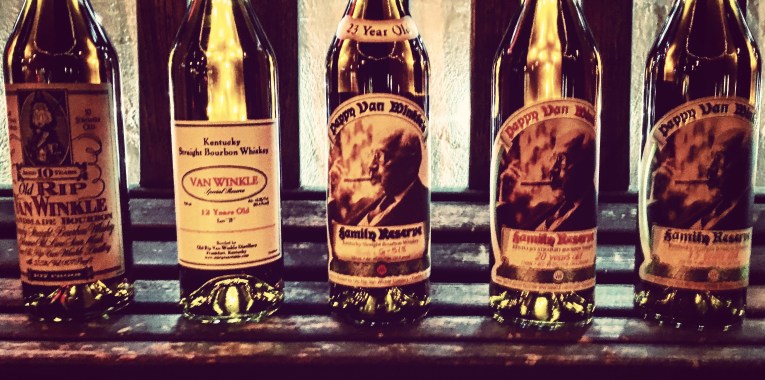
Pappy is history. Literally and figuratively.
Figuratively, the time when the whiskey was equal to the hype is long gone. The search and endless discussion of the search for Pappy Van Winkle has become a bigger story then the actual whiskey itself. But for most people it’s still just a name. Rather than focus on the ephemeral qualities that may have lead to Pappy’s preeminent status let’s talk some cold hard historical facts that lead to where we are now.
Pappy Van Winkle is a line of Premium Bourbons that in recent years have become the hot ticket item with bottles going for thousands of dollars at auctions and on the secondary whiskey market. The label includes a 15, 20 and 23 year old Bourbon all called “Pappy” as well as several younger variations referred to as “Old Rip Van Winkle” as well as a 13 year old Rye. All of the Bourbons are currently known to be “wheated” Bourbon, meaning that their mashbill is composed of corn, wheat, and barley and as of 2010 all of the whiskey in the bottles has been distilled at the Buffalo Trace Distillery. That wasn’t always the case.
 Julian “Pappy” Van Winkle was a real man. He was involved in the whiskey business well before prohibition. He and his partner, Alex Farnsley purchased a controlling stake in W.L. Weller and Sons in 1908. At the time Weller and sons was strictly a bottler. They distilled nothing themselves but worked very closely with the Stitzel Distillery.
After Prohibition Pappy, ever the shrewd business man, managed to acquire the Stizel Distillery, merged the two operations into the Stizel-Weller Distillery and opened the new distillery on Derby Day in 1935. They begin production on many purchased pre-Prohibition brands including Cabin Still, Rebel Yell and most notably: Old Fitzgerald.
 Pappy’s flagship brand was Old Fitzgerald. His biggest contribution to his namesake Bourbons is his “whisper of wheat.” Every brand that came out of Stizel-Weller was a “Wheated” Bourbon as opposed to the standard mash of corn, rye, and barley. To many this produces a rounder, softer bourbon with more dark fruit and cherry.
Pappy passed away in 1965 when all the cigars and Bourbon caught up to him at the far too young age of 90. His son, Julian Van Winkle, Jr. inherited the business but in 1972 he was forced by stockholders to sell the distillery and brands. He still maintained a bottling plant and resurrected yet another pre-Prohibition brand “OldRip Van Winkle.” No family relation. He continued producing the label sourcing whiskey from what had been the family distillery.

Flash forward to 1992, Julian Van Winkle III is now in charge of the family company and the Stizel-Weller Distillery is completely shuttered. The remaining brands and whiskey stocks are sold off (the flagship Old Fitzgerald fell into the hands of Heaven Hill) and Julian II continues to use old stock for new bottlings. Old Rip Van Winkle 15 year was released in 1989 but the first mention of “Pappy Van Winkle Bourbon” appears along with the first edition of the 20 year old in 1995.
However, many of these early bottlings are not Stizel-Weller whiskey. Julian II was back where Pappy had started, as a non-distilling producer. A bottler. He was sourcing whiskey and many of the initial offerings of the “Pappy” lineup, like the first edition of Pappy 23 in 1998 are actually high-rye Bourbon from the Barton Distillery.
But the Van Winkle’s never let facts get in the way of a good story and Pappy began getting rave reviews in the late 90s by picking up steam as the Bourbon revival does. In 2002 the Van Winkle’s partner with the Buffalo Trace Distillery and secure a continuous source for their brands.
In the end, the cold hard fact about why Pappy Van Winkle is considered the best Bourbon in the world is because people keep saying it is.
And In 2007 the New York Times puts the Pappy 20 at the top of their list of
premium and super-premium Bourbons leading the revival of the industry. By the time Anthony Bourdain tweets that he’s considering getting a “full pappy back tattoo” in 2011 Pappy-mania is swinging into fifth gear.
Now when most people ask how they can get a bottle of this coveted whiskey gold the answer is, you can’t. Yet people are still getting bottles, often at massive price hikes. So it’s not that you can’t get a bottle, it’s just that someone else is willing to pay more. To the Van Winkle and Buffalo Trace’s credit they haven’t seized upon the Pappy craze to drastically raise prices but the people they sell the bottles to have. Pappy Van Winkle not only helped fuel the Bourbon Revival but also the secondary Bourbon trading market where bottles are traded and sold, technically illegally, online. That’s a lot for one small whiskey to carry on its shoulders.
 In the end, the cold hard fact about why Pappy Van Winkle is considered the best Bourbon in the world is because people keep saying it is. And because people keep making money off of saying it is. Those who don’t learn from history are doomed to repeat it. Think about that the next time you see it listed on someone’s menu for $150+ a pour, and maybe find a bartender you trust to help you drink your next history lesson.

 any good. Just like being big and global doesn’t necessarily negate your quality and attention to detail. Everyone wants to start a distillery these days and I’ve got one piece of advice for you: wait. The quality of product being produced right now can’t support the number of “craft” products being produced and in about five years there’s going to be a glut of distilling equipment available for pennies on the dollar.
 FEW has always had a delightful self awareness about the fact that they’re just making booze. The distillery name gives rise to a myriad of word play about having a FEW drinks, etc. But it’s also a nod to the distilleries home in Evanston, right out side of Chicago, which was a major staging ground for the Woman’s Christian Temperance Movement and the home of woman’s suffragist and prohibitionist France Elizabeth Willard. That playfulness carries over into their rye.
 Bottled In Bond LA