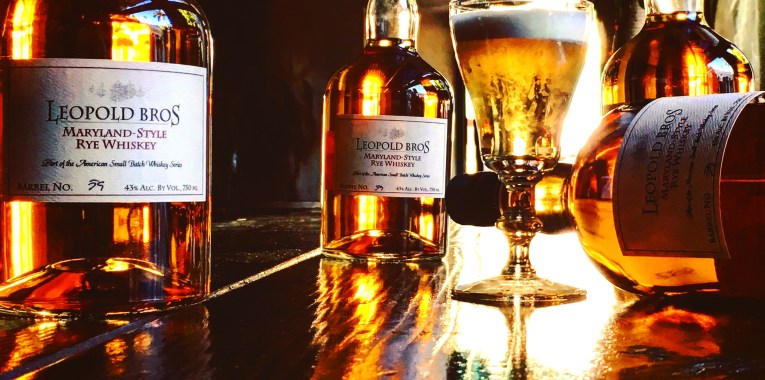
Whiskey Wednesday: Leopold Maryland Style Rye

Alright nerds, here’s a good one for you today. Maryland Style Rye.
Before the advent of the ‘Great Experiment’ that was Prohibition there were two dominant styles of American Rye Whiskey. The Pennsylvania Style (spicy, dry, and oaky) and Maryland Style, which was more floral, fruit forward and less aggressive. Among the many great things that Prohibition destroyed, Maryland Style Rye was one of them.

But the boys at Leopold Brothers are fighting the good fight and trying to recreate the style in the only way they know how: with exceptional quality and attention to detail. And boy are they fighting hard, you can read about the future here. But as for the pastWhile ye olden Maryland Ryes often achieved their more mellow nature and fruit flavors from additives and prune juice, the brothers are following their eco-distilling nature and recreating the flavors throughWight'sMarylandRye3.jpg careful distillation and selection of yeast strains to create a wholly unique product. They’ve even had an old time compound still made exclusively for them, and are working with local farmers to grow late 1800’s style rye, which has a completely different flavor and starch content than it’s modern descendant.

While we’re still waiting on the first batches off the new still, the current bottling shouldn’t be ignored. Young, but light and green. Green as in like biting into a huge green apple, apricot, and stone fruit. All supported by a rich chocolate malt rounding out to a juicy and more mellow finish than your more familiar ryes.

Whiskey Wednesday Adjacent: Pick Your Apple Poison

You can always tell what a bar manager’s secret passion is. You’ll look at the backbar and no matter how well curated it is there will always be a collection of bottles that are out of place, an odd amount of variety in an esoteric category. For me, that guilty pleasure is apple brandy.

Bourbon may have become the United States Native Spirit through Congressional Resolution in 1964 but Apple brandy, that New Jersey Lightning, is the real first spirit of the colonies. In the cold New England winters colonists would leave cider outside overnight allowing it to freeze. Since alcohol doesn’t freeze what was left over after this rudimentary distilling, or “jacking”, process was a more concentrated alcoholic apple beverage.

This proto-brandy became known as Applejack and had as large a reputation for causing blindness from poor ‘distilling’ as it did for getting the drinker drunk. But it wasn’t long before industrious businessmen started cleaning things up. Robert Laird was a Continental Soldier who served under George Washington during the Revolutionary War. There are records of Washington requesting Laird’s family recipe for “cyder spirits” which has lead to the claim that Laird supplied Applejack to the Continental Army. After the war Laird founded a distillery in Scobeyville, NJ and which is now the oldest licensed distillery in the United States, receiving License Number 1 from the U.S. Treasury in 1780. But the “cyder spirits” and their hard cider cousins did not fair well under prohibition.

Prior to Prohibition most of the apple orchards in the colonies were not the juicy, edible fruit that we think of today. They were in fact the hard, bitterly sour variety that make excellent cider. Apples are what are known as extreme heterozygotes. Essentially, the latent genetic diversity of the actual seeds means that a tree grown from a seed will bare almost no resemblance to the varietal of the parent tree and more often than not will be completely inedible. These types of apples are known as “spitters.” To create consistent apple varieties a process known as grafting, where a budding branch of the parent tree is implanted into existing rootstock essentially cloning the original tree. There were a few issues with getting active graft to the New World in those early Colonial days which meant that most attempts at growing apple trees were from seeds. And while these spitters were terrible for eating they were perfect for cider.

On the frontier, Cider was actually safer to drink than the water so settlers again turned to cider orchards. And many of these orchards were in fact planted by John Chapman, or as he’s better known, Johnny Appleseed. John Chapman was a real man who bares an actual resemblance to his folkhero self. He did wander the frontier planting apples from seeds, but Chapman was more a shrewd businessman than a carefree vagabond.

Starting in 1872, the Ohio Company of Associates promised potential settlers 100 acres of land if they could prove they had made a permanent homestead in the wilderness beyond Ohio’s first permanent settlement. To prove their homesteads were permanent the settlers were required to plant 50 apple trees and 20 peach trees in three years. This proved they were sticking around because an average apple tree took ten years to bear fruit.

Chapman realized that if he stayed just ahead of the settlers, doing the difficult orchard planting he could sell them for profit to the incoming frontiersmen. And being a member of the Swedenborgian Church his belief system explicitly forbade grafting because the thought it caused unnecessary suffering for the plants. Thus his orchards were grown from seeds and unfit for eating but perfect for cider.

Unfortunately, most of Chapman’s orchards were cut down during Prohibition when FBI officers were targeting cider productions and orchards helping hasten the downfall of America’s cider tradition. Meanwhile, the apple brandy world had consolidated with Laird’s being the only game in town. The drinking populace’s tastes also changed looking for lighter, less flavorful options like vodka and blended whiskey which transformed Applejack into a blend of apple brandy and grain neutral spirit. By 1970 Laird’s had shrunk from three distilleries to its single plant in New Jersey. They even ceased production for several years as the stocks on had were more than sufficient for demand.

Flash forward to 2017 and Apple Brandy and cider are riding a resurgent wave. Craft cider producers have expanded the category and given it respectability. Apple brandy got to come along for the ride and also got it’s own boost from the Cocktail Renaissance. Many classic drinks called for “applejack” and I know personally it helped be ease many drinkers off of drinks calling for “apple pucker.”

The variety of apple brandy these days is rather astounding. From classic French Calvados, to Laird’s New Jersey Bottled-In-Bond, to Germain Robin’s French style California apple brandy, to Copper and Kings new wave distinctly American Apple Brandy made right in the heart of Bourbon Country. They are all as unique as the seeds that they sprang from. Which is why I need so much shelf space for them.

Whiskey Wednesday: Elijah Craig Check In

Another year and another barrel of Elijah Craig. The very first single barrel I ever picked out for a bar was a barrel of Elijah Craig for Areal a good five years ago. I’ve been fortunate enough to select an Elijah Craig barrel every year since so its arrival is usually a great touchstone for me to reflect on the previous year. A Bourbon New Year as it were. And it’s been a hell of a year.

I left a bar that I ran for nearly five years that promptly closed six months later. I started a new job at Faith and Flower in Downtown LA, competed in the National finals of three major cocktail competitions, traveled to Tokyo, started this wordy blog, and picked out another barrel of Elijah Craig.

Elijah Craig is often the answer to the inevitable question, “What do you drink?’ I’ve talked about it at length here, and here, and during innumerable shifts behind the bar. The basic gist though is that Elijah Craig is one of the semi-mythical early Bourbon distillers that sometime after his death was decreed to be “the Father of bourbon” after he became the first person to char his barrels before aging his whiskey. It’s a completely unsubstantiated claim that makes a good story. So, we all tell the story and then acknowledge that it’s complete nonsense.

The current Elijah Craig brand was introduced by Heaven Hill in 1986 and has gone through multiple changes in its 30-year history but the past year was quite striking. The iconic 12-year old age statement was dropped from the label with the whiskey instead becoming a blend of 8-12 year old. The old school squat bottle was also replaced with a sleeker, taller, more streamlined bottle that I’m personally not a fan of but does actually fit a pour spout .

If you can’t tell, I don’t like change. And that’s not to say anything against the whiskey. It’s still an earthy, massively tanic, barrel forward whiskey that is one of the few bottles that I think works equally well in both mixed drinks and as a neat sipper. Most of these changes were made because there’s not enough whiskey to go around. Especially not old whiskey. Part of me feels like saying so what? Let there not be enough for everyone, don’t change this bottle that I love. Yet, that view is selfish.

Part of the joy of bartending, and indeed the joy of this very blog, is getting to share things that I love with other people. In the end, these changes aren’t for me. I clearly jumped on the train years ago. These changes are for the people seeing Elijah Craig for the first time on a billboard, or a sports arena, or even hearing about it on its recent NPR advertisements. The old Preacher is growing and hanging out with a younger crowd these days and I’m glad to see it.

In the end change isn’t good or bad. How we react to it, how we deal with it, that’s where the emotion comes in. Sometimes, change is just change. And I look forward to seeing what the Preacher and I have to talk about the next time we see each other.

Whiskey Wednesday: Four Roses Al Young’s 50th

Almost every shift I get asked what has to be one of my least favorite questions, “What’s your favorite whiskey?” My response is usually, “That’s like asking a mother to pick her favorite child.” We all know mommy had a favorite but it’s a lot more complicated than it looks at first glance.

Is it a special occasion? What kind of bar am I at? What’s the price of a pour? These are all things that I take into consideration when it comes to what I drink but increasingly when I’m out I find myself ordering Four Roses Single Barrel. Part of this is that the whiskey is damn good, but it’s also the fact that it’s become almost ubiquitous and it’s cost effective. That wasn’t always the case though.

There are a few conflicting stories about the origin of the brand but the one that Four Roses currently promotes is that they were founded by Paul Jones, Jr. who trademarked the name Four Roses in 1888 with a claim of production and sales back to the 1860’s. The name supposedly comes from Jones, Jr. being smitten by an unnamed Southern Belle. He sent her a proposal and she replied that if her answer was “yes” she would arrive at the ball with a corsage of roses on her gown. When she arrived she was wearing not one but four red roses. This legend of romance lead to a romance in a bottle.

After prohibition Four Roses thrived. In the 30’s and 40’s it was the number one selling Bourbon in the United States. In 1943 the brand was purchased be Seagrams who, despite the brands popularity, discontinued the brand in the United States to focus on overseas markets. It quickly became the number one American bourbon in Europe and Asia while at home it became rotgut, blended whiskey, despite Seagrams creating new Bourbon brands in the following decades.

While the Seagrams company might not have been putting out the highest quality brands, they were training some amazing distillers. After Seagrams collapsed in 2000 we began to see the quality that was going on behind the scenes. Because a large part of Seagram’s business was contract distilling and blended whiskey there were a massive amount of recipes being produced at their distilleries that turned out to be absolutely phenomenal drinks on their own. Like Bulliet? That 95% rye mashbill is all made at MGP, the former Seagrams distillery in Indiana. And that Bulliet Bourbon? It was all originally made at the Four Roses.

After the Seagrams collapse Four Roses was purchased by Japanese beer giant Kirin, and while contract distilling remained part of the business this change also allowed Master Distiller Jim Rutledge to win his battle to revive the Four Roses label as an actual Bourbon whiskey.

Rutledge had been with the company since 1966 and had taken over as Master Distiller in 1995. And in 2004 he saw his dream realized as Four Roses was once again sold in the U.S and has quickly reclaimed its reputation of excellence.

Part of that quality again comes from the variety of distillation. Four Roses utilizes two different Bourbon mashbills, both of them high rye recipes, and five different strains of yeast. This allows them to create ten different reciepes each with their own unique characteristics. All ten of these mecipes are blended together for the Four Roses Yellow Label, four of them are used for the small batch, and only a single recipe, the OBSV, is used for my personal favorite Single Barrel.

These bottles have such an ever day, soft spoken elegance that its easy to see why it’s become such a ubiquitous bottle. But these recipe have also allowed some legendary special releases. The latest of which is the Al Young 50th Anniversary Edition.

While Jim Rutledge was the heart of the brand until his retirement in 2015 Al Young has been its face. Al started with the company  only a few years after Rutledge in 1967 and this bottle celebrates his 50 years with the company. Working with current Master Distiller Brent Ellis the bottle is a blend of four recipes: 23 year old OBSV, 15 year old OBSK, 13 year old OESV, and 12 year old OBSF.

The result is a Bourbon that has a lot of fruit, the expected fig and cherry but also a touch of peach and raspberry. The oak is deep, but mellow with a toasted nougat and cinnamon. The bottle is also a throwback design. One of Young’s many hats at Four Roses is as archivist and looking through old ads and press clippings they settled on a bottle design from the year he started.

The end result is a prime example of what has given Four Roses such growth and recognition since it reemerged on the U.S. market. It combines the history, talent, and skill of the company and the people who make it up. Four Roses may still be making blends but this ain’t your granddad’s blend.