Whiskey Wednesday: The Old Bushmill’s Story

Irish Whiskey is my least favorite category of whiskey.

To be fair that’s only because I think about Canadian Whisky so infrequently that I genuinely forget that it’s a thing. Yet, there are some true gems in the category. Redbreast should be a staple at any bar. Tyrconnell Madeira Cask is one of my favorites bottles of any category, and I can’t count the number of shots of Power’s I’ve had. The problem is that these don’t define the category of Irish Whiskey. Accounting for 82% of sales in the United States Jameson’s Irish Whiskey is essentially the entire category of Irish Whiskey. And Jameson’s just isn’t for me.

            Call me elitist, I’m sure part of my distaste for Jameson is it’s ubiquity, but it isn’t very interesting to me. It’s light, forgettable and honestly a little harsh. And while I might love the aforementioned bottles the first two aren’t affordable mixers and trying to convince a Jameson drinker to have a dram of Power’s instead is a lesson in futility. People aren’t cold calling high end Irish whiskey the way they are Japanese, Scotch, or Bourbon so it becomes an afterthought. Which brings me to Bushmill’s.

            I got a call from friends at Half Full, The Daily Beast’s Food and Drink section, asking me what I thought about Bushmills. And my answer was, “I honestly haven’t thought about it in a while.” They then asked if I’d be interested in coming on a trip to film a documentary and explore Bushmill’s and I said of course because who doesn’t want an excuse to go to Ireland?

            But beyond the boondoggle of a trip there was a genuine curiosity. Irish Whiskey is currently the fastest growing spirit category in the world. The industry went from a measly four distilleries on the whole island in 2013 to 16 distilleries in production today with another 13 on the way. While these numbers pale in comparison to the sales and production numbers of Scotch and Bourbon clearly many people with a lot of money feel that this is not just single brand growth but a reemerging category. I wanted to see what was giving these people such confidence.
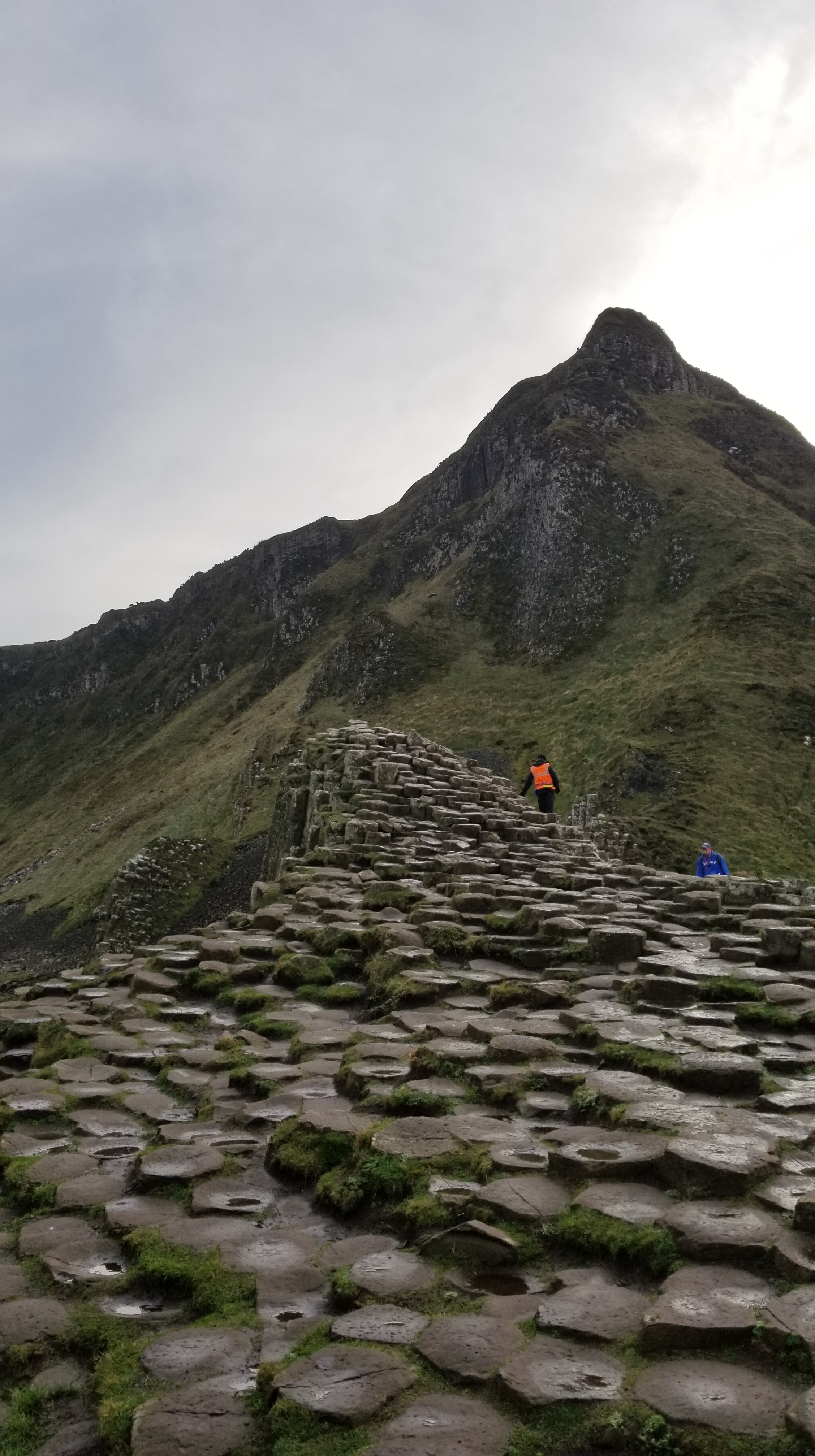
Giant’s Causeway

We spent two days at the Old Bushmills Distillery and the surrounding countryside. The distillery takes its name from the River Bush and all the water used on site comes from the rivers tribute Saint Columb’s Rill. Although the date 1608, the year King James I granted a writ to distill whiskey to Sir Thomas Philips, is emblazoned everywhere, the Bushmill’s Old Distilling Company wasn’t establish until 1784. No matter which date you take as the distillery’s origin Old Bushmill’s is the only distillery in all of Ireland that was in operation before 1974 and was one of the three that kept production alive.

Irish Whiskey has always been deeply tied to the American market and American Prohibition tanked the industry. 400 brands made by over 160 distilleries became three distilleries all owned and operated by a single group, Irish Distillers, with their purchase of Bushmill’s in 1972. Irish Distillers was purchased by Pernod Ricard in 1988 with Bushmill’s then purchased by Diageo in 2005. They began a massive ad campaign to gain market share  but even the largest liquor company in the world couldn’t seem to boost the brand and it was sold to Jose Cuervo in 2014 after Bushmill’s sold 1.3 million liter cases in the U.S. compared to Jameson’s 18 million.

Everyone loves a good underdog story and while technically being in second place Bushmill’s was a very clear underdog. A part of me was hoping I’d find some spark that craft spirit authenticity or other such nonsense that would make it worth the uphill battle to recommend Bushmill’s White Label over Jameson’s iconic green bottle. What I found out is that the White label isn’t what you should be drinking.
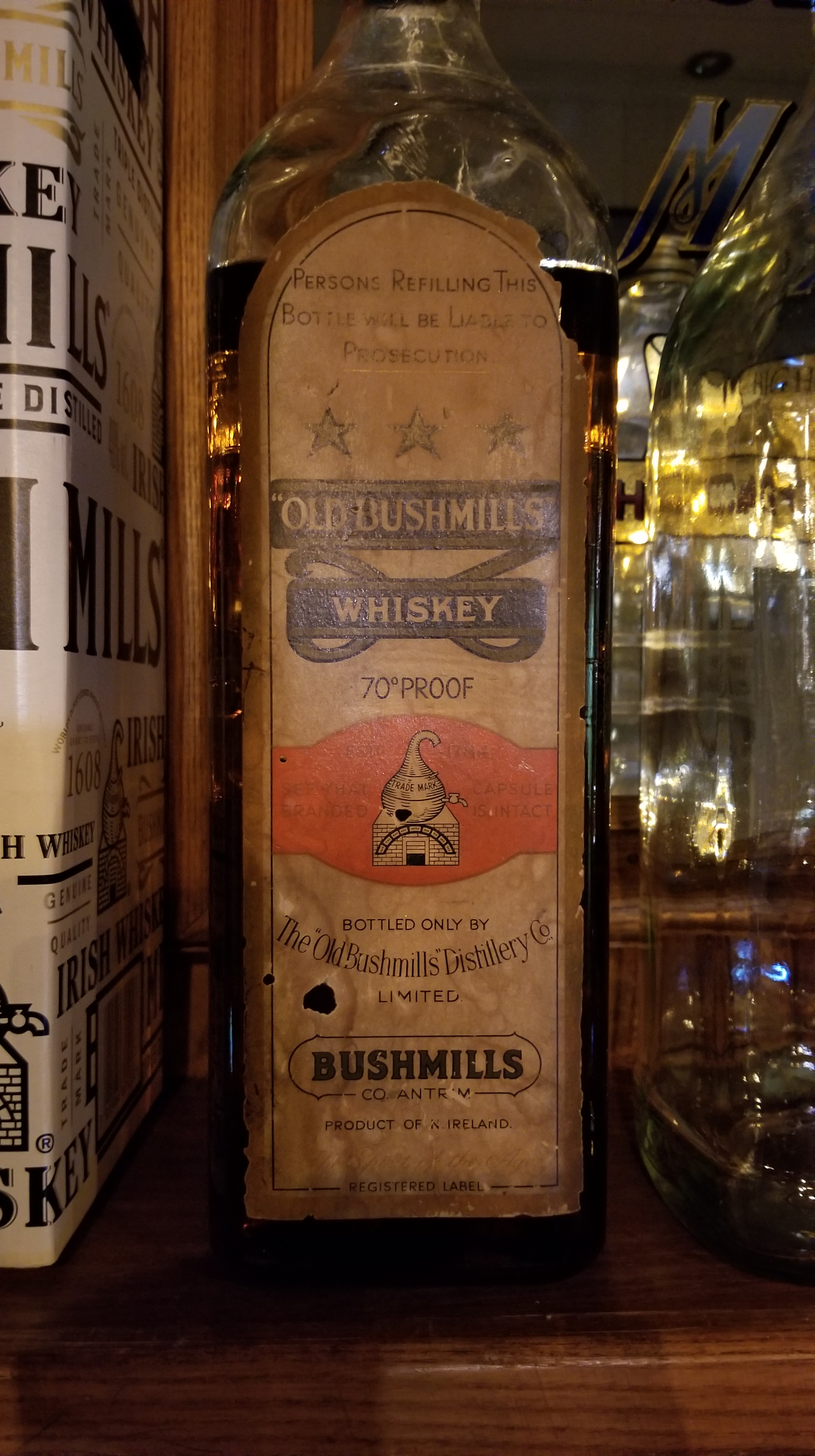
Old Bushmill’s bottle is old.

Bushmill’s is a single malt distillery. They age grain whiskey on site for blending but every drop of whiskey that’s distilled at the distillery is Irish Single Malt. This is unusual because most non-blended Irish whiskey is Single Pot Still, which is a distillate made up of  both Malted and Unmalted Barley. This style originated as a middle finger to the English who put a tax on malted barley in 1785. Despite the added expense Bushmill’s has only ever made Single Malt.  

Irish Single Malt is also distinct from (most) Scotch Single Malt in that it is triple distilled instead of double distilled. This creates a lighter whiskey as it’s gone through an additional set of cuts and stripping. This malt forms the base of all of the blends and single malt line at Bushmill’s . And every bottle of Bushmill’s is put together by the first female master Blender in all of Irish Whiskey history. She’s sitting comfortable with over 25 years of experience tripping across her palette and when she proclaims the 10 year old single malt to be her personal favorite there’s a weight that goes along with that statement.

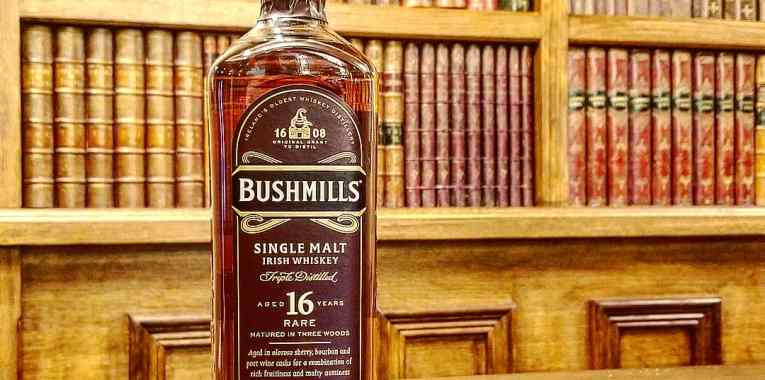
The 10 Year Old fills a very interesting place for Irish Whiskey. It’s affordable, mixable, and quaffable on it’s own it could honestly be that missing midpoint for Irish whiskey that bridges the shots and the Super Premium category. Yet from what I tasted it the true gem of the line is the 16 Year old Single Malt.
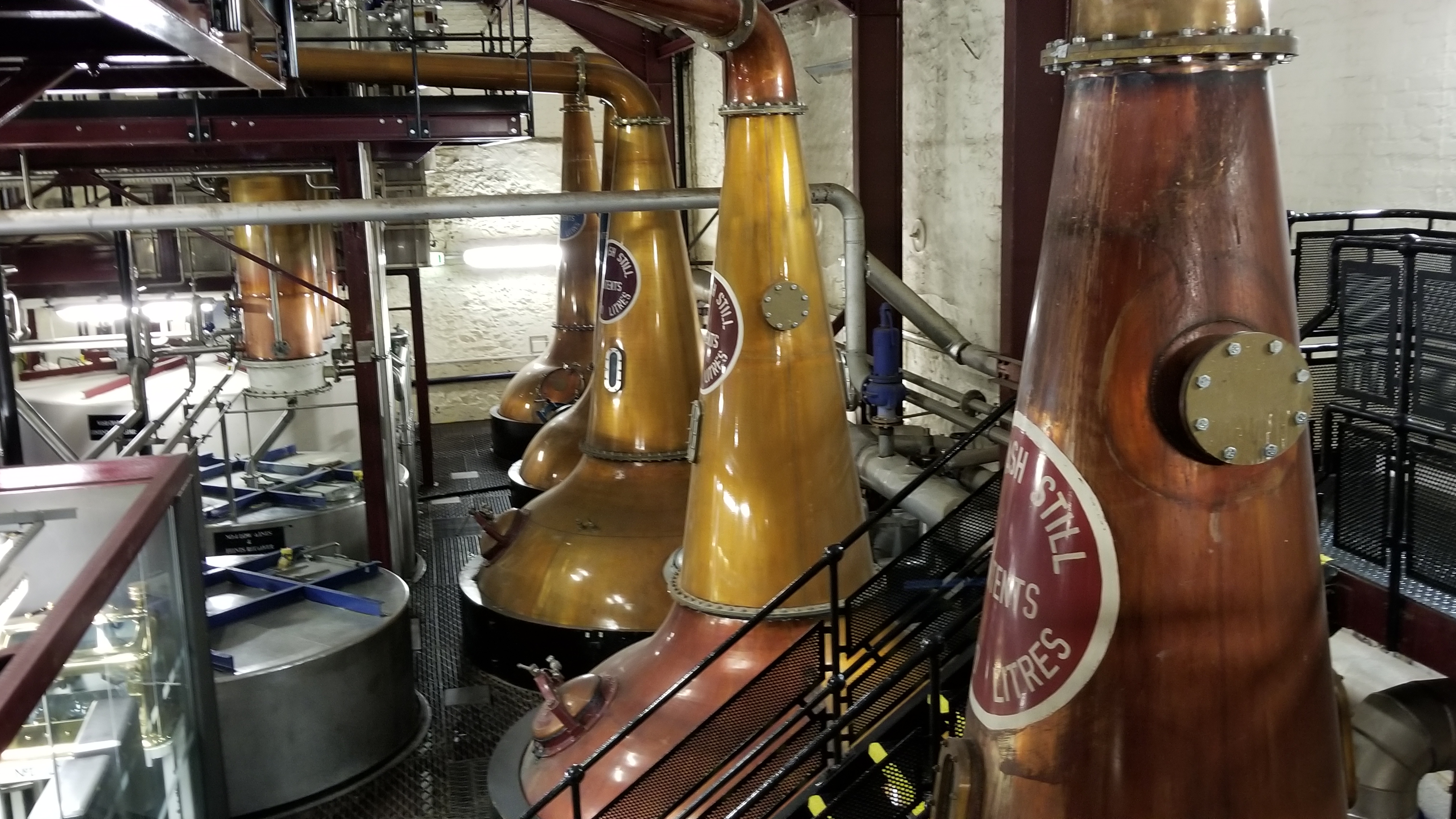
Pot Stills for days.

Aged for a minimum of 16 years a blend of ex-Bourbon and Olorosso barrel aged single malt is blended together and then further aged for an additional 6 months in used port barrels. It was the first thing I was poured after nearly 18 hours of travel and was one of those moments of surprise and disbelief at how good it was. In conversation with Noah Rothbaum, Senior Editor at Half Full, he expressed how it reminded him of the experience of discovering Hibiki 12 years ago before we drank it all-I had to agree with him. But not trusting my jetlagged senses I proceed drink at least a bottle over the next few days and to bring a bottle home for continued research.

NOSE: Dark Fruit, Raisin, Plum, and a touch of vanilla.

PALETTE: Dried Red Fruit, a slightly nutty undertone with a bright sherry through line to cut through the toffee, vanilla, and richness of the malt.

FINISH: Long and lingering, leaving the dried fruit and a slight amount of tannin and spice.

Ultimately I came away from Bushmill’s, and Ireland, with another story. A spirit is ultimately the distillation of the people who make it. A distillation of their culture, their taste, their landscape, and their time. Getting to know them, getting to experience them, ultimately opens doors to experience a spirit they way they do. In the end, Jameson is still my least favorite Irish Whiskey but, like life, whiskey is really shades of grey. A single dominant force can not define either. 

Whiskey Wednesday: A Tale of Two Elmer’s

            I received a text this week from a friend that without preamble said, “Did Elmer T. Lee get worse?”

            My gut reaction was, “Of course not! How dare you besmirch the name of the dearly departed father of modern Bourbon!?” After calming myself with a hefty dram I remembered that despite centuries of tradition whiskey making is a constantly evolving art and barrel aging is by no means an exact science. To add to that, there were claims of “cork taint” by members of the Reddit whiskey community in 2016.  The popularity of Elmer T. Lee has also exploded in recent years so the odds are that it’s younger stock than previous years. By the end of the glass the question was less of an attack and more of a probability.

Son, we’re not hiring today.”

            This could have remained a simple thought experiment but a recent trip to the Liquor Locker left me with a bottle of 2014 Elmer and the ability to do a little compare and contrast. But first a little context.

What exactly is Elmer T. Lee? Elmer T. Lee is both a Single Barrel Kentucky Straight Bourbon, and the deceased former Master Distiller of the distillery we now know as Buffalo Trace. 

“Son, we’re not hiring today.” Is how Col. Albert B. Blanton first greeted Elmer in 1949, but at the instance of his friend at the distillery he showed up to work the next week anyway.  Over the years Elmer grew from a maintenance engineer to the distilleries first Master Distiller. He officially “retired” in 1985 but not before releasing the world’s first Single Barrel Bourbon, Blanton’s, named after the man who didn’t hire him.

After Blanton’s became a hit the distillery honored its Master Distiller emeritus with his own namesake Single Barrel. Elmer was still heavily involved with the distillery and would come in every Tuesday to taste barrels and make selections for his namesake release.

Before Blanton’s, and Elmer, the concept of a “Single Barrel” Bourbon didn’t exist.  Remember, barrel aging isn’t an exact science. Every barrel ages differently depending on where in the rickhouse it sits, the quality of the barrel, the temperature swings over the years, all of these factors contribute to each barrel being a unique specimen But the whole idea of a bottled whiskey is consistency so generally barrels are blended, or batched, together to recreate a specific flavor profile. For a Single Barrel all of the whiskey in the bottle comes from one single barrel and has to stand on its own individual merits. While there will always be some variation, it is a sign of the skill of the distillery to be able to produce quality single barrels that are still consistent.

Both Blanton’s and Elmer share the same DNA. They’re both Buffalo Trace Mashbill #2 which is slightly higher in rye content (about 15%) and are both technically co-owned and produced with Age International. They’re both single barrels and they’re both non-age statement Bourbon’s so we know they’re at least older than four years. But two things separate them from each other: aging and proof.

Drinking is such an individual experience. It’s can be a social activity but the act of tasting is something intrinsically personal.

Blanton’s is always aged in Warehouse H, which was commissioned by Blanton himself. It  is a fully metal clad warehouse which allows for greater heat transfer and, supposedly, more rapid aging. Elmer has no such restrictions on what warehouse it must be aged in which theoretically allows for a larger variation in flavors.

Elmer is also bottled at 90 proof (45% ABV) where as Blanton’s is bottled at 93 Proof (46.5% ABV). While this difference seems small the alcohol is where the flavor is. A few extra proof points can make a world of difference and a whiskey can open up with just a few more drops of water. That isn’t to say that higher proof is always better, just like older doesn’t always mean better, it just means a different flavor profile. Interestingly, Elmer was said to drink his Bourbon at 60 Proof as he felt that was the point when he could taste all the flavor with out the alcohol getting in the way.

Now that all the intellectual foreplay is out of the way, how do they actually taste?

Four Years can really change a bottle.

2014

  NOSE: Oak and Clove

  PALETTE: Earthy, Dark Chocolate, Coffee, Tobacco

  FINISH: Long, slightly damp and musty

2018

            NOSE: Oak, Stone fruit, Vanilla

            PALETTE: Rye Spice, Stone Fruit, Tobacco, Coffee

            FINISH: Light, Spicy

Surprisingly, the 2014 is livelier in the glass, with a bigger spice on the nose and a more rounded midpalette. However, the 2018 carries a darker earthiness, more of the tobacco I associate with Elmer’s and a longer finish. Yet they are both still Elmer. In fact, pouring the two together creates an almost uber-Elmer that is exactly what I expect Elmer to taste like all the time.

Drinking is such an individual experience. It’s can be a social activity but the act of tasting is something intrinsically personal. Where you are at, what time of the year, and how much effort you put into finding the bottle all effects how the spirit tastes. So, back to my friends original question. Did Elmer T. Lee get worse? I’d say no, but it is different. But then again, so am I.

Whiskey Wednesday: Hitting Johnnie Green’s Stride

Johnnie Walker is a striding behemoth, straddling the world as the number one selling Scotch whisky brand. It’s so popular that “What makes Johnnie Walker Blue the best?” is a Google search autocomplete. It’s so popular that due to knockoffs and literal bootlegs there are more bottles of Johnnie Walker Black Label sold in India every year than are actually produced for the entire world.

            With this level of popularity the level of disdain and outright backlash for Johnnie Walker that abounds is almost inevitable. Something so popular could never actually be good. Yet, amongst its vast palette of labels there abides a quality and constancy that’s earned its place on back bars across the globe. It also contains one of my all time favorite colors and bottles: Green.

            Johnnie Walker, the Scotch Whisky, began its long walk in the 1819 when the father of John Walker, the actual Scotsman, died. The family sold their farm and invested in a grocery in Kilmarnock, Scotland in 1820. Grocery stores were a different breed in the 1800’s and many grocers would make their own house blends of whisky. This became much more prominent after the Excise Act of 1823 deregulated many of the laws on the distillation of whisky and more importantly greatly reduced the taxes on distilling and selling. In short order the teetotaling John Walker was selling his own blended malt whisky called Walker’s Kilmarnock Whisky. John passed away in 1857 leaving the company to his son Alexander Walker who would usher in the beginnings of the company’s global dominance.

This rise in popularity began with another act completely outside of Alexander’s control, the Spirit Act of 1860. For the first time it was now legal to blend malt and grain whiskies together, thus creating the blended whisky style that is the core of Johnnie Walker, as well as the vast majority of worldwide Scotch sales.

Alexander also took advantage of the newly arrived railroad to make connections with shipping captains to create a larger distribution network. This expanded shipping reach combined with a more approachable, lighter style of Scotch whisky literally made inroads with new drinkers.

            The increase in global shipping also led to the development of the iconic square bottle in 1860. The square shape allowed more bottles to fit in the standard shipping containers as well as greatly reduced breakage during transit. Alexander was also responsible for tilting the label at its jaunty angle across the bottle allowing for larger print as well as making the bottle more recognizable from a distance.

            It was the Third Generation of Walkers that added the final touch with a rebranding in 1909 that first saw the “Striding Man” added to the labels. They also had the companies three blended whiskies officially renamed to White Label, Red Label, and Black Label. The White Label was dropped during World War I but the Red and Black remain the core of Johnnie Walker to this day.

            With demand for Johnnie Walker Scotch spread across 120 countries the company began purchasing single malt distilleries to ensure  consistent supply and blends.  Beginning with Cardhu in 1893, they followed it up with the Coleburn Distillery, The Clynish Distillery and Talisker, before capping it off with the legendary Mortlach Distillery in 1923. Then in 1925 the company joined Distiller’s Company, which was purchased by Guinness in 1986, which then merged with Grand Metropolitan in 1997 to form Diageo, the largest liquor conglomerate in the world. 1997 is also an important year because it marks the reintroduction of Blended Malt Whisky to the Johnnie line up. Originally called Johnnie Walker Pure Malt my favorite bottle received its chromatic designation as Green Label in 2004.

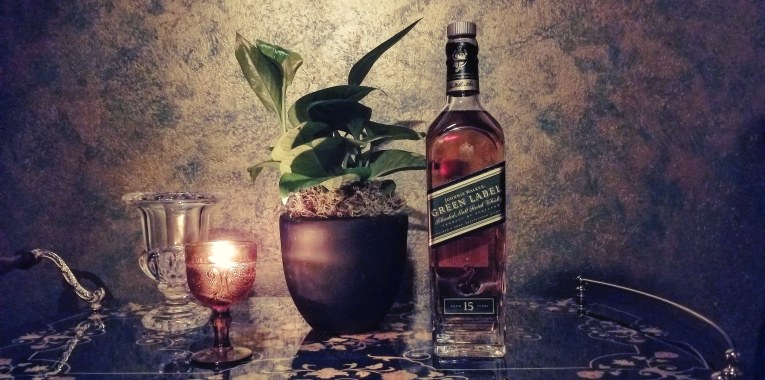
            In a lot of ways the Green Label is a return to that very first John Walker blend. Being a blended malt it is comprised of completely single malt whiskies, which means none of the grain whisky that Alexander introduced and the helped spread the brand across the globe. Diageo is vague on the specific details, listing it as a blend of malts from the Speyside, Highland, Lowland, and Scottish Isle malts which is essentially saying it’s made up of Scotch from Scotland. But digging deeper you can find the names Cragganmore, Linkwood, Caol Ila and Talisker as the primary malts. It also carries a 15 year age statement, meaning the minimum age of every malt in the blend is at least 15 years old, making it one of the oldest constantly available Johnnie Walker blends.

            In a lot of ways this blend is at the root of Johnnie Walker’s history which is why it’s so surprising to me that it’s always felt like the redheaded stepchild of the family. It was “discontinued” in the Western markets around 2012 with plans to focus the brand in Asia. A massive shift in Chinese regulations brought the brand back globally in 2016. Yet it is still often passed over, ironically, because it isn’t as ubiquitous as the Black and Blue.

            Or maybe it’s a victim of Johnnie’s success. The sun never sets on the empire of Johnnie Walker yet it is an empire built on that addition of grain whisky to its single malt base. It’s a lighter style with more mellow flavor and the Green is rich and almost overly opulent in comparison. Someone who enjoys Black label might not find the Green to be their cup of tea. On the flip side the type of drinker that would truly love an aged-stated, blended malt is probably also the kind to turn up their noses at the mere mention of Johnnie’s name.

            Or maybe it’s that people still don’t truly understand what a blended malt is. It’s a misunderstood style just like Green Label is a misunderstood bottle. But the fact that it is so misunderstood and overlooked just makes it all the more endearing to me. I’ll gladly quaff a dram when I can find it.

NOSE: A light touch of seaside smoke, vanilla, dry oak and baking spices

PALETTE: Decadent and rich. Raisins, dried plums with a touch of that seaside air and a whiff of sherry. Slightly nutty, with a bright mid palette.

FINISH: A relatively quick, clean finish that leaves a lighter impression that the rest of the experience. It ends with lingering oaky sweetness mixed with a hint of smoke.