Quarantine Bottle Kill #9: Elijah Craig 12 Year (From Long Ago In The Before Time)

There’s a sense of static in the air these past few weeks of quarantine. Not of any sense of normal but certainly of familiarity. A sense of sameness and of the world outside the familiar walls drifting away. But also there’s that electrical charge like anything can and could happen at any moment.

The world seems to be looking for answers and I’m sitting here working my way through old booze and writing about it.

It is a way to help keep my sanity. Beyond it being something from the Great Before that I enjoyed it’s also been an avenue for self reflection and rumination.

It’s mental travel.

Placing myself in the place, time, and person that I was when this bottle joined the collection. No spirit allows me to check in with myself and chart my trajectory more than Elijah Craig.

Elijah Craig 12 Year Bourbon was my first true Bourbon love. I’m not going to say that it “got me into whiskey” but it certainly helped expand my understanding of what good Bourbon could be. When I started buying barrels for my program Elijah Craig was the first barrel I bought. And I kept buying barrels. Even after the aged statement was dropped. It is a benchmark Bourbon and the numerous barrels arriving over the years have given me an excuse to examine the years as they pass.

But as time goes on and the age has changed and after so many barrel selections I forgot what old school Elijah tasted like. Was it inflated in my mind? Was the memory of who I was when I discovered it altering the actual liquid? Am I drinking nostalgia flavored whiskey?

So how fortunate was I to discover a bottle of standard issue  Elijah Craig 12 Year Old from 2012 hiding in my closet. This bottle is from when my career shifted from being a bartender to a Bar Manager and when so many of my early influences and opinions crystallized. Here is a liquid opportunity to examine the past.

NOSE: Caramel, Oak, Apricot, Tilled Soil
PALETE: Toffee, Vanilla, Baked Apples, Baking Spices, Earthy and Deep
FINISH: Long, clean, spicy with a hint of white pepper. Drying to a lingering woodyness

This dram is deep and powerful. It is what I have idolized for years. While the NAS Elijah Craig is a very good Bourbon this old 12 Year has a maturity, for lack of a better word, that its descendant does not. 

And while the Elijah Craig Barrel Proof releases are still 12 Years old the much higher proof gives an edge that here is softer and more nuanced.

This is a dram for deep thoughts and late night conversations. It’s also a perfect example that things don’t stay static forever. Eventually all things change.
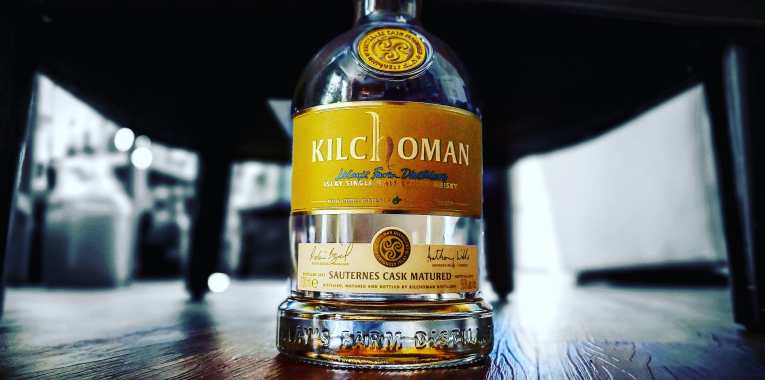
Quarantine Bottle Kill #8: Kilchoman Sauternes Cask Matured (2016)

It feels like the quarantine weeks are quickly going up in smoke. That’s probably because half of the home bar is Islay Whisky right now. Is that a forced transition? You bet it is.

I thoroughly enjoy heavily peated whisky. I often use Octomore as an example of just how good a Scotch Whisky can be and it doesn’t get any peatier, or more over proof, than that. Yet for all my love of the smoke finishing a bottle of heavily peated whisky rarely shows up on my list of achievements. That’s because drinking an Islay is a state of mind.

Drinking a good Islay transports me to rocky ocean beach in the evening. The campfire has just sputtered out and there’s a hint of rain in the air. But for now I can see the stars and wonder about my place in the universe.

Unlike its Highland brothers the island of Islay firmly embraces the one trait most people claim to hate about Scotch: the peat. Being aggressively peated, Islay Whiskies have an earned reputation of being an acquired taste. Sipping on a truly great peated whisky cause the taste buds to expand, the mind to slow, and an introspective nature to descend on the evening. At least it does for me.

Millions of drinkers across the globe have acquired this taste which have given Islay Scotch a cult like following. They are devoted but it does make it hard to break into the old boys club.

Enter Kilchoman. The first new distillery on Islay in 124 years this distillery, and its whiskies, came out of the barrel swinging. They began production in December of 2005 with their inaugural three year old whisky released in 2009. Since then they have racked up an impressive reputation and managed to take a seat at the clichy Islay table. They are also one of only a handful os Scotch distilleries using traditional floor malting on site as well as growing all of their barley on Islay at local farms.

One of the nice things about being the new kid in the old club is there is no tradition that you must adhere to. This gives Kilchoman a lot of room for experimentation. Like with their Sauterns Cask release. There have been a few different release but this was from their first offering in 2016.

Distilled in 2011 and bottled in 2016 this this 5 year old malt was completely aged in ex-Sauternes wine casks. Now, I clearly have a thing for malts that are finished in wine casks. So, how does a fully wine cask matured malt measure up?

NOSE: Buttery, with a hint of dried oranges and a misting of peat and sea salt
PALETE: Sweet apricot, caramel, honeysuckle, baking spices, and a salinity melding with a wonderfully balanced smoke
FINISH: Lingering, long clean, with a touch of sweet exhaling into a mouthful of smoke

This is a beautiful dram that is again an adventure and an experience. It transports while drinking. The experience also takes me back to when this bottle was purchased. 

It was 2016 on my first ever trip to Europe with my brand new partner who has stayed with me all these years. So much has happened since then but as the last drops slide from this bottle after four years I will cherish every experience this dram has given me and every moment between purchase and completion.

Quarantine Bottle Kill #7: Drouin Pomme Prisonnière

I think the biggest thing people feel they have lost from this whole quarantine is time.

Time lost on their career. Time lost to spend with loved ones. Even the time to simply plan. The future looks so uncertain that it filters back into the present spreading a malaise over each individual moment. And while there are many people hopefully planning for the future, bookings for cruises this fall are up 600%, there is certainly a sense of mourning for the past few months. Of time lost.

The dirty secret is of course that we never had time. Entropy constantly moves us along time’s arrow with the past ever distant and the future never truly more fixed than it is at this moment. All we ever hold in our hands is the present moment with hope and memory creating the expanse.

That’s why physical reminders of the past resonate with us so hard. And for me why spirits and open bottles have so much poetry. I can watch time pass in liquid form behind glass. And when it’s at its end I can reflect on the beginning and everything in between.

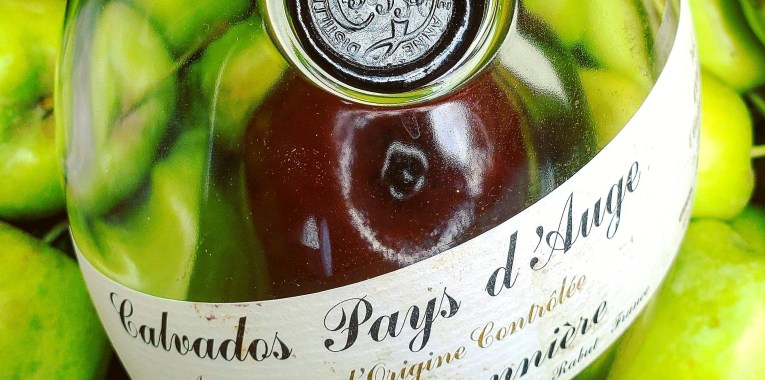
Take this bottle of Christian Drouin Calvados Pomme Prisonnière. It’s the perfect example time in a bottle. And this goes beyond the standard “aged spirit” metaphor.

It starts with an apple tree in spring.

Pink and white flowers cover the trees feeling the spring fever and hoping to be among the lucky 5% that are fertilized and grow into full, ripe, plump apples. During this time is when the carefully trained eyes of the Drouin and Alleaume families place 10-20,000 glass carafes over these budding flowers. Over the next several months the apple grows inside of its prison until in the fall the are harvested, cleaned, and filled with calvados.

Timing here is key. Put the bottle on too early and the flower won’t become fertilized. Put it on too late and you risk the new fruit being too large for the neck of the bottle. And that’s even before the mishaps that can happen during the months of growth. Even with nearly 40 years of experience spread across three generations only about 40% of the bottles are successful, and that’s a marked increase from the 5% success rate from their first attempts.

After that time marches on and the calvados in the bottle evolves and melds with its prisoner. The liquid evolves over time and the apple changes with a life time spent maturing inside a bottle and preserved in Calvados.

All of these facts combine for a pretty remarkable encapsulation of how a spirit, and a bottle, can capture time. But metaphors are truly meaningful when they become personal. No matter how fascinating the process of its creation is, it is its connection to my personal growth that has the true meaning.

This bottle was purchased nearly two years ago on an impromptu vacation in France. My well documented love of apple brandy led us to spend a night in Normandie specifically in Trueville and Deauville, mirror cities with mirror casinos. We had been connected with Herve Pellerin at Christian Drouin who picked us up from the train station on a rainy afternoon, drove us to the distillery and left us in the hands of Guillaume, third-generation Drouin and the brand’s current head distiller. We spent hours talking about distillation, harvest, bottling, and of course Pomme Prisonniere. 

This bottle isn’t a list of facts. It’s an experience. An experience that lead to my first professional gig as a writer by crafting an article for The Daily Beast about this Calvados experience.

So, I will savor the last drops of this bottle while examining these moments of time trapped under memory, while trapped in my home by an unseen virus, and contemplate how to free this Pomme Prisonniere from its glass prison.

NOSE: Cinnamon, apple, clove,
PALETE: Apple, apricot, honey, baking spice, oak
FINISH: Medium, semi-sweet, and a touch floral

Quarantine Bottle Kill #6: Tanqueray #10 and the 5:00 Martini

It’s not all about whiskey over here. Just like this weekly bottle talk isn’t just about drinking. It’s a mental check in with myself and an attempt to connect with my community as we shelter and wonder what our industry will look like once we start hosting happy hours outside of digital boxes again.

When this all started I wrote about my experience with illness that led me to the hospitality industry, how it created a new normal for me, and how this pandemic was going to create a new normal for all of us. 

This became clear almost immediately as people across the country who are sheltering in place found daily rituals to help mark the daily passage of time. I for one am not at all surprised by the resurgence of the cocktail hour under quarantine. Everyone has their rituals and for us it’s Martini’s.

The 5:00 Martini became an easy metronome to mark the days. The idea of a “weekend” or even a definitive “work day” may have slipped away but the silvery liquid pouring from the mixing glass into its chilled chalice was the sign post that marked the end of another day. It immediately became a daily comfort of the quarantine.

While I am a great lover of libations this was something distinctly unusual for me. Starting at 5:00 is not recommended when you work nights but without a bar to stand behind this ritual of making a drink for myself and my partner became more than a simple drink. It became a meditative process to soothe the mind and numb the spirit.

Martinis are also incredibly personal drinks. They vary from person to person and from day to day which is another reason they resonate during quarantine: variety amongst familiarity.

I’m a fan of classics and have been accused of having an “old school” vibe so it should come as no surprise that for me a Martini is always made with gin. While the gin varies on the mood I tend to lean towards very traditional London Dry gins. The baseline for which I judge all martinis is a Beefeater Martini with a twist. But the gin that has seen us through these past few months has been Tanqueray No. Ten.

Tanqueray Ten differs from its classic sibling with the addition of what they call the “Citrus Heart.” Essentially this is an incredibly potent citrus distillate made from fresh, whole grapefruit, lime, and orange. This helps set Tanq Ten apart as traditionally it is only the dried citrus peels that lend their flavor to a gin. 

This is also where the gie gets its name. While you’d be forgiven for thinking that it is called Tanqueray Ten because of the number of botanicals it is actually because the citrus heart is distilled on Tanqueray’s “Tiny Ten” still which is a small pot still that was used for experimental distillation before becoming the permanent home for Tanqueray Ten. It then receives a second distillation in the more traditional “Old Tom” No. 4 still where the traditional Tanqueray botanicals, coriander, angelica, licorice, and of course juniper, are added along with a touch of chamomile flowers. This ultimately results in a fresh, citrus forward gin that is credited as being one of the forerunners of what we now call “New Western” style gin. 

It’s also billed as being the perfect gin for a martini and while every gin will make that claim I can safely say after two months that it does make a damn good martini. 

If you want to follow along at home the 5:00 Martini is a 5:1 ratio Tanqueray Ten to Dolin Dry Vermouth (for those of you who struggle with math that 2.5 oz Gin to .5 oz Dry Vermouth) stirred over ice, strained into a stemmed glass, and garnished with a lemon peel. If you’re greedy like my partner you can add an olive and a caper as well. And for all of you purists out there screaming for orange bitters there’s enough citrus in Tanq Ten that you’re simply gilding the lily at that point.

5:00 Martini:
2.5 oz Tanqueray Ten
.5 oz Dolin Dry Vermouth
Stir, strain into a chilled glass,
Garnish with a lemon twist

Unlike a lot of the bottles I’ve been posting about Tanqueray Ten isn’t rare or irreplaceable so why am I writing about it? Because this quarantine normal, this 5:00 meditative space will eventually fade. It will be replaced as the world finds a way to move on and suddenly a 5:00 Martini won’t be acceptable or practicle again. And I’d like to remember the small ritual that brought a moment of calm to the chaos.

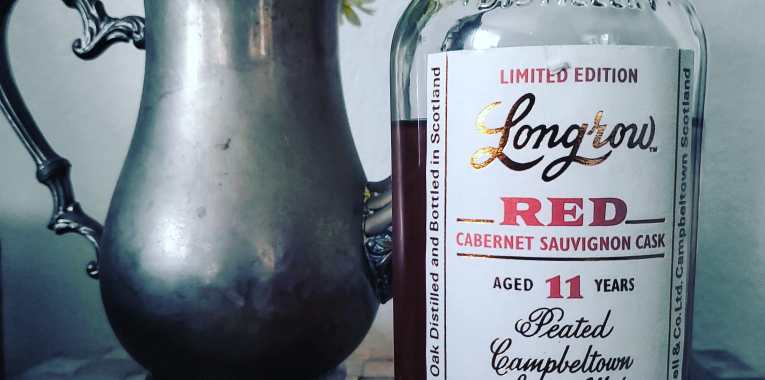
Quarantine Bottle Kill #5: Longrow Red 11 Year Cabernet Sauvignon Cask

Just because we’re in quarantine doesn’t mean that there can’t be a theme. Aside from sparking joy by eliminating bottles from the booze cart that is. So next up on the quarantine bottle list is the cousin to the last, the Longrow 11 Year Red: Cabernet Sauvignon Cask.

For all single malts produced in Scotland the brand must be identified with the distillery. Hence the Macallan whiskey being made at the Macallan distillery, the Jura at Jura, Laphroaig at Laphroaig, and so on. This seems intuitive yet it’s absolutely not how things are done here in the US. While there are a few eponymous distilleries most of them produce dozens of other brands as well. For example, Jim Beam not only produces Jim Beam but Bookers, Knob Creek, Basil Hayden, Old Overholt, and the many variations there of. 

This makes Longrow rather unique as it’s brand but not a distillery. Part of the reason this is allowed under Scottish law is that the brand is intrinsically understood to be produced at Springbank Distillery and the name of the distillery appears on every bottle. Larged embossed letters proudly proclaim “Springbank” above every label. But also, the style of Longrow is drastically different than its cousin allowing for a true separation and not just a label change on the same liquid.

Longrow, unlike Springbank, is heavily peated. There is actually a scientific way to measure the “peatiness” of a Scotch. It’s called Parts Per Million, or PPM, and is used to determine the phenol level after kilning but before distillation. Essentially the longer the malted barley is exposed to the peat fire during kilning the higher the peat and PPM. Longrow clocks in at 50 PPM which means it’s technically even peatier than the notorious peat bomb, Laphroaig which clocks in at 40 PPM.

So, here is a heavily peated Campbeltown Single Malt with less than a hundred casks produced every year at a non eponymous distillery. If that’s not enough to peak your interest then the Cabernet Sauvignon Cask will. Every Longrow Red release spends some of its formative years in a red wine cask, similar to the recently emptied Springbank Burgundy. For this release it spent the first seven years in ex-Bourbon barrels and the last four in a Cabernet Sauvignon cask.

To cap it all off the Red is bottled at Cask Strength clocking in at a whopping 104 proof meaning none of those big flavors are lost.

NOSE: Assertive smoke, raspberry, cherry,
PALETE: Leather, sea salt, smoke, darker fruit, blackberry, a touch of sweetness and a strong tannic backbone
FINISH: Long and dry yet juicy. Reminiscent of sea air with those red fruits returning.

This is a complex little dram. There’s a beautiful salinity that provides the throughline for Longrow while the tannin and the fruit lent from the Cabernet Sauvignon cask shines through at almost every level without being overwhelming. Surprisingly, I actually enjoy this one with a little water in it. The high proof gets in the way of some of the more delicate flavors that I really enjoyed in the Springbank Burgundy that are also present here.

All in all, this bottle actually feels like a perfect quarantine metaphor: subtle yet aggressive, complex yet needing a bit of hydration, and packing a hell of a punch.