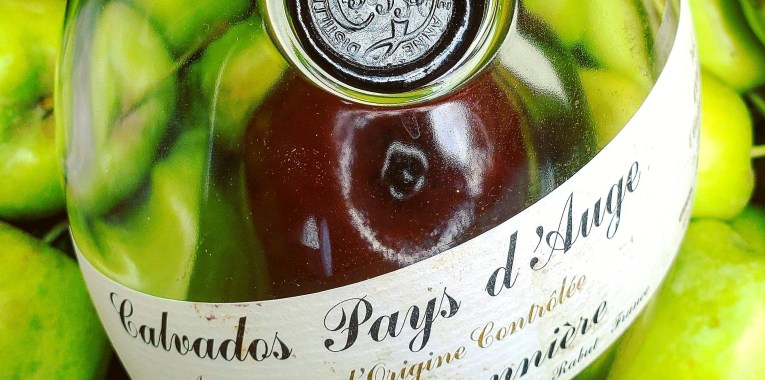
Quarantine Bottle Kill #7: Drouin Pomme Prisonnière

I think the biggest thing people feel they have lost from this whole quarantine is time.

Time lost on their career. Time lost to spend with loved ones. Even the time to simply plan. The future looks so uncertain that it filters back into the present spreading a malaise over each individual moment. And while there are many people hopefully planning for the future, bookings for cruises this fall are up 600%, there is certainly a sense of mourning for the past few months. Of time lost.

The dirty secret is of course that we never had time. Entropy constantly moves us along time’s arrow with the past ever distant and the future never truly more fixed than it is at this moment. All we ever hold in our hands is the present moment with hope and memory creating the expanse.

That’s why physical reminders of the past resonate with us so hard. And for me why spirits and open bottles have so much poetry. I can watch time pass in liquid form behind glass. And when it’s at its end I can reflect on the beginning and everything in between.

Take this bottle of Christian Drouin Calvados Pomme Prisonnière. It’s the perfect example time in a bottle. And this goes beyond the standard “aged spirit” metaphor.

It starts with an apple tree in spring.

Pink and white flowers cover the trees feeling the spring fever and hoping to be among the lucky 5% that are fertilized and grow into full, ripe, plump apples. During this time is when the carefully trained eyes of the Drouin and Alleaume families place 10-20,000 glass carafes over these budding flowers. Over the next several months the apple grows inside of its prison until in the fall the are harvested, cleaned, and filled with calvados.

Timing here is key. Put the bottle on too early and the flower won’t become fertilized. Put it on too late and you risk the new fruit being too large for the neck of the bottle. And that’s even before the mishaps that can happen during the months of growth. Even with nearly 40 years of experience spread across three generations only about 40% of the bottles are successful, and that’s a marked increase from the 5% success rate from their first attempts.

After that time marches on and the calvados in the bottle evolves and melds with its prisoner. The liquid evolves over time and the apple changes with a life time spent maturing inside a bottle and preserved in Calvados.

All of these facts combine for a pretty remarkable encapsulation of how a spirit, and a bottle, can capture time. But metaphors are truly meaningful when they become personal. No matter how fascinating the process of its creation is, it is its connection to my personal growth that has the true meaning.

This bottle was purchased nearly two years ago on an impromptu vacation in France. My well documented love of apple brandy led us to spend a night in Normandie specifically in Trueville and Deauville, mirror cities with mirror casinos. We had been connected with Herve Pellerin at Christian Drouin who picked us up from the train station on a rainy afternoon, drove us to the distillery and left us in the hands of Guillaume, third-generation Drouin and the brand’s current head distiller. We spent hours talking about distillation, harvest, bottling, and of course Pomme Prisonniere. 

This bottle isn’t a list of facts. It’s an experience. An experience that lead to my first professional gig as a writer by crafting an article for The Daily Beast about this Calvados experience.

So, I will savor the last drops of this bottle while examining these moments of time trapped under memory, while trapped in my home by an unseen virus, and contemplate how to free this Pomme Prisonniere from its glass prison.

NOSE: Cinnamon, apple, clove,
PALETE: Apple, apricot, honey, baking spice, oak
FINISH: Medium, semi-sweet, and a touch floral

Whiskey Wednesday Adjacent: Pick Your Apple Poison

You can always tell what a bar manager’s secret passion is. You’ll look at the backbar and no matter how well curated it is there will always be a collection of bottles that are out of place, an odd amount of variety in an esoteric category. For me, that guilty pleasure is apple brandy.

Bourbon may have become the United States Native Spirit through Congressional Resolution in 1964 but Apple brandy, that New Jersey Lightning, is the real first spirit of the colonies. In the cold New England winters colonists would leave cider outside overnight allowing it to freeze. Since alcohol doesn’t freeze what was left over after this rudimentary distilling, or “jacking”, process was a more concentrated alcoholic apple beverage.

This proto-brandy became known as Applejack and had as large a reputation for causing blindness from poor ‘distilling’ as it did for getting the drinker drunk. But it wasn’t long before industrious businessmen started cleaning things up. Robert Laird was a Continental Soldier who served under George Washington during the Revolutionary War. There are records of Washington requesting Laird’s family recipe for “cyder spirits” which has lead to the claim that Laird supplied Applejack to the Continental Army. After the war Laird founded a distillery in Scobeyville, NJ and which is now the oldest licensed distillery in the United States, receiving License Number 1 from the U.S. Treasury in 1780. But the “cyder spirits” and their hard cider cousins did not fair well under prohibition.

Prior to Prohibition most of the apple orchards in the colonies were not the juicy, edible fruit that we think of today. They were in fact the hard, bitterly sour variety that make excellent cider. Apples are what are known as extreme heterozygotes. Essentially, the latent genetic diversity of the actual seeds means that a tree grown from a seed will bare almost no resemblance to the varietal of the parent tree and more often than not will be completely inedible. These types of apples are known as “spitters.” To create consistent apple varieties a process known as grafting, where a budding branch of the parent tree is implanted into existing rootstock essentially cloning the original tree. There were a few issues with getting active graft to the New World in those early Colonial days which meant that most attempts at growing apple trees were from seeds. And while these spitters were terrible for eating they were perfect for cider.

On the frontier, Cider was actually safer to drink than the water so settlers again turned to cider orchards. And many of these orchards were in fact planted by John Chapman, or as he’s better known, Johnny Appleseed. John Chapman was a real man who bares an actual resemblance to his folkhero self. He did wander the frontier planting apples from seeds, but Chapman was more a shrewd businessman than a carefree vagabond.

Starting in 1872, the Ohio Company of Associates promised potential settlers 100 acres of land if they could prove they had made a permanent homestead in the wilderness beyond Ohio’s first permanent settlement. To prove their homesteads were permanent the settlers were required to plant 50 apple trees and 20 peach trees in three years. This proved they were sticking around because an average apple tree took ten years to bear fruit.

Chapman realized that if he stayed just ahead of the settlers, doing the difficult orchard planting he could sell them for profit to the incoming frontiersmen. And being a member of the Swedenborgian Church his belief system explicitly forbade grafting because the thought it caused unnecessary suffering for the plants. Thus his orchards were grown from seeds and unfit for eating but perfect for cider.

Unfortunately, most of Chapman’s orchards were cut down during Prohibition when FBI officers were targeting cider productions and orchards helping hasten the downfall of America’s cider tradition. Meanwhile, the apple brandy world had consolidated with Laird’s being the only game in town. The drinking populace’s tastes also changed looking for lighter, less flavorful options like vodka and blended whiskey which transformed Applejack into a blend of apple brandy and grain neutral spirit. By 1970 Laird’s had shrunk from three distilleries to its single plant in New Jersey. They even ceased production for several years as the stocks on had were more than sufficient for demand.

Flash forward to 2017 and Apple Brandy and cider are riding a resurgent wave. Craft cider producers have expanded the category and given it respectability. Apple brandy got to come along for the ride and also got it’s own boost from the Cocktail Renaissance. Many classic drinks called for “applejack” and I know personally it helped be ease many drinkers off of drinks calling for “apple pucker.”

The variety of apple brandy these days is rather astounding. From classic French Calvados, to Laird’s New Jersey Bottled-In-Bond, to Germain Robin’s French style California apple brandy, to Copper and Kings new wave distinctly American Apple Brandy made right in the heart of Bourbon Country. They are all as unique as the seeds that they sprang from. Which is why I need so much shelf space for them.