History is tricky. It’s written by the winners and often overly romanticized by the survivors as they remember the good and forget the bad in the harsh light of present difficulties. And when you throw alcohol into the mix things can get even murkier. Take the modern obsession with all things Pre-Prohibition. From the style of the bar, to the bartenders uniforms, to the whiskey being poured, at every step of the road the booze industry is proud to be returning things to their turn of the century glory.
Yet, despite the romance of Prohibition speakeasies and Pre-Prohibition style and quality, that “style” and “quality” was all over the map. The quality issue was first addressed with the Bottled In Bond Act of 1897, but even though the term “Bourbon” being used as early as the 1820’s, what made a whiskey a “Bourbon” wasn’t truly codified into law until the Bourbon Act of 1964. So what they hell does “Pre-Prohibition style” even mean? Unregulated? Undefined?
While this elusive style might not mean anything on its own it can serve as inspiration. And if anyone should have an idea of what Pre-Prohibition whiskey tasted like Booker Noe would have been the one. The grandson of Jim Beam and the Master distiller at his grandfather’s distillery since the 60’s, Booker’s pre-Prohibition inspired bourbon, Knob Creek, rolled out in 1992.
 Named after the stream that ran along Abraham Lincoln’s childhood home in Kentucky, the bottle was modeled after turn of the century apothecary bottles with the label inspired by the tradition of wrapping bottles in newspaper at the distillery. Knob Creek was originally an age stated 9 Year Old bourbon bottled at 100 proof. The age statement has been dropped in the past few years but the brand still claims extra aging compared to the companies other small batch whiskies. So in this case pre-Prohibition style would seem to mean longer aged and higher proof, which is almost the exact opposite of what those early whiskies would have been.
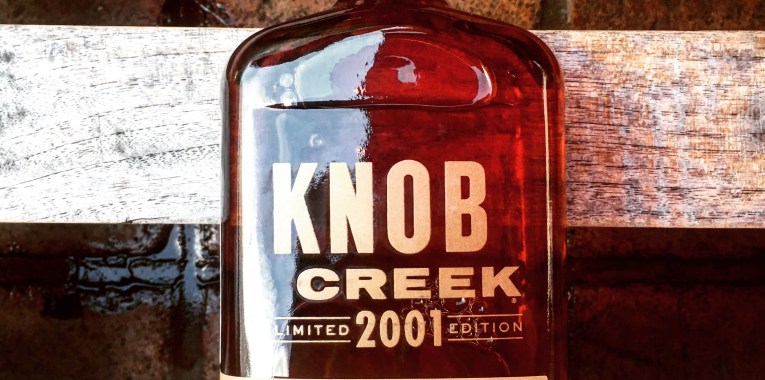
Knob Creek was one of Booker’s babies. He continued to oversee the brand until he continued another family tradition and handed the title of Master Distiller and production of the brand over to his son Fred Noe in 2001. Which is how we ended up with the aptly named Knob Creek 2001 Limited Edition.
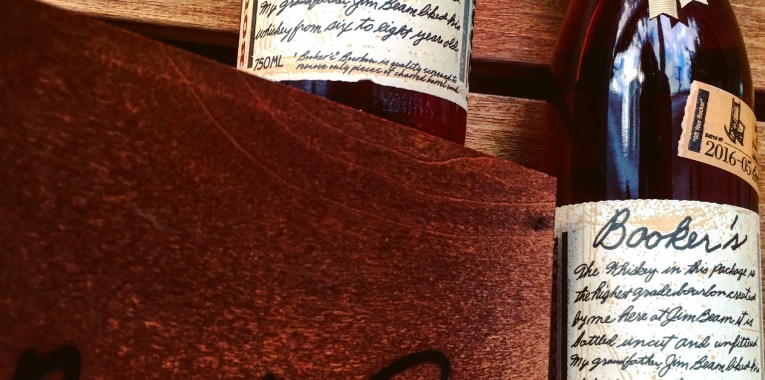
The Knob Creek 2001 was made from some of the last barrels ever laid down by Booker and then finished by Fred. It’s a passing of the torch in bottle form. And this excited the Bourbon nerds, understandably so. The other bottling to come out of the last of Booker’s barrels was last years Booker’s Rye, which turned a lot of heads and was named Jim Murray’s Whiskey of the Year. Those are some big shoes to fill.
 What set the Booker’s Rye apart was the age and a unique mashbill. The Knob Creek 2001 certainly has the age, at 14 years old it clocks in a good five years older than the old 9 year, but there’s no variation on the mashbill, simply different batches. This leaves a through line connecting it to the standard issue Knob Creek because no matter what batch you pick up all of these bottles are unmistakably Knob Creek: powerful, with pistachio, walnut, sweet oak and that unmistakable Jim Beam yeast.
As for the differences, Batch #1 dials up the vanilla, caramel, and maple leaving the middle of the palette sweeter with the barrel and age showing up again on the finish. Batch #3 goes the opposite way with massive, dry tannin, heavy oak, and extremely dry mouthfeel. Batch #2 walks the line between the other two rather well.
In the end this is just bigger, larger, and older Knob Creek. That’s not necessarily my cup of tea but as a changing of the guard it makes sense. Booker was a larger than life figure in the Bourbon world and his impact on the modern industry is arguable as big as his grandfather Jim’s. To me whiskey is bottled time, bottled history. And this bottle is a touch of liquid history. Only time will tell how big a piece of history it really is.
 Bottled In Bond LA