
When you think of whisky and what gives it it’s flavor what springs to mind? Is it the mashbill, the barrel type, the aging location and length? Chances are good terrior didn’t spring to mind but the team at Bruichladdich would like to change that.

Bruichladdich is a distillery that blends history and modernity. Founded in 1881 the distillery was, at the time, the most modern distillery on the island of Islay. It wafted in and out of popularity until the distillery was mothballed in 1994 for being “surplus to requirements.” It gained new life in 2000 when it was purchased by a group of private investors who dismantled and revamped the entire distillery once again making it one of the most modern distilleries on the island. They also brought with them a lot of experience in the wine world including a deep reverence for terrior, a reverence that has survived the distilleries sale to Remy Cointreau.. They also made two great decisions in their early days 1) hiring the legend Jim McEwan to be their master distiller and 2) deciding to actually grow barley on the island of Islay.
Scotch does not require the barley to be Scotch. To be Scotch that barley needs be distilled in Scotland not grown there. This is very reflective of the mentality that terrior doesn’t matter in whiskey. It’s not that distillers don’t care about the quality of the barley but rather that with so many other factors effecting the final product the terrior was way down the scale of importance, especially once the economics of scale set in. 
The early days of whisky making were a local affair. A farmer had excess crops, they distilled them to preserve the grain, and sometimes managed to sell some of the spirit for extra profit. Many of these farm distilleries were successful enough to grow into commercial affairs but most did not survive the true industrialization of the spirit industry in the early 19th century. This was when improvements in technology and more interconnected trade allowed whisky making to become a large scale, commercial endeavor.
While there is some evidence that there was barley being grown on Islay before this time the advent of these large distilleries made in commercially unviable. These new distilleries were also all on the coast where they had their own piers or shallows where a flat-bottomed boat could dock. This made it more economic for these distilleries to import cheap grain from the mainland and export whisky.
As these distilleries continued to grow they also out grew the ability of the island to grow enough barley for them. There just simply isn’t enough land to supply all the barley these industrial distilleries need, so the farmers stopped growing the barley and turned to more economically advantageous pursuits.
Bruichladdich changed all of this in 2004 when they partnered with a local farmer named Raymond Stewart at Kentraw Farm on Richard Macaeire’s Foreland Estate on the Rhines. Raymond grew barley and Bruichladdich distilled it. The first release of the Bruichladdich Islay Barley was released in 2010. Each release is dated with the year of the barley’s harvest and labeled with which farm it called home.
Some of these releases have been stunners, the 2007 Rockside Farm is something I wish I’d squirreled away a few bottles of, but growing barley on the island of Islay is extremely finicky. The 2009 and 2010 releases of Islay Barley were blends of several farms. Still distinctly labeled but you can’t help but feel that the strong idea of terrior is running into the old problem of supply.
This blend of farms may be a temporary hiccup as the Islay Barley series has expanded. Bruichladdich divides its products into three core lines: Bruichladdich (unpeated whiskey), Port Charlotte (heavily peated whisky), and the Octomore (experimental, cask strength, super heavily peated whisky). The Port Charlotte is also utilizing a blend of farms but the Octomore is not. But then again the Octomore has always been a unique case with all of its barley coming from the farm of Octomore a mere 2 miles from the distillery.

In the end, these are whiskies that are still evolving. Not just with different bottlings from year to year but also in terms of the process of making the whisky. And they are hit or miss. Barring the previously mentioned Rock Hill Farm the Bruichladdich Islay Barley releases have been interesting at least but the Port Charlotte’s have always fallen flat for me. I’m inclined to think that it’s because of the peat adding one more layer of obfuscation between the original barley and the finished whisky. The Octomore Islay barley however is a stunning beauty of a whisky with a layered elegance and subtle floral quality the belies its status as a cask strength monster and is one of the most heavily peated whiskies in the world.
Bruichladdich is the first Scottish distillery to put such a laser sharp focus on the terrior. They are experimenting and finding new boundaries inside of one of the most heavily defined spirits in the world and for that they should be applauded. Whether this experiment continues to grow and leave its own terrior on the whisky world or if it succumbs to the economics of industrial scale production has yet to be seen.
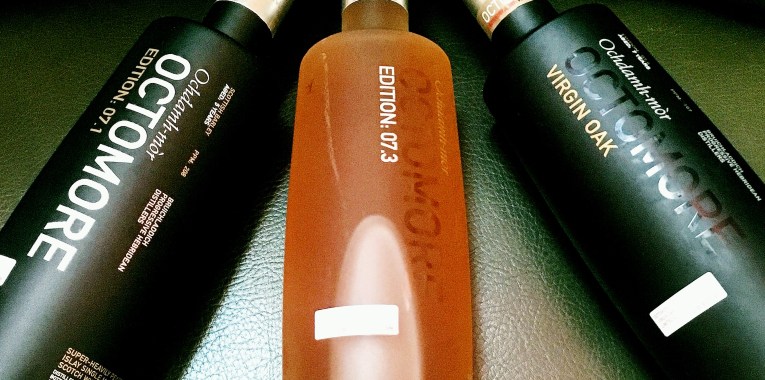
 The Octomore line sails in from the shores of Islay and the Bruichladdich distillery. Bruichladdich is old history with a new face with that spirit of this spirit running right back to its earliest days. When the distillery was founded in 1881 it was the height of modernity. A state of the art facility, especially when compared the distilleries on Islay at the time which were often just converted farm houses. Built right on the shore with uniquely tall and narrow necked stills the distillery managed to survive when many others failed. At least until 1994 when it was mothballed for being ‘surplus to requirements’.
 The Octomores are some of the most heavily peated whiskies in the world. Their phenol content (the scientific way to measure peat) have been as high as 238 but even in their “standard” range they are three times as peated as a Laphroig. Yet, even with all this smoke, and being bottled at cask strength, they avoid being one dimensional. They are sea salt air tinged with smoke and a threat of rain in the air once the sun has set while I’m reading by the fire.
 Bottled In Bond LA