Whiskey Wednesday: Dry(ish) January

On January 16th, 1919 Nebraska became the 36th of the 48 states that composed these United States of America at the time to ratify the 18th Amendment thus beginning the “noble experiment” that was Prohibition. While Congress didn’t ratify the Amendment until January 29th, and the sale of alcohol wasn’t made fully illegal until January 20th, 1920, it was this date and this vote that set us inexorably down the dry path. And every “Dry January” I’m reminded why I so fundamentally disagree with that decision.

This year over 4 million Americans, including myself, are participating in Dry January, a self inflicted month long Prohibition. After the often booze soaked holiday parties, family visits, and New Year’s parties it makes sense that many people would be feeling the hangover and want to start the New Year with a clean slate. Advocates of Dry January point to increased energy and better sleep, as well as claims that a month long absence of drinking can help reverse some of the damage done by long term drinking. Yet despite these benefits I find myself nearly every day saying “Dry January is dumb.”

I grew up Catholic. Once a year, during Lent, everyone I knew would give up one “vice.” It was usually something absurdly innocuous like candy or soda, but there were a fair amount of people in my community that would go sober for the season. However what I noticed about myself and the people around me, was that this was less of a sacrifice or abstinence but more of an obligation. We weren’t giving up these habits because we were looking for change but rather the illusion of self gratification.

It is self reflection, rather than self prohibition that I would argue for.

As the days ticked down the forbidden substance became more alluring until finally on Easter there was an explosion of indulgence. Children who had been starved of sugar for a month were given literal baskets of candy, those on diets were treated with a feast at Easter Brunch, bottles of wine were cracked, beers were popped, and the spirits did flow.

Now don’t misunderstand, I fully support the idea of self improvement and of examining one’s own personal relationship with their vices and habits, especially when it comes to alcohol, but the self reflection needed for true understanding and growth always seemed lacking from these yearly rituals. People were controlled by the absence of their vices nearly as much as they were beholden to those vices.

I’ve noticed this in my own experimentation with Dry January, which if I’m being honest is really just more of a “Drier” January. This isn’t from lack of will power either, it simply because life is complex, which has always been: a much needed long weekend in Palm Springs with the girlfriend called for a few martinis over a steak dinner, a celebratory dinner at a cocktail competition deserves a communal toast, a complimentary upgrade to first class on a flight cross country nearly demands a glass of wine, and that’s just the first two weeks of the year.

I’ve found myself in these situations actively denying myself from participating in moments of community because of a hardline rule about that is ostensibly about improving my life. And I have learned from my time sober. Particularly, I enjoy realizing how much casual drinking I participate in, and noticing how much even a single drink effects my body. It’s also thrown into focus those times where a drink feels warranted and I’ve deliberately made decision to partake in those communal experiences without feeling like I’m betraying the ideals of my time sober. Yet I have remained dry on more days than I’ve been wet, and it’s a choice I want to make every day.

It is this self reflection, rather than self prohibition that I would argue for.

Instead of “Dry January” might I suggest the “Deliberate Year”

The proponents of Prohibition argued that it would reduce violence, organized crime, promote public health, and generally improve the morals of the country. History proved them pretty drastically wrong primarily I believe because people had no choice. People were not choosing to reduce their consumption to increase their “overall moral character” but were being forced into it, in the same way my family and friends felt obligated during Lent, and over 4 million American’s feel locked into a New Year’s resolution.

I’ve always argued that going dry is untenable because there’s this dinner coming up, or this trip happening, or a myriad of other excuses but that paints a picture to starkly in black and white. It’s what happens in the grey spaces between where change can happen, because there is nothing wrong with raising a glass for a thoughtful reason. So, instead of “Dry January” might I suggest the “Deliberate Year” where we take the time to examine why we want something, why we derive pleasure from it, and adjust our relationship with ourselves rather than our vices.

Sounds exhausting doesn’t it? I think I need a drink…

Whiskey Wednesday: Repeal Day

With all the excitement, food, and celebrations that are crammed into the space between Thanksgiving and New Year’s Day you can be excused for not noticing that noted scoundrel and always bartender Jeffrey Morgenthaler managed to squeeze a completely new holiday in there: December 5th, Repeal Day.

Repeal Day is the Hallmark Card Holiday of the booze world.

Repeal Day marks the anniversary of the passing of the 21st Amendment to the U.S. Constitution on December 5th, 1933. The 21st Amendment acknowledged that the previous 13 years of alcohol prohibition were in fact a terrible idea. It reinstated the constitutional right of every man and woman (of legal drinking age) in these United States to raise a glass in celebration, in mourning, or simply because its Happy Hour damn it. Wander into any “serious” cocktail bar on December 5th and odds are you’ll find a whole Repeal Day cocktail menu.

But here’s the thing, Repeal Day is the Hallmark Card Holiday of the booze world.

Hindsight, even when drinking, is still 20/20. Through the lens of history it is easy to see that Prohibition was an outright failure but its repeal brought its own host of issues that still reverberate 85 years later.

According to proponents like Molly Hatchet, Prohibition was going to reduce drinking, reduce domestic violence against women and children, reduce crime AND cut government spending. That’s a tall glass that never got filled.

Spending, taxes, and crime, especially organized crime, all took an uptick. People actively flaunted their lawlessness to the point that a wealthy Prohibitionist by the name of Delcevare King sponsored a contest to create an appropriate word to describe these “lawless drinkers.” The winning word was independently submitted by two different people and the term Scofflaw was born followed shortly thereafter by a mixed drink of the same name.

Prohibition broke bartending…And then even worse for the profession of bartending, Prohibition ended.

Prohibition also indirectly gave birth the Federal Income Tax. Before Prohibition 30-40% of the Federal budget was generated from taxes on alcohol. A Federal Income Tax was technically un-Constitutional and needed a Constitutional Amendment to make it legal. The 16th Amendment legalizing the Federal Income tax was passed in 1913 with direct help from Prohibitionists.

I also feel like it caused a cultural disconnect. Every civilization has learned to ferment and distill eventually developed their own native spirit and their own drinking traditions to go with that spirit. These traditions are passed from parent to child and a respect for alcohol becomes a part of everyday life. Prohibition pushed alcohol into the dark, demonized it yet also made in alluring. You can still see this destructive relationship play out in our modern binge drinking habits.

On the other hand, we are a nation of immigrants. A hodgepodge, mish mash of different cultures and booze. Maybe Prohibition just sped up the naturally occurring separation. The Italians know how to drink amaro, the French know how to drink brandy, and the Scandinavians know how to drink aquavit but what the hell does the English colonist do with any of those? The art of mixing drinks is a distinctly American art and I’ve always believed it had it’s roots in the Irish barman having no idea what to do with the Dutch Genever and the French Vermouth so fuck it, let’s mix it together until it’s delicious.

Which leads naturally into Prohibitions effect on the craft of tending bar. Prohibition broke bartending. While popular culture glorifies the idea of the speakeasy and the great mixed drinks of Prohibition the truth was that while people drank gallons at speakeasies what they drank was terrible.

Before Prohibition bartending was a skilled and respected trade. Bartenders would apprentice and learn their craft just like any other skilled tradesman. Now and entire profession was made illegal and those that knew how to bartend moved overseas and taught the rest of the world how to mix drinks.

For 13 years the trade languished with no one to train the next generation and basic skills and knowledge was lost. And then even worse for the profession of bartending, Prohibition ended.

Scofflaw:

2 oz Rye Whiskey

.5 oz Dry Vermouth

.5 oz Grenadine

.5 oz Lemon

2 Dash Orange Bitters.

Shake with Ice, Double strain into a Sour Glass

The moment selling booze was legal again everyone wanted to open a bar, which means you need bartenders. The old skilled tradesman had moved on. There were no young professionals so it became a job for amateurs. The end of Prohibition was arguably the worse thing that could have happened to the American “mixology” tradition. 80+ years later and the professionalism that was taken for granted is still viewed as aloof or fussy today.

And all of this is before we even get into the how the disruption in alcohol production eventually to lead watered down, blended whiskies and eventually the rise of gin and then vodka over the US’s own native spirit: Bourbon. A cascade effect that changed how an entire culture drank. Prohibition and the compromises that needed to be made to for its repeal still shape how, where, and what we drink to this day. (Not to mention the abhorrent three-tiered system.)

Yet, because of Repeal Day I’ve had steady, good employment for most of my adult life and have gotten to travel the world all because I can but booze in a glass in a way that makes other people want to drink it.

So, should we be celebrating? Absolutely. But when you find yourself saddled up to the bar this December 5th ask yourself, are you celebrating some mythological golden age through boozed tinted glasses? Or are you celebrating the triumph of personal freedom and rational thinking? Either way, once you’re done with the inevitable brand-sponsored Old Fashioned throw the barkeep a curve ball and see how good a Scofflaw they can make.

History Along the Knob Creek 2001

History is tricky. It’s written by the winners and often overly romanticized by the survivors as they remember the good and forget the bad in the harsh light of present difficulties. And when you throw alcohol into the mix things can get even murkier. Take the modern obsession with all things Pre-Prohibition. From the style of the bar, to the bartenders uniforms, to the whiskey being poured, at every step of the road the booze industry is proud to be returning things to their turn of the century glory.

Yet, despite the romance of Prohibition speakeasies and Pre-Prohibition style and quality, that “style” and “quality” was all over the map. The quality issue was first addressed with the Bottled In Bond Act of 1897, but even though the term “Bourbon” being used as early as the 1820’s, what made a whiskey a “Bourbon” wasn’t truly codified into law until the Bourbon Act of 1964. So what they hell does “Pre-Prohibition style” even mean? Unregulated? Undefined?

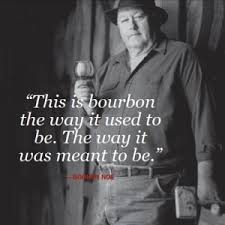
While this elusive style might not mean anything on its own it can serve as inspiration. And if anyone should have an idea of what Pre-Prohibition whiskey tasted like Booker Noe would have been the one. The grandson of Jim Beam and the Master distiller at his grandfather’s distillery since the 60’s, Booker’s pre-Prohibition inspired bourbon, Knob Creek, rolled out in 1992.

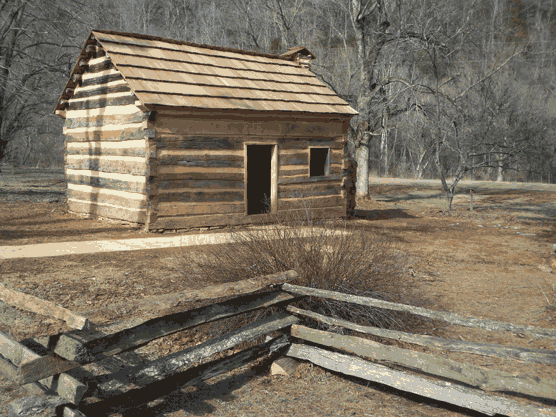
log-cabin-KC.gifNamed after the stream that ran along Abraham Lincoln’s childhood home in Kentucky, the bottle was modeled after turn of the century apothecary bottles with the label inspired by the tradition of wrapping bottles in newspaper at the distillery. Knob Creek was originally an age stated 9 Year Old bourbon bottled at 100 proof. The age statement has been dropped in the past few years but the brand still claims extra aging compared to the companies other small batch whiskies. So in this case pre-Prohibition style would seem to mean longer aged and higher proof, which is almost the exact opposite of what those early whiskies would have been.
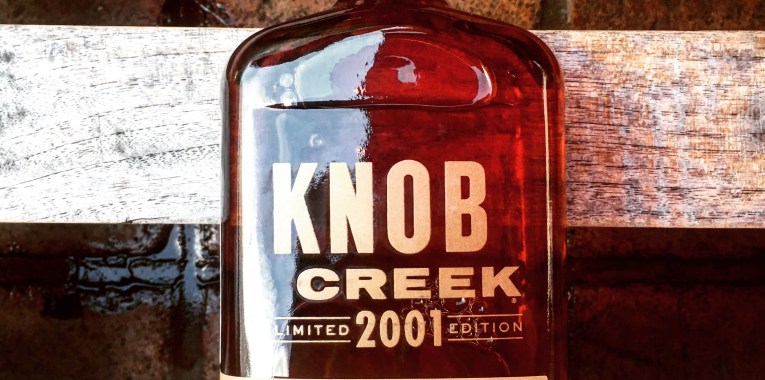
Knob Creek was one of Booker’s babies. He continued to oversee the brand until he continued another family tradition and handed the title of Master Distiller and production of the brand over to his son Fred Noe in 2001. Which is how we ended up with the aptly named Knob Creek 2001 Limited Edition.

The Knob Creek 2001 was made from some of the last barrels ever laid down by Booker and then finished by Fred. It’s a passing of the torch in bottle form. And this excited the Bourbon nerds, understandably so. The other bottling to come out of the last of Booker’s barrels was last years Booker’s Rye, which turned a lot of heads and was named Jim Murray’s Whiskey of the Year. Those are some big shoes to fill.

images.jpgWhat set the Booker’s Rye apart was the age and a unique mashbill. The Knob Creek 2001 certainly has the age, at 14 years old it clocks in a good five years older than the old 9 year, but there’s no variation on the mashbill, simply different batches. This leaves a through line connecting it to the standard issue Knob Creek because no matter what batch you pick up all of these bottles are unmistakably Knob Creek: powerful, with pistachio, walnut, sweet oak and that unmistakable Jim Beam yeast.

As for the differences, Batch #1 dials up the vanilla, caramel, and maple leaving the middle of the palette sweeter with the barrel and age showing up again on the finish. Batch #3 goes the opposite way with massive, dry tannin, heavy oak, and extremely dry mouthfeel. Batch #2 walks the line between the other two rather well.

In the end this is just bigger, larger, and older Knob Creek. That’s not necessarily my cup of tea but as a changing of the guard it makes sense. Booker was a larger than life figure in the Bourbon world and his impact on the modern industry is arguable as big as his grandfather Jim’s. To me whiskey is bottled time, bottled history. And this bottle is a touch of liquid history. Only time will tell how big a piece of history it really is.