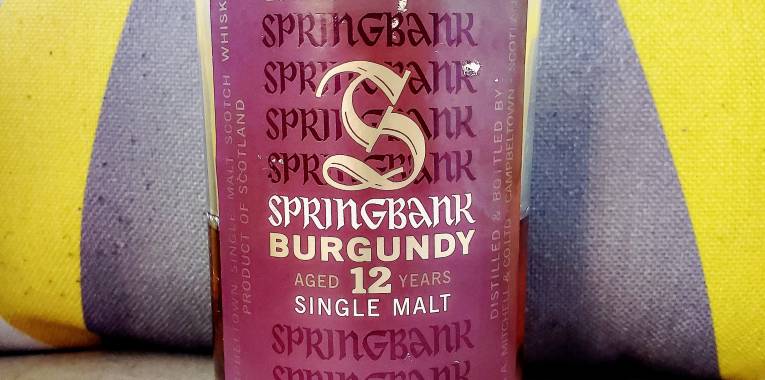
Quarantine Bottle Kill #3: Springbank 12 Year Cask Strength Burgundy

Springbank has always been a fascinating distillery to me. I intellectually love them. They are one of the last great Campbeltown distilleries. Located on Kintyre Peninsula, Campbeltown was once known as “the whisky capital of the world” with 28 distilleries packed into its borders. Today a measly three remain with one of them, Glengyle which produces Kilkerran, only releasing a single malt again starting in 2012.

All of this is to say that there is no Campbeltown “style” but when people refer Campbeltown style they are almost inevitably referring to the Springbank style. Especially since Springbank produces three distinct single malt brands: Longrow (peated), Hazelburn (triple distilled), and the eponymous Springbank.

What’s interesting to me is that the standard Springbank Single Malt isn’t particularly interesting to me. Love the history of the region and I love the nuances that make it a distinct malt but it’s never something I needed to keep a bottle of on the shelf. The Wine Cask finishes however are a different story.

Springbank releases a special edition 12 year old cask strength once or twice a year. These are usually met with great acclaim but the ones that truly peak my taste buds are their wine cask finished releases. The subtly and creaminess of the standard Springbank style plays wonderfully with the tannin and juiciness added from a used wine barrel. There’s also less of the sweetness that is associated with sherry or port cask finishes. Where sherry and port can often become the defining characteristic of a malt, here the red wine melds into the base flavors creating something larger than the sum of its parts while not overwhelming any part of it. 

These bottles tend to sit on my shelves begging for a special occasion and now every night ends up as a special occasion so let’s pour out this 12 Year Old Burgundy Cask.

This special release was bottled in 2016 at 107 proof after being aged in 1st Fill Burgundy Barrels and is everything I love about these style of releases from Springbank.

NOSE: Golden Raisin, Raspberries, Black Currant, Vanilla

PALETE: Plum, Apricot, Sea Salt, Leather, Honey, with a massively creamy mouthfeel

FINISH: Long, dry, slightly peppery, and a lingering oak

This is a truly breathtaking bottle. Literally, the proof, the flavors, the mouthfeel take my breath away on the first sip everytime I come back to it. And now it’s time to take the bottle away. Another sacrifice to social distancing.

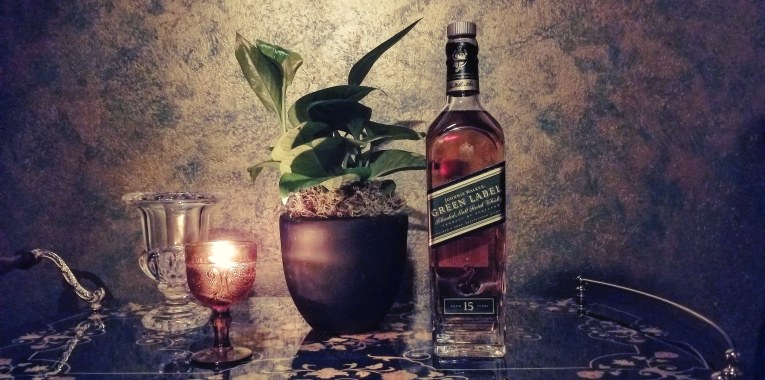
Whiskey Wednesday: Hitting Johnnie Green’s Stride

Johnnie Walker is a striding behemoth, straddling the world as the number one selling Scotch whisky brand. It’s so popular that “What makes Johnnie Walker Blue the best?” is a Google search autocomplete. It’s so popular that due to knockoffs and literal bootlegs there are more bottles of Johnnie Walker Black Label sold in India every year than are actually produced for the entire world.

            With this level of popularity the level of disdain and outright backlash for Johnnie Walker that abounds is almost inevitable. Something so popular could never actually be good. Yet, amongst its vast palette of labels there abides a quality and constancy that’s earned its place on back bars across the globe. It also contains one of my all time favorite colors and bottles: Green.

            Johnnie Walker, the Scotch Whisky, began its long walk in the 1819 when the father of John Walker, the actual Scotsman, died. The family sold their farm and invested in a grocery in Kilmarnock, Scotland in 1820. Grocery stores were a different breed in the 1800’s and many grocers would make their own house blends of whisky. This became much more prominent after the Excise Act of 1823 deregulated many of the laws on the distillation of whisky and more importantly greatly reduced the taxes on distilling and selling. In short order the teetotaling John Walker was selling his own blended malt whisky called Walker’s Kilmarnock Whisky. John passed away in 1857 leaving the company to his son Alexander Walker who would usher in the beginnings of the company’s global dominance.

This rise in popularity began with another act completely outside of Alexander’s control, the Spirit Act of 1860. For the first time it was now legal to blend malt and grain whiskies together, thus creating the blended whisky style that is the core of Johnnie Walker, as well as the vast majority of worldwide Scotch sales.

Alexander also took advantage of the newly arrived railroad to make connections with shipping captains to create a larger distribution network. This expanded shipping reach combined with a more approachable, lighter style of Scotch whisky literally made inroads with new drinkers.

            The increase in global shipping also led to the development of the iconic square bottle in 1860. The square shape allowed more bottles to fit in the standard shipping containers as well as greatly reduced breakage during transit. Alexander was also responsible for tilting the label at its jaunty angle across the bottle allowing for larger print as well as making the bottle more recognizable from a distance.

            It was the Third Generation of Walkers that added the final touch with a rebranding in 1909 that first saw the “Striding Man” added to the labels. They also had the companies three blended whiskies officially renamed to White Label, Red Label, and Black Label. The White Label was dropped during World War I but the Red and Black remain the core of Johnnie Walker to this day.

            With demand for Johnnie Walker Scotch spread across 120 countries the company began purchasing single malt distilleries to ensure  consistent supply and blends.  Beginning with Cardhu in 1893, they followed it up with the Coleburn Distillery, The Clynish Distillery and Talisker, before capping it off with the legendary Mortlach Distillery in 1923. Then in 1925 the company joined Distiller’s Company, which was purchased by Guinness in 1986, which then merged with Grand Metropolitan in 1997 to form Diageo, the largest liquor conglomerate in the world. 1997 is also an important year because it marks the reintroduction of Blended Malt Whisky to the Johnnie line up. Originally called Johnnie Walker Pure Malt my favorite bottle received its chromatic designation as Green Label in 2004.

            In a lot of ways the Green Label is a return to that very first John Walker blend. Being a blended malt it is comprised of completely single malt whiskies, which means none of the grain whisky that Alexander introduced and the helped spread the brand across the globe. Diageo is vague on the specific details, listing it as a blend of malts from the Speyside, Highland, Lowland, and Scottish Isle malts which is essentially saying it’s made up of Scotch from Scotland. But digging deeper you can find the names Cragganmore, Linkwood, Caol Ila and Talisker as the primary malts. It also carries a 15 year age statement, meaning the minimum age of every malt in the blend is at least 15 years old, making it one of the oldest constantly available Johnnie Walker blends.

            In a lot of ways this blend is at the root of Johnnie Walker’s history which is why it’s so surprising to me that it’s always felt like the redheaded stepchild of the family. It was “discontinued” in the Western markets around 2012 with plans to focus the brand in Asia. A massive shift in Chinese regulations brought the brand back globally in 2016. Yet it is still often passed over, ironically, because it isn’t as ubiquitous as the Black and Blue.

            Or maybe it’s a victim of Johnnie’s success. The sun never sets on the empire of Johnnie Walker yet it is an empire built on that addition of grain whisky to its single malt base. It’s a lighter style with more mellow flavor and the Green is rich and almost overly opulent in comparison. Someone who enjoys Black label might not find the Green to be their cup of tea. On the flip side the type of drinker that would truly love an aged-stated, blended malt is probably also the kind to turn up their noses at the mere mention of Johnnie’s name.

            Or maybe it’s that people still don’t truly understand what a blended malt is. It’s a misunderstood style just like Green Label is a misunderstood bottle. But the fact that it is so misunderstood and overlooked just makes it all the more endearing to me. I’ll gladly quaff a dram when I can find it.

NOSE: A light touch of seaside smoke, vanilla, dry oak and baking spices

PALETTE: Decadent and rich. Raisins, dried plums with a touch of that seaside air and a whiff of sherry. Slightly nutty, with a bright mid palette.

FINISH: A relatively quick, clean finish that leaves a lighter impression that the rest of the experience. It ends with lingering oaky sweetness mixed with a hint of smoke.
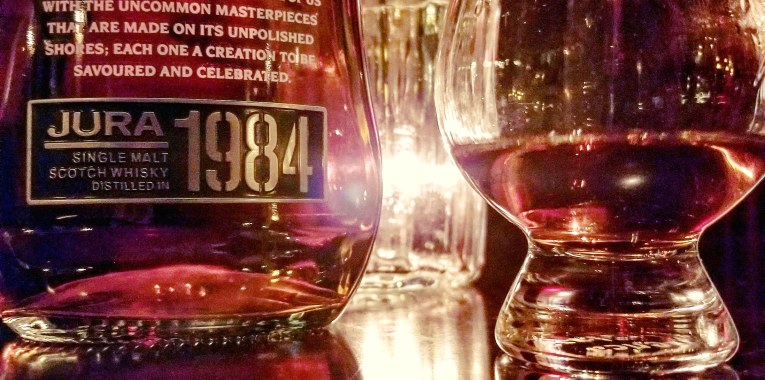
Open Bottle: Nineteen Eighty-Four JURA

“Who controls the past controls the future. Who controls the present controls the past.”

Released in 1949 George Orwell’s masterpiece Nineteen Eighty-Four often feels as alive and resonant as it must have when it was first published. Reading the headlines it feels like doublespeak, Big Brother, and New Speak have leapt from the lexicon of the theoretical into the mundanely of reality.

What was once meant as a cautionary tale has instead become the blueprint for how entire organizations operate.

The world has become vastly interconnected since 1984 and people are starting to realize how small a piece of the global whole they actually are. Some have risen to the challenge and sought to make their corner of that cold, distant expanse warm and welcoming. The seek to grow their communities.

Others, however, have become jealous of their small portion and rather than growing they shrink. They shrink from responsibility, from compassion and not only do they personally shrink they seek to diminish the world around them. To force the world to be smaller, leaving no room for those that are different or for those who seek an equal share in the world in which we must cohabitate.

Not exactly light, whisky sipping, thinking but these are thoughts that are constantly on my mind these days and were brought into sharp focus when presented with a dram of Jura’s 1984 Edition.

The Isle of Jura lies off the North-East shore of Islay, has one road, one pub and one distillery, the eponymous Jura. Orwell described the island as “extremely unget-at-able” which remains very true to this day. It was at the “unget-at-able” locale that Orwell wrote the bulk of Nineteen Eighty-Four while incredibly ill with tuberculosis fro 1947-1948. It’s this act of creative output that Jura is honoring with the 1984 Edition.

Casked in 1984 and bottled in 2014 this 30-year-old single malt was aged in ex-Bourbon, Amoroso (cream) sherry, and Apostoles Oloroso sherry casks. Only 1,984 bottles were released world wide making it a rather limited release. This is a lot of attention to detail to pay homage to an event that happened when the distillery didn’t exist.

The distillery was built in 1810 but fell into disrepair at the end of the 19th century. It wasn’t rebuilt and operational again until 1963. So there is clearly a bit of a marketing gimmick tied into this release, which is nothing new to the spirits world, and unlike most gimmicks this whisky is a phenomenal product.

NOSE: The nose is rich, redolent in those sherry aromas with nutmeg, dark dried fruit, raisins, and a noticeable touch of the sweet.

PALETTE: Deep cherry and candied orange peel. There’s also a hint of roasted peaches with a large dollop of honey and, of course, oloroso sherry.

FINISH: The dram has a medium finish that lingers with a surprising amount of spice for how sweet it starts, leaving the dry baking spices and a touch of dessert.

I don’t care what your marketing angle is as long as it’s true and the product is good. And this product is exceptional. The story being crafted is a bit forced but it is also clearly the result of a small community taking pride in its past and continuing to build for its future.

It is perhaps unfortunate that Orwellian thoughts float through my mind while sipping on this malt but then again the age that we live in requires us to be active participants in the world around us, even when just sipping on a whiskey.

Education is the best tool we have to enact change and I, for one, would not have known that George Orwell wrote Nineteen Eight-Four on Jura with out this bottle. With out this bottle I wouldn’t have spent a week researching and reflecting on the themes of a book I haven’t read since high school. Not only was I researching but I was also reexamining these themes in the light of the modern world and my adult experiences.

We must stand up, we must think for ourselves and not simply walk the party line. We must not become orthodox for, “Orthodoxy means not thinking–not needing to think. Orthodoxy is unconsciousness.”


P.S. VOTE