Drinking Poetic: The Banana Dance

I’m prouder of the Banana Dance than almost any other drink that I’ve created. More so than I probably have any right to be. It’s an esoteric, nerdy, centrifuge requiring, relatively prep heavy drink that is ultimately delicious, complicated, and easy to batch and execute in a way that belies its complexity. Its evolution is also a damn good microcosm of my personal journey behind the bar in the past few years. 

The Banana Dance began life as the Josephine Baker as an entry for Diageo’s World Class competition three years ago. I had entered my very first competition the year before, a little competition known as World Class and having made it to the Western Regionals I was determined to make it back and prove myself. Prove that I wasn’t just some beach side Santa Monica bartender slinging Vodka Soda’s all day long. I certainly had a chip on my shoulder when I was younger. 

For my entry the following year I looked at the spirits available and decided that I wanted to play to my strengths with a stirred drink and ended up riffing on the modern classic the Chet Baker.  I knew the base was going to be Ron Zacapa Centenario and I wanted a drink name, and a flavor profile, that would compliment the story and flavors of the rum. Enter Josephine Baker. 

Josephine Baker

Josephine Baker was an African-American ex-Pat who rose to fame as a dancer and performer in Paris in the 1920’s. Earnest Hemingway once called her, “the most sensational woman anyone ever saw.” While being a multifaceted performer her most famous act, and photos, are of her dancing in a banana skirt. Josephine was more than a performer though. During WWII Josephine used the freedom granted to her as a performer to spy for the Allied troops and help smuggle refugees out of France. She was also incredibly active in the American Civil Rights movement later in life. Pairing this phenomenal woman’s story with a rum crafted by one of the few female master blenders in the world was a no brainer. 

Too add to that the Giffard Creme de Banan had just be released which provided a perfect flavor, and thematic, compliment to tie the two together. Add in a little amontillado sherry and a passable Old Fashioned style variation on the Chet Baker was born. It was serviceable but unfortunately didn’t make the cut leaving me out of the competition that year. I knew there was something special in there though and couldn’t let the idea go. 

The next year I ended up using some discretionary income to help fund Dave Arnold’s kickstarter for the Spinzall tabletop centrifuge because, well, I’m a nerd. I had already been experimenting with every technique that I possible could from Liquid Intelligence and had voraciously devoured every technique book I could get my hands on. I was actively experimenting with melding flavors in every way that I could. However, there were two pieces of technology that seemed like they would forever bne outside my reach: the rotovap and a centrifuge.  Now here was one of those unicorns just sitting on my kitchen counter. I went nuts. 

I played with infusing and clarifying everything but one of the most successful experiments was that original pairing of Sherry and banana. It was a relatively simple process, slightly overripe bananas were blended/ together with sherry and Pectin X and the resulting smoothie was run through the Spinzall clarifying the mixture. Here phenomenal fresh banana flavor married perfectly with the sherry with out adding any unnecessary sweetness like other creme products.  

The experiments took a hiatus however as I joined Team NoMad as one of the opening Bar Managers for NoMad LA. The training, translating and entire hospitality culture from NYC to LA, and opening four separate venues in a single building consumed my and my team’s attention for months. It was in this period that I also learned to collaborate in a way I never had before.  

Not only was this team larger than any I had ever worked with before, it was also the most talented. And while I was a leader this was not a program that was about me or my force of personality as so many venues I had worked on in the past were. This was about the guest experience and about working as a team to create the best product and experience possible. It was demanding, meticulous, and honestly exhausting. The light at the end of the tunnel was R&D. 

I love doing drink R&D. I love throwing things at the wall to see what sticks, I love creating crazy ingredients, and I love what seeing other people do with those ingredients. Once we were in a place to start R&Ding drinks specifically for LA I dove in head first. But you never walk into a R&D session with out a concept. The drink hiding up my sleeve that seemed to most fit this NoMad model I had learned was the Josephine Baker, updated with the new clarified Banana Sherry of course. 

If you check the NoMad compendium they make phenomenal drinks. They also rely heavily on sherry and a lot of small culinary touches. This comes from the collaborative R&D process as well as the fact that NoMad bar was birthed out of the bar at Eleven Madison Park which is absolutely driven by the mentality of its award winning kitchen. 

This was going to be the first time putting any of my drinks through this culinary tasting style with a group of incredibly talented, and opinionated, peers. I’m still amazed to this day how the process can create a drink that is both unrecognizable from the original yet still wholly in the same spirit and design. 

The first thing that became clear was that style of sherry needed to be dialed in. We quickly moved away from the darker amontillado in favor of an oloroso which left more acidity with the banana. The Banana Sherry was a crowd favorite and we decided to make it the star of the show. The banana sherry became the base of the drink instead of a modifier. 

To add back in some of the richness that the clarification process had stripped out of the sherry we turned to another classic NoMad ingredient, Brown Butter Falernum. Essentially a brown butter washed Velvet Falernum that add in baking spices, a rich mouth feel and tied back into that original idea of bruleed bananas and sherry that had inspired the flavor pairing. 

Finding the right balance was tricky because the Falernum can easily overwhelm. As a through line between the Sherry and the Falernum was added Blanc Vermouth. A touch of bitter to go with the vanilla that lengthened the flavors. It wasn’t quite bitter enough so a quarter ounce of Punt e Mes was also added to round out the effect. This firmly moved the drink out of the Old Fashioned style and into the Manhattan style, a subtle but important distinction. 

At this point I gave into my true desire to make every drink a whiskey drink and pulled the Zacapa and subbed it with Greenspot Irish Whiskey. This Pure Pot Stilled Irish Whiskey is aged in New American Oak. It has an intrinsic bright green banana note as well as the barrel tannins to be a base for all of these complex flavors to stand on. 

At this point the drink was good but the culinary drive for perfection kicked in and we went through countless more variations. The difference between them being a teaspoon of this versus a dash of that. The final touches were a teaspoon of Walnut Liquor to bring a bit more tannin and a nuttiness to compliment the banana as well as a teaspoon of Verjus Blanc to add in a hint of acidity to cut through all of the rich fruits and fats. 

The drink was now a lovely fruit forward, complex, surprisingly dry, low ABV stirred drink that still had enough depth and tannin to stand on its own as well as pair with food. It was a real crowd pleaser while still being esoteric and weird. It was my kind of drink. It just needed a garnish and a name. 

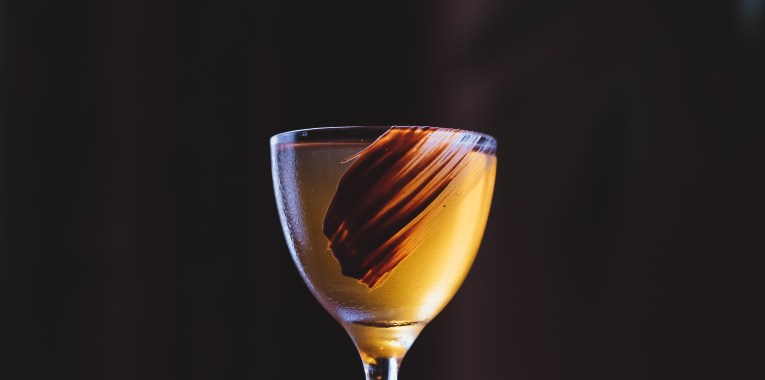
The garnish was easy. While I personally love an incredibly dry drink I know not everyone does. And the drink ingredients could read sweeter than the final product. So, to appease both types of drinkers a single brush stroke of chocolate ganache was added to the outside of the glass. This allowed the guest to choose their own adventure. If they wanted the drink slightly sweeter they could indulge in the chocolate or leave it alone. It also ads a look of elegance has an elegance that can sit just at the tip of the lips. 

The name quickly followed. While the drink had come miles and even years from its roots with Josephine her spirit, her dance, still infused every ounce of this drink and thus it was christened the Banana Dance. 

I love this drink. I think that the prep needed for it is relatively small considering the final product. Especially for the Banana Sherry. I was fortunate enough to finally utilize a version of this drink, with the Banana Sherry and Zacapa, at the World Class National Finals this past year bringing the drinks journey full circle. 

I’ll never create a drink that’s a modern classic but I hopefully will create things that inspire people and tickle their imagination. The NoMad just published a brand-new cocktail book and while sadly the Banana Dance didn’t make the cut the Banana Sherry did. Bright and bold at the top of the ingredients section is the recipe for Banana Sherry. 

Hopefully this little dance will continue to inspire people not only in my extended NoMad family but the entire cocktail community that has embraced me and given me so many opportunities this past decade. 

Photo Credit: Jordan Hughes
@highproofpreacher

The Banana Dance:

1.5 oz Banana Infused Oloroso Sherry (Preferably Lustau)
.5 oz Greenspot Pure Pot Still Irish Whiskey
.5 oz Blanc Vermouth
.5 oz Brown Butter Washed Velvet Falernum
.25 oz Punt e Mes
Tsp Verjus Blanc
Tsp Nocino

Combine All ingredients in a mixing glass.
Short stir with Kold Draft Ice.
Strain into stemmed cocktail glass painted with a chocolate ganache brushstroke.

Banana Sherry:

750 ml Oloroso Sherry
3 overripe bananas
3ml Pectin X

Blend all ingredients together.
Into the Spinzall spindle add 375ml and set to continuous mode.
Once the centrifuge reaches full speed pump the rest of the mixture in at 80ml/minute. The should run clear.
Once all liquid has been pumped into the centrifuge let it run for another 5 minutes then power down and strain the remaining liquid through a chinoios.
Bottle and store under refrigeration for up to three (3) weeks.

Brown Butter Falernum:

750ml Velvet Falernum
.5lbs unsalted butter

Cube butter and place in pot over medium heat. 
Melt and constantly whisk butter so that milk solids brown evenly
Continue to brown, whisking constantly, until as dark as the color of an almond skin
Remove from heat, and add velvet falernum
Transfer to cambro and place in freezer until the fat has risen and solidified on the top 
Remove solidified fat cap from top and discard
Bottle and store under refrigeration for up to one (1) month

Whiskey Wednesday: The Darkest (Bowmore) Timeline

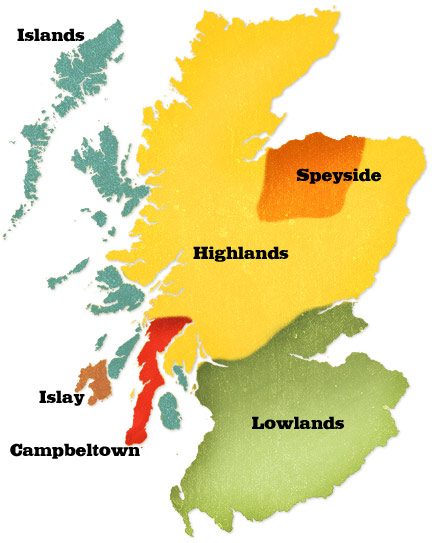
Remember when the regions of Scotland were a thing?  Highlands, Lowlands, Islands, Campbelltown, Speyside, and Islay? For years brand ambassadors and whisky makers preached the golden gospel of the distinct styles of the six regions of Scotland.

ey-region-map

The first problem a lot of people see with this list is that three of the regions are technically just small regions of the other three. Speyside is part of the Highlands, Campbelltown is part of the Lowlands, and Islay is very much an Island. If these three places can have their own unique style why can’t the plot of land down the road have its own style? The truth of the matter is that style is more about the distiller and blender than anything to do with the arbitrary geographical location.

Let’s look at Islay, quite possibly the most distinct and memorable Scotch style. The mere mention of the word Islay causes people’s tastes buds to shiver at the onslaught of peat, smoke, and saltiness of the most famously peated Scotch’s in the world. Yet many of the whiskies coming off the island are completely unpeated. Bunnahabhin is very famously unpeated. Everything coming out of the Bruichladdich distillery that is bottled as “Bruichladdich” is currently unpeated. They have to save up all that smoke for the Octomore. Even amongst the “peat bombs” there is a massive variety of style for such a tiny island.

Lagavulin is like a misty, damp marshland while Laphroig is like a dusty campfire and The Octomore is like smoke gently resting on the briny salt air. And then somewhere in the middle of all this is Bowmore.

Founded in 1779 the Bowmore distillery has been in continual operation except for a brief pause in the World War II to host the RAF Costal Command. It’s never risen to the same height of fame as say, a Laphroig, but they consistently put out great whiskey that seems to walk the line between the styles and practices other distilleries are doing with more flash.

They’re sourcing a good portion of their barley from Islay, similar to Bruichladdich, and they’re giving a the whisky a healthy dose of peat, just like the island island is known for, but they’re also throwing in a fair amount of Sherry barrel aging which is more commonly associated with those Speyside malts on the other side of the country. The Bowmore 15 “The Darkest” hits all these notes perfectly.

It is a 15 year old single malt aged in ex-Bourbon and Sherry barrels for 12 years. The malt is then married together for three years in Olorosso sherry cask that imparts a deep color and melds a gentle smoke together with raisins, dried cherry, and stone fruit with a touch of saltiness and a note of bitter chocolate on the finish. It’s a bottle that can be enjoyed by lovers of peat and lovers of Sherry. Or by lover of Islay or lovers of Speyside malts.

We like easy boxes and categories to help define what we like and don’t like. But just like any complex creation style isn’t about where you come from. It’s about what you make of yourself.

Whiskey Wednesday: A’bunadh, Aberlour A’bunadh

Bigger is always better right? Just like the old fashioned way is the best way. Or at least that’s what Aberlour has been banking on the past two decades with their A’bunadh releases.

Despite a history stretching back nearly 140 years Aberlour still feels relatively unknown to the wider world. The distillery was founded in 1879 by James Fleming who built an extremely modern distillery for the time powered by a waterwheel driven by the Lour river . Aberlour literally means “the mouth of the chattering burn” and was supposedly named for the ancient Druids belief that the river actually spoke to them. The water for the distillery is drawn from St. Drostan’s Well, which only adds to the mythic nature of the Aberlour’s waters as the well is named after the 6th century Columbian Monk who supposedly used it as a baptismal site. So, like many Scotch distilleries there is a lot of history, myth, and legend involved.

James Fleming operated the distillery until his death 1895 and then the distillery changed hands over the years, being acquired by S. Campbell & Sons in 1945, before being sold to Pernod Ricard in 1974, who updated and expanded the distillery the following year, finally merging  the former Campbell Distilleries with the Chivas Brothers in 2001.

Aberlour is quintessentially Speyside in style and is double cask matured. Unlike the more well known Balvenie line, the Aberlour line isn’t finished in a second style of oak. Instead, the malt is fully matured in ex-bourbon or Olorosso Sherry barrels and once they are finished aging these different barrel styles are batched together. The proportion varies depending on the interation. The 12 Year is 75% Ex-Bourbon, the 16 year is 50/50, and the A’bunadh is 100% Sherry. And while the general line up of Aberlour might be less known the A’bunadh definitely has a cult following. Though it was first released in 2000 the A’bunadh story actually begins with that distillery expansion brought on by their purchase by Pernod Ricard in 1975.

During construction some workers stumbled upon some an 1898 newspaper with a story about the distillery fire that year, wrapped around a bottle of Aberlour from 1898. The workers who discovered the bottle finished off most of the bottle before guilt kicked in and they turned the bottle over to the master distiller, who immediately sent the remainder off to the laboratory for analysis. The A’bunadh is an attempt to recreate the whiskey in that bottle.

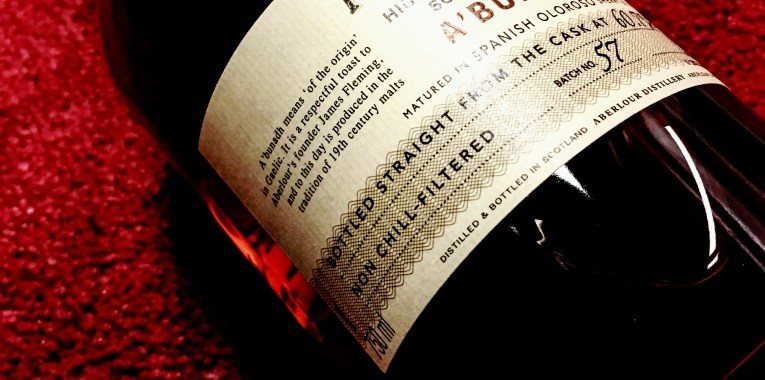
“A’bunadh” means “the original” in Gaelicand if the above story is to be believed this is the style of malt the distillery was making before it’s catastrophic fire in the late 1900s. There is no age statement, each batch is blended together from malts ranging from 5 – 25 years old, is non chill filtered, and bottled at cask strength. It is 100% Olorosso Sherry barrel aged and though there is no age statement , each batch is uniquely numbered allowing whiskey connoisseurs, otherwise known as nerds, to easily track the “best” batches.

2017 saw the release of Batch 58 but I’ve still got a few bottles of the 57 hanging around and it lives up to its predecessors. There is a massive amount of all spice and caramelized orange on the nose. There is a massive amount of that Sherry sweetness, melded with orange, dark fruit, a little bitter chocolate and heavy malt. The finish is long and sustained and with Batch 57 coming in at solid 11.42 proof the mouth is left dry and clean afterwards.

Whether or not the A’bunadh actually is like the original malt distilled at Aberlour is rather irrelevant at this point. It has certainly earned its place in the Single Malt hierarchy and deserves a little more love from those of us not constantly dreaming about our next dram.

Redbreast and the Irish Behemoth

For all the talk of the growth of Japanese whisky and the revival of American Bourbon and Rye the words “explosive growth” can only truly apply to Irish whiskey. This trend shows no sign of slowing down with sales expected to double by 2020. Those are some staggering gains so why doesn’t it get the same kind of geeky love that, say, a Yamazaki does? I’d say it’s because for many of us Irish whiskey isn’t a category. It’s just Jameson.

Irish whiskey has traditionally lived and died with the American market. American Prohibition was so devastating that 400 brands made by over 160 distilleries turned into essentially three brands and a whopping four distilleries. And while you may have heard of John Power and Cork Distilleries what you’ve drunk is Jameson.

You’ve drunk a lot of it. In 2014 Jameson sold nearly 18 million liters in the U.S. alone. It’s closest competitor, Bushmills, sold a paltry 1.3 million. Jameson accounts for 63% of the global Irish whiskey market. It’s a behemoth.

You may be asking, if Jameson is such a monster and there are only four distilleries cranking out all of this liquid then where are all these craft Irish whiskies coming from? The answer is Jameson. Or more accurately Irish Distillers who are the massive Irish whiskey conglomerate.

While on this side of the pond growth is being fueled by the proliferation of “craft” distilleries creating a wide range of diverse products, in the Irish segments growth and innovation is being by the big boys. And let’s not kid ourselves it’s a business decision. Premium and super-premium Irish whiskey sales have grown by nearly 600% since 2002. Which is a much more impressive way of saying no one drank it at all and now they drink it a little. They’re creating their own market, and they’re not doing it for the little guys.

That doesn’t mean it’s bad whiskey by any means. In fact I truly believe that there are Irish whiskies that can measure up to the best in the world. Look at Redbreast. It’s an example of understated elegance. The brand goes back to possibly 1903 but certainly 1912 where it was bottled by Gilbey’s using whiskey sourced from the Bow Street Distillery in Dublin, which was, you guessed it, the home of Jameson Irish Whiskey.

In the 1971 Irish Distillers decided to close all of their Dublin distilleries and consolidate their operations at a New Midleton Distillery in Cork. This lead to a disruption in supply and eventually Gilbey’s sold the rights to Redbreast to Irish Distillers in 1986. It seemed like the end of the brand but it was reintroduced in 1991 still boldly 12 years old. In a whiskey world where age statements and brands are disappearing every month the core Redbreast has never lost it’s age statement. In fact, it’s grown over the years with the introduction of a 15 year, 21 year (which is simply stunning) and even a 12 year old cask strength. Where others are contracting they are expanding.

The latest edition to the family is the Lustau Edition. It’s the same Redbreast formula: Pure Pot stilled, made from a blend of malted and unmalted barley (we can talk about the historical reasons for that later) but rather than just the bit of sherry influence carried on the standard 12 year, this whiskey is finished in first fill Lustau Olorosso Sherry casks pulling all those sherry notes to the forefront. It is rich, creamy, with a dark fruit and fig note wrestling with nougat and candied fruit. It is a lively whiskey.

At first the lack of age statement may seem like a step backwards but this Lustau Edition isn’t replacing anything. The 12 year isn’t going anywhere, this is simply an expansion. It is a way to experience and highlight many of the subtleties that exist in the Redbreast line. It is also an experiment.

Experimenting costs money and Jameson is almost certainly footing the bill on this experimental expansion. Big doesn’t always mean bad, just as craft doesn’t always mean good. Experience is one thing you can’t teach and it’s something that the craft distillery world is going to learn the hard way. The folks at Redbreast have already got it down.