
I don’t like to repeat myself, but the conversation about the Wild Turkey Kentucky Spirit Barrel a few weeks ago got me thinking. While I might not be a Wild Turkey Bourbon man at heart the rye has always tickled my fancy. I’d like to say that it’s simply because it’s damn good whiskey but that hasn’t always objectively been true.
I touched a bit on the history of Wild Turkey with the post of Kentucky Spirit (You can read about that here) but Wild Turkey’s history feels more tied with the pop culture of past decades that almost any other brand except Jack Daniel’s and Jim Beam.
Wild Turke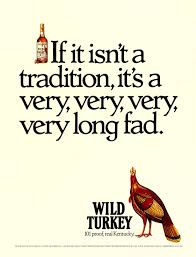 y as a brand was said to originate in the 1940’s when an Austin Nichols executive, Thomas McCarthy, brought some choice whiskey along on a wild turkey hunting trip in South Carolina. Enamored with the samples he brought his friends kept asking for more of “that wild turkey bourbon.” More likely it was a marketing approach to appeal to hunters and the rugged, rustic type but every whiskey loves a mythical origin story.
Turkey also appeals to me because it’s been the favored drink of self destructive writers for decades. Hunter S. Thompson was a known lover, Stephen King mentions it with distinction in a few books, and in his biography it’s listed as the drink of choice for perennial hipster literary icon David Foster Wallace.
Yet throughout all this pop culture iconography it’s always the bourbon they’re talking about. The rye always seems to be the unspoken younger sibling despite, at least from personal experience, it being the bartender favorite.
The Wild Turkey Rye is known as being a “barely legal” rye. At 51% Rye/37% corn/12% barley it meets the bare minimum by law to be considered a rye whiskey. Yet, along with the brand Rittenhouse, it is a rye that kept rye alive in the decades when it was certainly not cool to drink. And it was certainly popular enough that when the 101 proof rye was dropped in 2012 there was enough of an outcry that it was reinstate a mere two years later. And now it might finally have its family champion.
Bruce Russell is the third generation of Turkey Russells and he is the current
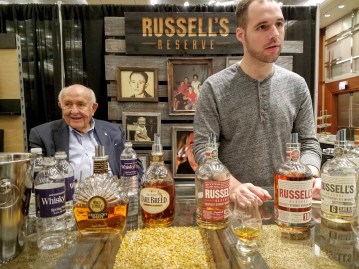
driving force behind their rye, at least their high end stuff. While Jimmy Russell has always been unassuming and focused on the fact Wild Turkey makes two products, a Bourbon and a Rye, his son Eddie and grandson Bruce have championed the expansion of the range arguing differentiation through aging.
The idea that certain spots in certain warehouses yield “honey” barrels is well established in Kentucky whiskey lore even if no one understands why that should be the case. But for Wild Turkey rye that took a new edge with the release of the Russell’s Reserve 6 Year rye and then even more focus with the Russell’s Reserve Single Barrel Rye.
While the single barrel carries no age statement it is clearly considered to be the upper echelon of the Turkey Family Rye. The 6-year was first introduced in 2007, the year after they raised the barrel entry proof from 105 to 115 and four years before the new distillery came online in 2011. This of course means there’s been a fair amount of flux in the production.
The rye itself is a fine example of Kentucky rye. It is all rich tobacco, which makes the old smoker in me shiver, a hint of dill, a full serving of citrus and a baked quality that ties in the darker spices and the heavy vanilla/caramel barrel notes. And it’s bottled at 104 proof which grants it the same oomph as its Wild Turkey 101 sibling.
The problem for me is twofold. 1) pricing and 2) transparency. The pricing hangup is easy for me to explain, I want quality at cost like it used to exist before the “Bourbon Boom” but that’s the old man in me yelling at the local teens to stay off my lawn: it ain’t going to happen. As for Number 2 there’s no denying that Jimmy, Eddie and now Bruce make good, and often great, whiskey but in an age where the consumer is more and more interested in the process of what ends up in their bottle the Russell’s Reserve Single Barrel Rye lacks any discerning features on the label. If a single barrel product is supposed to be different barrel to barrel I want to be able to compare barrels and bottlings, and nothing on the label gives me the ability to do that. There is no barrel number, warehouse ID, or even simply year or batch number. And these aren’t new requests. These are standard industry practices for single barrel and have been since single barrels were introduced in the 80s. Which brings me back around to the why of why does the Wild Turkey Rye tickle my fancy so?
I think it has to do with placement. There is a wonderful sweet spot that the 101 Proof Wild Turkey Rye hits in flavor, cost, and history. While I can love the flavors and the drive to create more rye that the Russell’s Single barrel presents the balance between those things isn’t there for me yet.
But then again, aren’t we most critical of those we want the love the most?


 nown as the Boulevard Distillery) in 1971 and renamed it the Wild Turkey Distillery. This purchase made sense since the Ripy distillery was where most of the Wild Turkey Whiskey was coming from but it was terrible timing as “white goods” started gaining steam and the bourbon market tanked. The brand and distillery, were purchased by Pernod Ricard in 1980 and then sold to Gruppo Campari in 2009. But through out all of those changes Jimmy Russell has been there, making whiskey.
 ake anymore? Seeing the Wild Turkey 101 Rye return with a vengeance was transcendent moment amidst all of these brands lowering proof and dropping age statements. Yet for all of my love of Jimmy, and his rye, when I drink the Bourbon it’s usually me trying to figure out why I don’t drink the Bourbon.
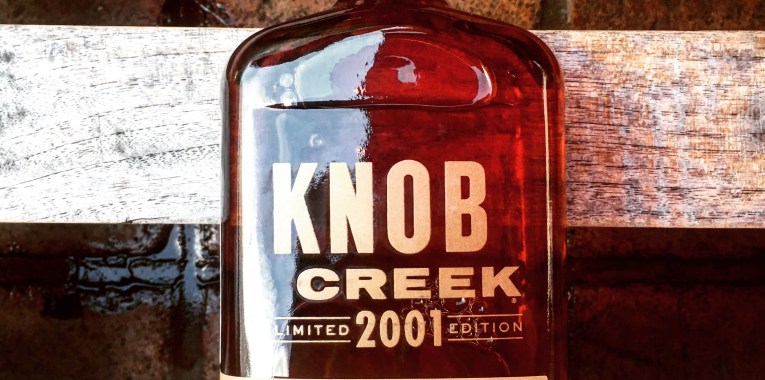
 Named after the stream that ran along Abraham Lincoln’s childhood home in Kentucky, the bottle was modeled after turn of the century apothecary bottles with the label inspired by the tradition of wrapping bottles in newspaper at the distillery. Knob Creek was originally an age stated 9 Year Old bourbon bottled at 100 proof. The age statement has been dropped in the past few years but the brand still claims extra aging compared to the companies other small batch whiskies. So in this case pre-Prohibition style would seem to mean longer aged and higher proof, which is almost the exact opposite of what those early whiskies would have been.
 What set the Booker’s Rye apart was the age and a unique mashbill. The Knob Creek 2001 certainly has the age, at 14 years old it clocks in a good five years older than the old 9 year, but there’s no variation on the mashbill, simply different batches. This leaves a through line connecting it to the standard issue Knob Creek because no matter what batch you pick up all of these bottles are unmistakably Knob Creek: powerful, with pistachio, walnut, sweet oak and that unmistakable Jim Beam yeast.

 Bottled In Bond LA