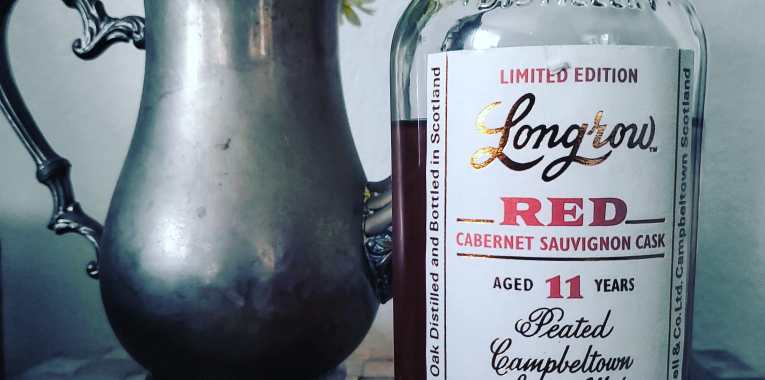
Just because we’re in quarantine doesn’t mean that there can’t be a theme. Aside from sparking joy by eliminating bottles from the booze cart that is. So next up on the quarantine bottle list is the cousin to the last, the Longrow 11 Year Red: Cabernet Sauvignon Cask.
For all single malts produced in Scotland the brand must be identified with the distillery. Hence the Macallan whiskey being made at the Macallan distillery, the Jura at Jura, Laphroaig at Laphroaig, and so on. This seems intuitive yet it’s absolutely not how things are done here in the US. While there are a few eponymous distilleries most of them produce dozens of other brands as well. For example, Jim Beam not only produces Jim Beam but Bookers, Knob Creek, Basil Hayden, Old Overholt, and the many variations there of.
This makes Longrow rather unique as it’s brand but not a distillery. Part of the reason this is allowed under Scottish law is that the brand is intrinsically understood to be produced at Springbank Distillery and the name of the distillery appears on every bottle. Larged embossed letters proudly proclaim “Springbank” above every label. But also, the style of Longrow is drastically different than its cousin allowing for a true separation and not just a label change on the same liquid.
Longrow, unlike Springbank, is heavily peated. There is actually a scientific way to measure the “peatiness” of a Scotch. It’s called Parts Per Million, or PPM, and is used to determine the phenol level after kilning but before distillation. Essentially the longer the malted barley is exposed to the peat fire during kilning the higher the peat and PPM. Longrow clocks in at 50 PPM which means it’s technically even peatier than the notorious peat bomb, Laphroaig which clocks in at 40 PPM.
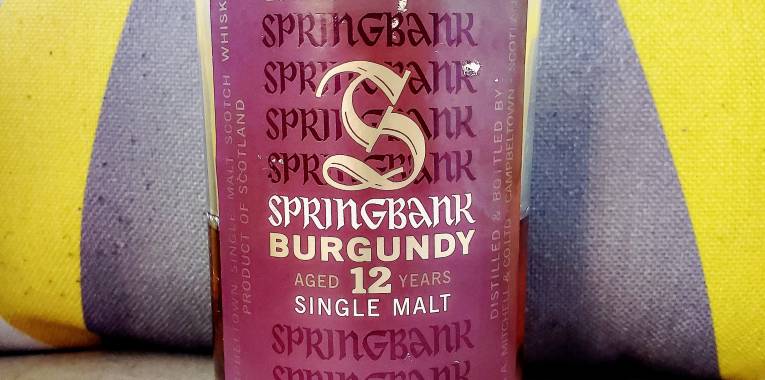
So, here is a heavily peated Campbeltown Single Malt with less than a hundred casks produced every year at a non eponymous distillery. If that’s not enough to peak your interest then the Cabernet Sauvignon Cask will. Every Longrow Red release spends some of its formative years in a red wine cask, similar to the recently emptied Springbank Burgundy. For this release it spent the first seven years in ex-Bourbon barrels and the last four in a Cabernet Sauvignon cask.
To cap it all off the Red is bottled at Cask Strength clocking in at a whopping 104 proof meaning none of those big flavors are lost.
NOSE: Assertive smoke, raspberry, cherry,
PALETE: Leather, sea salt, smoke, darker fruit, blackberry, a touch of sweetness and a strong tannic backbone
FINISH: Long and dry yet juicy. Reminiscent of sea air with those red fruits returning.
This is a complex little dram. There’s a beautiful salinity that provides the throughline for Longrow while the tannin and the fruit lent from the Cabernet Sauvignon cask shines through at almost every level without being overwhelming. Surprisingly, I actually enjoy this one with a little water in it. The high proof gets in the way of some of the more delicate flavors that I really enjoyed in the Springbank Burgundy that are also present here.
All in all, this bottle actually feels like a perfect quarantine metaphor: subtle yet aggressive, complex yet needing a bit of hydration, and packing a hell of a punch.
 Bottled In Bond LA