Continuing this month’s conversation about Nikka comes the news that Nikka will be discontinuing the Taketsuru 17, 21, and 25 Year old expressions as of March of 2020. While some stocks will remain under “heavy allocation” all three marks will no longer be listed by the company. The Nikka Taketsuru Pure Malt, a Non-Age Statement (NAS) edition that replaced the 12 Year old Taketsuru several years ago, will also be discontinued.
While the loss of the age statements is lamentable, it falls neatly into the familiar story of aged stocks not being able to keep up with current demand for high end whisky. But the loss of the NAS Taketsuru Pure Malt comes as a bit of a shock. The NAS was originally released in late 2015 and was meant to address the supply issue. Then in 2019 it won Jim Murray’s Japanese Whiskey Of The Year. Add to this the discontinued Nikka Miyagikyo and Yoichi Single Malts in 2015 and the temporary interruption in supply of their Coffey Malt and Grain in early 2019 and the picture of a company struggling to match pace with demand while also seeking to define its core identity emerges.
So, what exactly is being lost with the Taketsuru’s?
The Taketsuru line was named after the company founder Masetaka Taketsuru. They have been the core of the Nikka line up for as long as I’ve been familiar with the brand. They’re also incredibly representative of the Japanese blending style. Every bottle is the Taketsuru line is a Pure Malt which is an old term for Blended Malts. Not to be confused with a Blended Whisky. A Blended Whisky is made up of both single malt and grain whiskey. A Blended Malt is comprised only of Single Malts. In this case the Taketsuru’s are made from a blend of malts distilled at the Yoichi and Miyagikyo distilleries.
Japanese Whisky makers often think of themselves more as blenders than distillers. They look to layer flavor by creating a blend of whiskies to create consistent and nuanced bottling. Take the Hibiki’s as a prime example. Suntory has repeatedly said that they consider the Hibiki to be the perfect representation of their art, both in terms of distillation but more as a blend. But while the Hibiki contains a fair amount of grain whiskey the Taketsuru line is comprised of big single malts.
One of the advantages of the centuries old whisky tradition in Scotland is 100s of distilleries that are relatively friendly with each other. This means that if a distiller wanted to make a Blended Malt with a style of malt they didn’t distill themselves there was always another distiller that did who would be willing to sell or trade. When Masataka founded Nikka in 1934 as the Dai Nippon Kaju, Co. there was no one to barter with so if he wanted different styles to create a blend he had to distill them himself.
This eventually lead to the creation of Nikka’s second distillery, Miyagikyo, outside on Sendai in 1969. This allowed for a greater depth of flavors for blending as well as over doubling the company’s production capability. Miyagikyo is much further south than its sibling Yoichi Distillery granting a different character as the whisky ages. We can expect to see more of this style of whisky from Nikka in the future as a planned expansion on Miyagikyo should be finished in 2021 with production expected to expand by 40%.
As for the present, the Nikka Taketsuru 17 Year Pure Malt. Award the Best Blended Malt Award by the World Whiskey Awards in 2014 it’s a blend of single malts from both the Yoichi and Miyagikyo distilleries. Aged for a minimum of 17 years this is a powerful whisky.
NOSE: Fresh fruit, Cedarwood, Honey PALETTE: White Pepper, Dried Fruits, Oolong Tea, A hint of smoke FINISH: Medium to long, rounded smoke and with dark chocolate and leather
The Taketsuru line represents NIkka’s history. It pays homage to its founding father as well as combining the art of both of the company’s distinct distilleries. The loss of the Taketsuru line is the loss of a piece of history but it does open a future. Whisky, and in particular Japanese Whisky, is having an incredibly large moment. Bit even if whisky distilled 25 years ago is being depleted left and right the world, and the flavor, that whisky represents is gone. The challenge now is to find the way to create the spirit that fills the barrel to be bottled in 25 years while still keeping the lights on in the years between.
I love a good story and Nikka Whisky certainly has a good story. A story of both an excellently crafted whiskey but also a phenomenal story in the life of the company’s founder, Masataka Taketsuru. The month of January is especially important to the story of Taketsuru and his redheaded Scottish wife, Rita. So I thought I’d take some time and look at a few of Nikka’s offerings for the rest of January.
In 1918 Masataka Taketsuru was sent to Scotland by the Settsu Shuzo company to learn how to make whisky from the Scottish master craftsmen. The goal was to learn from the best, return home, and create a Japanese whiskey that would be on par with the best whiskies being produced in the world. The unexpected consequence was Taketsuru meeting Jessie Roberta Cowan, known as Rita, while teaching Judo to her brother Ramsay.
In a time when “international” marriages were rare the two fell in love. Takatsuru proposed in September of 1919 and the two were married on January 8, 1920, exactly 100 years ago. After the marriage the two moved to Campbelltown where Taketsusru completed his apprenticeship. The two returned to Japan in November of 1920, partially due to Rita’s encouragement. Taketsuru had expressed a desire to stay in Scotland with his marriage to Rita but she disagreed. “We should not stay in Scotland, she said, “We should head to Japan. Masataka-san is living a big dream, a dream to make whisky in Japan. I want to live your dream together.”
Upon their return to Scotland the landscape had changed. The post World War II depression had set in and the Settsu Shuzo company was no longer financially able to invest in new projects, like whisky making. When he left the company in 1922 he found a job, through a friend of Rita’s, as a science teacher. The following year he was offered a job at Kotobukiya to make whisky.
The name Kotobukiya may not be familiar to Western ears but the company it grew into, Suntory, certainly is. While Masataka helped them produce their first whiskies from the brand new Yamazaki Distillery his first wide spread release was essentially a failure and Masataka parted way after fulfilling his ten year contract.
In 1934 the couple founded the Dai Nippon Kaju, Co., literally the “Great Japanese Juice Company, in Yoichi, Hokkaido. The two said the Yoichi, more than any other place in Japan, reminded them most of Scotland. This endeavor was made possible by investors who were introduced to Taketsuru through Rita. Both of the primary investors had family that had taken private English lessons from Rita. With the help of these investors, and the production of many apple products in the early years, Taketsuru was eventually able to release his own whisky in 1940 winning much acclaim over the years and the company formally being renamed as Nikka Distilling in 1952.
Sadly, on January 17, 1961 Rita passed away at the age of 64. She was buried on a hill overlooking the Yoichi Distillery and Taketsuru engraved both of their names on the tombstone promising they’d be together forever.
As much as I love a good whisky making love story, I also love duty free shopping. There is always something unique and quirky to be found. But in a world where Japanese Whisky is in ultra-high demand, and age stated malts are disappearing daily even the unique duty-free offerings are drying up. Which is why, on a recent international trip, I was so surprised to find a bottle I had never seen before, the Nikka Days.
The Nikka Days was released in 2018 and seems to be a response to all of the factors above that are pressing in on stocks of Japanese Malt. It is a blended whiskey made of lightly peated malt and grain whiskies from both the Yoichi and Miyagikyo distilleries.
The brand says that it has always stood at the crossroads of between East and West, tradition and innovation. Saying that each day is a journey and an opportunity to learn from previous days, and that this whisky embodies that mentality. Hence the name.
The whiskey is certainly result of the current journey of the whisky world. So how does it taste?
NOSE: Apple, Orange Blossom, Vanilla, Melon PALETTE: White Chocolate, Toffee, Citrus, a touch of smoke, and fresh apples FINISH: Slightly sweet, bright, with a touch of creaminess
It is certainly fitting that apples are so prominent on the nose and palette of this whisky. Ultimately this is a very serviceable whisky but it stands in the shadow of its history and the massive malts that Nikka is known for. The price point also makes it hard to justify as a day to day sipper but it is worth the journey to spend a few days with if you are traveling.
I’m prouder of the Banana Dance than almost any other drink that I’ve created. More so than I probably have any right to be. It’s an esoteric, nerdy, centrifuge requiring, relatively prep heavy drink that is ultimately delicious, complicated, and easy to batch and execute in a way that belies its complexity. Its evolution is also a damn good microcosm of my personal journey behind the bar in the past few years.
The Banana Dance began life as the Josephine Baker as an entry for Diageo’s World Class competition three years ago. I had entered my very first competition the year before, a little competition known as World Class and having made it to the Western Regionals I was determined to make it back and prove myself. Prove that I wasn’t just some beach side Santa Monica bartender slinging Vodka Soda’s all day long. I certainly had a chip on my shoulder when I was younger.
For my entry the following year I looked at the spirits available and decided that I wanted to play to my strengths with a stirred drink and ended up riffing on the modern classic the Chet Baker. I knew the base was going to be Ron Zacapa Centenario and I wanted a drink name, and a flavor profile, that would compliment the story and flavors of the rum. Enter Josephine Baker.
Josephine Baker
Josephine Baker was an African-American ex-Pat who rose to fame as a dancer and performer in Paris in the 1920’s. Earnest Hemingway once called her, “the most sensational woman anyone ever saw.” While being a multifaceted performer her most famous act, and photos, are of her dancing in a banana skirt. Josephine was more than a performer though. During WWII Josephine used the freedom granted to her as a performer to spy for the Allied troops and help smuggle refugees out of France. She was also incredibly active in the American Civil Rights movement later in life. Pairing this phenomenal woman’s story with a rum crafted by one of the few female master blenders in the world was a no brainer.
Too add to that the Giffard Creme de Banan had just be released which provided a perfect flavor, and thematic, compliment to tie the two together. Add in a little amontillado sherry and a passable Old Fashioned style variation on the Chet Baker was born. It was serviceable but unfortunately didn’t make the cut leaving me out of the competition that year. I knew there was something special in there though and couldn’t let the idea go.
The next year I ended up using some discretionary income to help fund Dave Arnold’s kickstarter for the Spinzall tabletop centrifuge because, well, I’m a nerd. I had already been experimenting with every technique that I possible could from Liquid Intelligence and had voraciously devoured every technique book I could get my hands on. I was actively experimenting with melding flavors in every way that I could. However, there were two pieces of technology that seemed like they would forever bne outside my reach: the rotovap and a centrifuge. Now here was one of those unicorns just sitting on my kitchen counter. I went nuts.
I played with infusing and clarifying everything but one of the most successful experiments was that original pairing of Sherry and banana. It was a relatively simple process, slightly overripe bananas were blended/ together with sherry and Pectin X and the resulting smoothie was run through the Spinzall clarifying the mixture. Here phenomenal fresh banana flavor married perfectly with the sherry with out adding any unnecessary sweetness like other creme products.
The experiments took a hiatus however as I joined Team NoMad as one of the opening Bar Managers for NoMad LA. The training, translating and entire hospitality culture from NYC to LA, and opening four separate venues in a single building consumed my and my team’s attention for months. It was in this period that I also learned to collaborate in a way I never had before.
Not only was this team larger than any I had ever worked with before, it was also the most talented. And while I was a leader this was not a program that was about me or my force of personality as so many venues I had worked on in the past were. This was about the guest experience and about working as a team to create the best product and experience possible. It was demanding, meticulous, and honestly exhausting. The light at the end of the tunnel was R&D.
I love doing drink R&D. I love throwing things at the wall to see what sticks, I love creating crazy ingredients, and I love what seeing other people do with those ingredients. Once we were in a place to start R&Ding drinks specifically for LA I dove in head first. But you never walk into a R&D session with out a concept. The drink hiding up my sleeve that seemed to most fit this NoMad model I had learned was the Josephine Baker, updated with the new clarified Banana Sherry of course.
If you check the NoMad compendium they make phenomenal drinks. They also rely heavily on sherry and a lot of small culinary touches. This comes from the collaborative R&D process as well as the fact that NoMad bar was birthed out of the bar at Eleven Madison Park which is absolutely driven by the mentality of its award winning kitchen.
This was going to be the first time putting any of my drinks through this culinary tasting style with a group of incredibly talented, and opinionated, peers. I’m still amazed to this day how the process can create a drink that is both unrecognizable from the original yet still wholly in the same spirit and design.
The first thing that became clear was that style of sherry needed to be dialed in. We quickly moved away from the darker amontillado in favor of an oloroso which left more acidity with the banana. The Banana Sherry was a crowd favorite and we decided to make it the star of the show. The banana sherry became the base of the drink instead of a modifier.
To add back in some of the richness that the clarification process had stripped out of the sherry we turned to another classic NoMad ingredient, Brown Butter Falernum. Essentially a brown butter washed Velvet Falernum that add in baking spices, a rich mouth feel and tied back into that original idea of bruleed bananas and sherry that had inspired the flavor pairing.
Finding the right balance was tricky because the Falernum can easily overwhelm. As a through line between the Sherry and the Falernum was added Blanc Vermouth. A touch of bitter to go with the vanilla that lengthened the flavors. It wasn’t quite bitter enough so a quarter ounce of Punt e Mes was also added to round out the effect. This firmly moved the drink out of the Old Fashioned style and into the Manhattan style, a subtle but important distinction.
At this point I gave into my true desire to make every drink a whiskey drink and pulled the Zacapa and subbed it with Greenspot Irish Whiskey. This Pure Pot Stilled Irish Whiskey is aged in New American Oak. It has an intrinsic bright green banana note as well as the barrel tannins to be a base for all of these complex flavors to stand on.
At this point the drink was good but the culinary drive for perfection kicked in and we went through countless more variations. The difference between them being a teaspoon of this versus a dash of that. The final touches were a teaspoon of Walnut Liquor to bring a bit more tannin and a nuttiness to compliment the banana as well as a teaspoon of Verjus Blanc to add in a hint of acidity to cut through all of the rich fruits and fats.
The drink was now a lovely fruit forward, complex, surprisingly dry, low ABV stirred drink that still had enough depth and tannin to stand on its own as well as pair with food. It was a real crowd pleaser while still being esoteric and weird. It was my kind of drink. It just needed a garnish and a name.
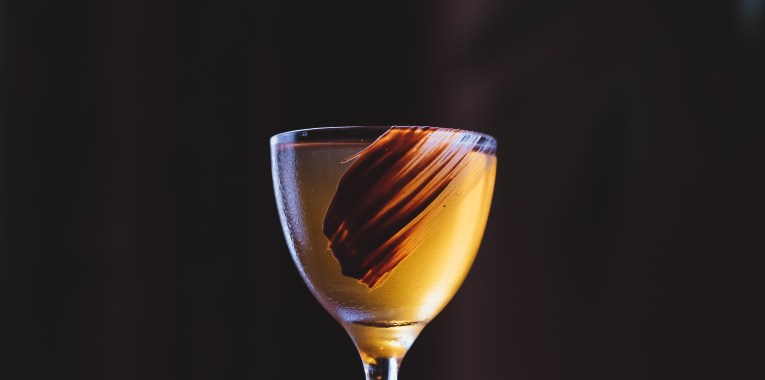
The garnish was easy. While I personally love an incredibly dry drink I know not everyone does. And the drink ingredients could read sweeter than the final product. So, to appease both types of drinkers a single brush stroke of chocolate ganache was added to the outside of the glass. This allowed the guest to choose their own adventure. If they wanted the drink slightly sweeter they could indulge in the chocolate or leave it alone. It also ads a look of elegance has an elegance that can sit just at the tip of the lips.
The name quickly followed. While the drink had come miles and even years from its roots with Josephine her spirit, her dance, still infused every ounce of this drink and thus it was christened the Banana Dance.
I love this drink. I think that the prep needed for it is relatively small considering the final product. Especially for the Banana Sherry. I was fortunate enough to finally utilize a version of this drink, with the Banana Sherry and Zacapa, at the World Class National Finals this past year bringing the drinks journey full circle.
I’ll never create a drink that’s a modern classic but I hopefully will create things that inspire people and tickle their imagination. The NoMad just published a brand-new cocktail book and while sadly the Banana Dance didn’t make the cut the Banana Sherry did. Bright and bold at the top of the ingredients section is the recipe for Banana Sherry.
Hopefully this little dance will continue to inspire people not only in my extended NoMad family but the entire cocktail community that has embraced me and given me so many opportunities this past decade.
Photo Credit: Jordan Hughes @highproofpreacher
The Banana Dance:
1.5 oz Banana Infused Oloroso Sherry (Preferably Lustau) .5 oz Greenspot Pure Pot Still Irish Whiskey .5 oz Blanc Vermouth .5 oz Brown Butter Washed Velvet Falernum .25 oz Punt e Mes Tsp Verjus Blanc Tsp Nocino
Combine All ingredients in a mixing glass. Short stir with Kold Draft Ice. Strain into stemmed cocktail glass painted with a chocolate ganache brushstroke.
Banana Sherry:
750 ml Oloroso Sherry 3 overripe bananas 3ml Pectin X
Blend all ingredients together. Into the Spinzall spindle add 375ml and set to continuous mode. Once the centrifuge reaches full speed pump the rest of the mixture in at 80ml/minute. The should run clear. Once all liquid has been pumped into the centrifuge let it run for another 5 minutes then power down and strain the remaining liquid through a chinoios. Bottle and store under refrigeration for up to three (3) weeks.
Brown Butter Falernum:
750ml Velvet Falernum .5lbs unsalted butter
Cube butter and place in pot over medium heat. Melt and constantly whisk butter so that milk solids brown evenly Continue to brown, whisking constantly, until as dark as the color of an almond skin Remove from heat, and add velvet falernum Transfer to cambro and place in freezer until the fat has risen and solidified on the top Remove solidified fat cap from top and discard Bottle and store under refrigeration for up to one (1) month




 Bottled In Bond LA