
Despite being a self avowed fanatic of American whiskey the thing I’ve
found myself writing about and drinking the most recently has been
Japanese whisky. The last time we spoke way back in December I was
drinking poetic about the Hakushu malts and the fact that though they often seem
to be in the shadow of their Yamazaki counterparts the excellence
of their design meant that it wouldn’t be long before they too
disappeared into a puff of Unicorn smoke.
That opinion seems to have be prophetic with the recent announcement
by Beam Suntory of the “partial” discontinuation of both the Hakushu
12 year and the Hibiki 17 year expressions. While the products will
only be officially discontinued in Japan they will only have “limited
availability in the next few years.” This announcement came as a bit
of a surprise to me with the Hakushu because I haven’t seen it have
the same name recognition and brand power as the Yamazaki does in the
States. But when your distillery is only 45 years old its easy to see
how your supply of 12 year old single malt could be tight.
But the real surprise to me was the Hibiki 17.
The house of Suntory have always considered themselves to be blenders
above all else. While the Single Malts may be the high priced auction
house darling the Hibiki line has always been the jewel in Suntory’s
eye.
Meaning “resonance,” the Hibiki line was first released in 1989, 5
years after the first release of Yamazaki 12 year. Originally
comprised of just the 17-year and the 21-year, a 30-year expression
was released in 1997 and the much missed 12-year was introduced in
2009 before being announced as discontinued in 2015.
Think about that for a moment. The Hibiki 12-year appeared on the
market, soared in popularity, became a staple of the bar world, and
then completely vanished all in the space of 6 years. That’s an insane
trajectory for any brand and is perfect evidence that Japanese whisky
is a truly global product at this point.
The Non-Age Statement Hibiki Harmony hit the market slightly before
the disappearance of the 12-year and despite everyone crying, “Foul!”
many of us were willing to give Beam Suntory the benefit of the doubt
for two reasons: 1) the Hibiki 12-year was the only expression to
utilize whisky that was aged in plum wine casks. They hadn’t
projected for the popularity of the expression, so they discontinued it
because 2) the Harmony wasn’t a replacement for the 12-year. It is
meant to be a more accessible version of the 17-year.
The Hibiki line has always been a blend of whiskies from all three
of the Suntory distilleries: Yamazaki, Hakushu, and
Chita. To them it is the confluence of every unique facet of their
operation. It is meant to represent the ideal of the harmony between
people and nature. The 24 facets of the bottle represent the 24
seasons of the Japanese calendar and invoke the comparison of this
balance to the balance of the malt and grain whiskies in the Hibiki
blend that resides inside the bottle.
This attention to detail is part of what has always set the Hibiki
line apart from my disdain of other blends. And yes, you would have
had to be a real prophet 20 years ago to predict the explosive growth
of the segment, and yes, it’s a real shortage. Bars in Japan are
pouring the Harmony just like we are over here. And yes, the rise of
shochu and decrease in whisky drinking in the 80’s led to lower
production. But the line was introduced in the late 80’s when this
downturn was happening and while the 17-year is being officially
discontinued in Japan it’s “limited availability” will continue to
limp on in the United States. This speaks to the power and demand for
premium aged Japanese whisky in the US, but also can’t help but lend
a tinge of cynicism to the disappearance of the 17-year. Its as if stocks
are being pulled at a younger age to go into blends like the Harmony
to cash in on the popularity wave now versus risking a drop in demand
later. And if that’s true who could blame them?
In Beam Suntory’s defense, the Harmony is still damn delicious and
their quality has not dropped. They have also consistently stated that
they are ramping up production and that this will be a temporary
hiccup, but how many temporary hiccups have we seen come with a flashy
return and a price hike? (I’m looking at you Old Fitz.)
None of this denies the fact that the Hibiki 17 Year is an amazingly
delicious dram. The nose is full and rich, distinct notes of honey,
with some roasted pear, a touch of smoke and ume plum.
The palette offers a touch of sweetness to go along with the initial
scents with the addition of raisin, oak, and a pithy citrus zest that
carries on to a long finish that turns into an darker
amontillado sherry note with a touch of cacao.
It’s easy to see why this blend is the crown jewel of the Hibiki line,
it’s easy to see how we drank it all out of stock, it’s easy to see
why they may have discontinued this expression to protect the more
award winning 21-year expression, and it’s easy to see why we should
all raise a glass and drink to this resonant whisky and to its equally
evocative moment in time.

 Suntory founder and first master blender, Shinjiro Torii and Masataka Taketsuru, “The Father of Japanese Whisky”, founded the Yamazaki distillery in 1923. Taketsuru had studied organic chemistry in Glasgow and was found by Torii after he made inquiries to Scotland looking for a whisky expert. Torii was told there was already one fully qualified in his own country and the two worked closely to build the Yamazaki distillery. However, the first whisky produced by the new company, dubbed the Suntory Shirofuda was a resounding failure. The Japanese drinkers preference for lighter, blended whiskies was blamed as well as Taketsuru’s fixation on doing things the “Scottish way.” Taketsuru was shunted away from the distillery to a beer factory where he served out the remainder of his ten year contract before leaving to start the Nikka distilling company, Suntory’s biggest rival.
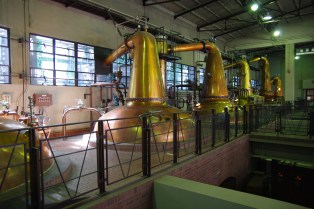 total to 12, which increased capacity about 40%. The added capacity didn’t prevent them from releasing the Non-Age Statement Yamazaki and Hakushu Distiller’s Reserve the following year just as talk of the worldwide whisky shortage began to surface. Also in 2014, Suntory purchased Beam, Inc. (home of the eponymous Jim Beam Bourbon) for $16 billion forming Beam Suntory, the third largest spirit producer in the world. This acquisition greatly expanded Suntory’s distribution lines spreading the already thin stocks of Yamazaki even thinner.
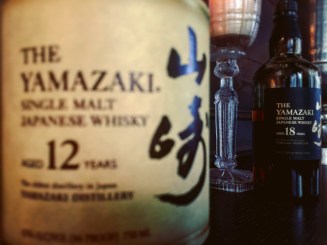 While the 12 year was once the perfect introduction to Japanese malt, before the price and the hype got in the way, it was the Yamazaki 18 year that always stirred my soul. This time roughly 80% Sherry casks with ex-Bourbon and Mizunara making up the other 20%. Here the promise of the 12 year has evolved into a stately elegance. The fruit dries out, turning to raison and apricot with dark chocolate and berries on the tongue with a touch of spice on the long march to the finish.


 But in a world of vanishing age statements and soaring prices I feel it’s hard for the general consumer to not see this as a replacement of a beloved bottle by a younger whiskey at a higher price. That’s not a problem with the Harmony though. That’s just the reality of the whiskey world we now live in.
 Bottled In Bond LA