A Balvenie Burns Night

Welcome to Burns Night. The annual celebration of the life and death of Robert Burns, the National Bard of Scotland and has an almost cult like following as a cultural folk hero. Not a bad legacy for a man born a poor Scottish farmer and who only lived to the age of 37.

Burns was born in 1759 and wrote his first poem after falling in love at the age of 15. He and I imgres-1.jpghave that in common. But unlike myself Burns pursued poetry, and love, with uncommon zeal. The first collection of his poems was published by subscription in 1786. While writing most of these poems in 1785 he also fathered the first of his 14 children. He was a busy man. As his biographer DeLancey Ferguson said of him, “it was not so much that he was conspicuously sinful as that he sinned conspicuously.”

Burns was immediately lauded through out England and Scotland as a “peasant-poet” and he took that success and used it to celebrate and preserve Scottish culture. Most of his poems are all written in Scots and document traditional Scottish culture. He also preserved folk songs. You can blame ol’ Rabbie Burns for why you know the words to “Auld Lange Syne” even if you don’t know the meaning. The song, which is about remembering friends from the past and not letting those times be forgotten actually has nothing to do with the holidays but is a perfect example Burns’ work. He celebrated life, love, friendship and drink all with humor and sympathy. His legacy is writ all over Scottish culture. Bobby Burns is as distinctly Scottish as the countries whisky.

mMcg5wXN6S-SFgDpBbkWkRQ.jpg            Ninety years later, on the opposite side of Scotland, another farmer was setting out to form his own legacy in a distinctly Scottish way: by quitting his job. William Grant had just quit his job as a bookkeeper at the Mortlach Distillery and purchased the land and equipment to start his own distillery. On Christmas day in 1887 the first whisky flowed from the still of the Glenfiddich distillery. Glenfiddich essentially created the Single Malt category in the 60’s and 70’s, often using ads that created a cult of personality of around the whisky and that of Sandy Grant Gordon, William’s great grandson. The company has always been incredibly savvy and it’s no wonder that they are the number one selling single malt in the world.

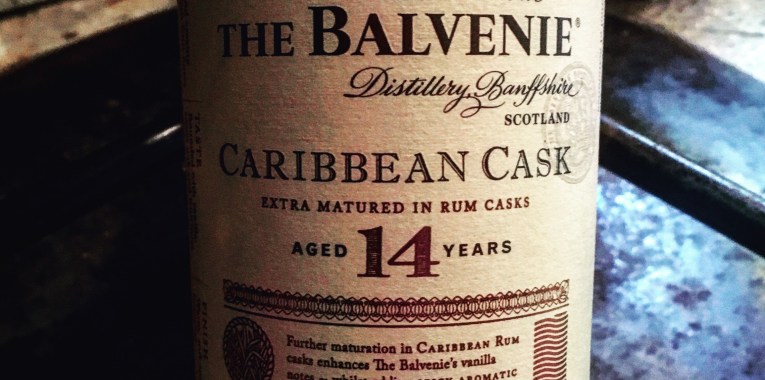
But when you are that large its hard to say that you truly have a cult following. That status today falls to Glenfiddich’s younger distillery sibling, Balvenie. Founded by William Grant a mere five years after Glenfiddich, Balvenie has always been the more experimental of the children. Balvenie is still 100% traditionally floor malted, and just like Glenfiddich they still have a Coppersmith and Coopers on site on site to keep the whole process in house. But I know people who would never touch a bottle of Glenfiddich perk right up at the mere mention of Balvenie, especially if we’re talking about the 14 year old Caribbean Cask.

The Caribbean Cask is a 14 year old single malt that has been aged in traditional oak casks, primarily ex-Bourbon, and then finished in casks that once held Caribbean Rum. These rum casks are American Oak casks that have been filled with a blend of West Indian Rums crafted by Malt Master David Stewart. Once Stewart deems the casks to be correctly seasoned the rum is dumped and the 14 year old malt whisky is added to receive its finishing touches. How long exactly is a “finish’? Well, until it’s finished, but generally about 6 months.

The result is a whisky that is massively vanilla and oaky with an evolving fruitiness and just an edge of the hobo funk that you find in truly great rums. It is flavorful without being overpowering and adds a sweetness that livens up that heavy malt that turns many people off of Scotch whisky. This whisky feels right at home in that ultimate of Burns Night celebrations: the Burns Supper.

Burns Suppers range from strenuously formal gatherings of esthetes and scholars to uproariously informal rave-ups of drunkards and louts. I’ll give you one guess as to which category I fall into. Most end up right in the middle and will follow the time honored form which includes the eating of a traditional Scottish meal, the drinking of Scotch whisky, the Toast to the Lassies, the responding Toast to the Laddies, and the recitation of works by, about, and in the spirit of the Burns.

Tonight I will be providing you with the whisky, but my brother will be providing you with the poetry. I don’t know if he wrote his first poem after a lovelorn night at the tender age of 15, but he certainly pens a verse worthy of raising a glass:

For Wintergreen Gorge

Once, illegally, on a train track bridge,

We sat with a handle a whiskey and three

Water bottles a gin, and I watched a gall midge

Land on your cheek and watched you brush it free

with your hand. Now what’s the use in holding

When we can sip and we can sit with our

Laughter and the iron and the wood to

Water sinking? Your hands get lost in folding,

Smoothing, and re-creasing the small flower

On the hem of your dress, and then you lower

Your eyes to wonder what we could do.

~Jacob Fournier
 

Open Bottle: Del Maguey Barril

Agave is an odd category to me. There is an abundance of good agave products pouring into Los Angeles but unlike whiskey, or even brandy and cognac, I often encounter what feels like an active, willful ignorance from people drinking tequila and mezcal, both in terms of education and general understanding of the spirits..

Requests for mezcal margaritas out number the requests spicy margaritas in my bar these days, but if a customer orders a tequila and I ask them if they’d like a blanco, reposado, or an anejo their eyes glaze over as if I was speaking a foreign language. I can’t imagine what would happen if they requested a mezcal and I asked them if they’d prefer a barril, madrecuiche or a tepezate. And this isn’t me being difficult for the sake of being difficult. These are the same types of questions I ask if someone requests a “whiskey” or a “scotch.” The proliferation, and premiumization, of agave has almost exacerbated the problem. People know that they want it even if they don’t know what “it” is.

If a customer orders a tequila and I ask them if they’d like a blanco, reposado, or an anejo their eyes glaze over as if I was speaking a foreign language.

This isn’t meant to ignore the inroads the category has made. I remember drinking mezcal out of a plastic jug that my collage roommate brought back from Texas and I can still feel that punch in the chest. With the category, and quality, growing so rapidly in the US and Mexico, greater education is needed.

And we wouldn’t be talking about mezcal at all if it weren’t for Del Maguey.

I know it’s hip to hate on the iconic green Del Maguey bottles these days. We’re always looking for what’s new and hip, and at 20 years old Del Maguey is the dinosaur of the mezcal world. But with out them we don’t even get a mezcal category in the U.S.- yet, to most “in-the-know” bartenders that I meet they’re just simply not a cool brand. I blame the Vida for this.

Everyone who’s had mezcal has had Vida. There were no other viable well options for a long time but let’s be honest, the Vida ain’t that great. I still enjoy it more than many other “mixing” mezcals , like say El Silencio, but both of them are stripping out something essential in the process. They may end up being more approachable but they also feel watered down and for the average consumer they end up associating that distinctive green bottle with that level quality.

That’s not to say Del Maguey doesn’t have an eye for quality. The Chichicapa is one of the best mezcals I’ve ever found for mixing and is an invaluable tool to open people’s eyes to the possibilities of what mezcal can taste like and the Santo Domingo Albarradas is to this day one of my favorite sipping mezcals.

But with 21 different products available, some named for the village of production and others for the species of agave they’re not necessarily helping simplify the category. I don’t blame them though. They are just incredibly excited about excellent mezcal and want to share everything they find with drinkers outside of its native village.

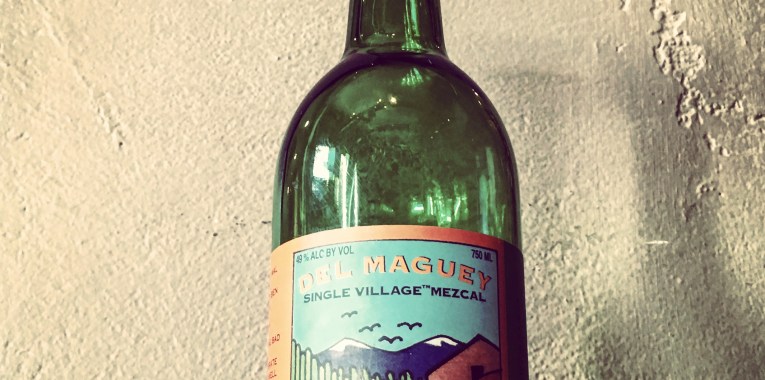
Take, for example, the Del Maguey Barril.

It’s part what’s known as the “Vino de Mezcal” series. It’s a term borrowed from the history of agave. Before there were rules on what made something a “Tequila” or a “mezcal” agave spirits were simply called “Vino de Mezcal.” If you’re wondering why they weren’t called “Vino de Tequila” it’s because technically Tequila is a type of mezcal. But that’s a conversation for another day.VinoDeMezcalSeries680.png

For the Del Maguey lineup “Vino de Mezcal” means limited. It’s mezcal that are very terrior driven but can only be produced in limited quantities. The Barril is a single varietal and literally means “barrel” which describes the size and shape of this particular agave varietal. The plants are all 15-20 years old, were fermented for thirty days and then were twice distilled on a clay still with bamboo tubing by Florencio “Don Lencho” Laureano Carlos Sarmiento, an 80 year old palenquero. A palenquero is a nifty word for “mezcal maker.”

It carries that clay minerality over into the liquid. It’s slightly salty, yet fragrant at the same time. There is a green vibrancy that is earthier rather than fruity while still remaining juicy. In the end, it’s a great example of what the world of mezcal can offer to drinkers of barrel aged spirits. It entices them in with some familiarity but then throws open the doors to what is beautiful about the differences.

How do I know all of this? Through tasting and having conversations with people who know more than me but also because the technical details are all right there on their website. You don’t get to be the granddaddy of your spirits category with out recognizing the education problem on your own.

I certainly don’t claim to be an agave expert. I’m just an enthusiast that is looking for a way to bridge that knowledge gap. I want to find a way to start a conversation that will keep mezcal from just becoming “smoky” tequila. And I’m open to suggestions.


Redbreast and the Irish Behemoth

For all the talk of the growth of Japanese whisky and the revival of American Bourbon and Rye the words “explosive growth” can only truly apply to Irish whiskey. This trend shows no sign of slowing down with sales expected to double by 2020. Those are some staggering gains so why doesn’t it get the same kind of geeky love that, say, a Yamazaki does? I’d say it’s because for many of us Irish whiskey isn’t a category. It’s just Jameson.

Irish whiskey has traditionally lived and died with the American market. American Prohibition was so devastating that 400 brands made by over 160 distilleries turned into essentially three brands and a whopping four distilleries. And while you may have heard of John Power and Cork Distilleries what you’ve drunk is Jameson.

You’ve drunk a lot of it. In 2014 Jameson sold nearly 18 million liters in the U.S. alone. It’s closest competitor, Bushmills, sold a paltry 1.3 million. Jameson accounts for 63% of the global Irish whiskey market. It’s a behemoth.

You may be asking, if Jameson is such a monster and there are only four distilleries cranking out all of this liquid then where are all these craft Irish whiskies coming from? The answer is Jameson. Or more accurately Irish Distillers who are the massive Irish whiskey conglomerate.

While on this side of the pond growth is being fueled by the proliferation of “craft” distilleries creating a wide range of diverse products, in the Irish segments growth and innovation is being by the big boys. And let’s not kid ourselves it’s a business decision. Premium and super-premium Irish whiskey sales have grown by nearly 600% since 2002. Which is a much more impressive way of saying no one drank it at all and now they drink it a little. They’re creating their own market, and they’re not doing it for the little guys.

That doesn’t mean it’s bad whiskey by any means. In fact I truly believe that there are Irish whiskies that can measure up to the best in the world. Look at Redbreast. It’s an example of understated elegance. The brand goes back to possibly 1903 but certainly 1912 where it was bottled by Gilbey’s using whiskey sourced from the Bow Street Distillery in Dublin, which was, you guessed it, the home of Jameson Irish Whiskey.

In the 1971 Irish Distillers decided to close all of their Dublin distilleries and consolidate their operations at a New Midleton Distillery in Cork. This lead to a disruption in supply and eventually Gilbey’s sold the rights to Redbreast to Irish Distillers in 1986. It seemed like the end of the brand but it was reintroduced in 1991 still boldly 12 years old. In a whiskey world where age statements and brands are disappearing every month the core Redbreast has never lost it’s age statement. In fact, it’s grown over the years with the introduction of a 15 year, 21 year (which is simply stunning) and even a 12 year old cask strength. Where others are contracting they are expanding.

The latest edition to the family is the Lustau Edition. It’s the same Redbreast formula: Pure Pot stilled, made from a blend of malted and unmalted barley (we can talk about the historical reasons for that later) but rather than just the bit of sherry influence carried on the standard 12 year, this whiskey is finished in first fill Lustau Olorosso Sherry casks pulling all those sherry notes to the forefront. It is rich, creamy, with a dark fruit and fig note wrestling with nougat and candied fruit. It is a lively whiskey.

At first the lack of age statement may seem like a step backwards but this Lustau Edition isn’t replacing anything. The 12 year isn’t going anywhere, this is simply an expansion. It is a way to experience and highlight many of the subtleties that exist in the Redbreast line. It is also an experiment.

Experimenting costs money and Jameson is almost certainly footing the bill on this experimental expansion. Big doesn’t always mean bad, just as craft doesn’t always mean good. Experience is one thing you can’t teach and it’s something that the craft distillery world is going to learn the hard way. The folks at Redbreast have already got it down.

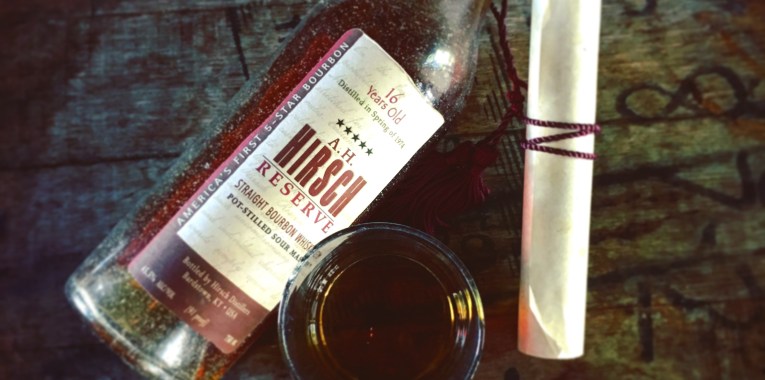
Open Bottle: A.H Hirsch Reserve 16 Year Straight Bourbon Whiskey

I’m absurdly lucky in my line of work. I get to taste things that are often considered legends and even more exciting get to stock them at the bar occasionally. Most of these bottles are outside the scope of being able to feature them on a typical Whiskey Wednesday but they all have a story, and all of them are open. So, I’m going to take advantage of this abundance of good fortune and drink my way through them and let you vicariously drink through me.

For our first go around we got a real unicorn of a bottle: the A.H. Hirsch 16 Year Straight Bourbon whiskey. This bottle, along with the original Pappy Van Winkle releases, are what kicked off the super premium Bourbon trend. There’s a great book about its full story called The Best Bourbon You’ll Never Taste by Chuck Cowdry so we’ll do the abridged version here.

Our story begins in a small farm outside of SchaferstowMichter's Ruins.pngn, PA in 1753. John Sheck was doing what most farmers did at the time and was simply distilling as a way to maximize his harvest and make a little extra cash from excess grain. There was no formula to it. But over the next 163 the family grew this small operation into a full blown distillery until they were forced to close the doors in 1919 due to the beast that was Prohibition.
During Prohibition the distillery and farm was sold to a local farmer who more than likely kept the stills warm with a few runs despite Prohibition and after repeal distilling commenced in full force yet again. The distillery changed hands several times in the next few years before being bought by the Schenley Corporation. Schenley was to the American spirits world of the 1940’s what Diageo is to world spirits today. Which is appropriate since Schenley was sold to Guinness in 1986 and Guiness’ merger with Grand Metropolitan in 1997 was the birth of Diageo.

But well before then the distillery had changed hand yet again, this time to Pennco Distillers, and was now know as the Michter’s Distillery. They had new owners, a new IMG_1970.JPGbrand, and Charles Everett Beam, of the Beam family fame, as master distiller. They were ready to rock and roll. Yet despite having limited success with the Michter’s Sour Mash Whiskey (which may or may not have been pot stilled) and being named a National Historic Landmark in 1980 the demand for Bourbon just wasn’t there. What may have been the oldest distillery in the United States closed its doors for good in 1989 and is now just a collection of abandoned buildings.

What does any of this have to do with Hirsch? In the spring of 1974 A.H. Hirsch was one of the major investors in the distillery. And as you may have heard the ‘70s were not a good time for American whiskey and the distillery was strapped for cash. Rather than invest more money into the distillery Hirsch commissioned Charles Everett Beam to make him a whiskey. It was a different mashbill than the sour mash Michter’s was making at the time. It was a true Bourbon and the run produced a measly 400 barrels. This commission did two things: it gave the distillery a quick influx of cash and gave Hirsch an investment that he could sell no matter what happened to the distillery in the future.

14555129485_c0f8ededa1_b.jpg                  And Hirsch never cashed that investment in. Oddly he left it aging in the warehouses, paying taxes on all 400 barrels until the distillery shuttered. Now sitting at a solid 16 years old, ancient by Bourbon standards at the time, Hirsch finally took position and sold of the stock.

The new owners transferred the whiskey to stainless steel tanks to prevent further aging and started bottling the whiskey, naming it in honor of A.H. Hirsch himself. And in another quirk of the incredibly small whiskey world some of the first bottlings were done by Julian Van Winkle III at the same bottling plant he would latter start bottling another famous whiskey named after his Pappy.

The whiskey hit the shelves at around $50 a bottle, again astronomically high for the time, but it turns out it was damn good. Deep leather and tobacco, with nougat  and dried cherry and orange. It’s literally history in a glass. It can never be recreated. The moment in time, and even the distillery are long gone. Unlike your Pappy Van Winkle’s or George T. Stagg’s this piece of Americana will never come around again.

People loved it. It’s a prime example of the excellence that can come from extra aged American whiskey. The bottle became a legend and definitely fueled the love for old Bourbons, and their price tags.
Once, Preiss Imports discovered the following for Hirsch they pulled the last remaining bottles and repacked them in a massive collectors edition with a more massive price tag. It was still possible to order A.H. Hirsch for your bar. If you were willing to shell out for it.

So does it live up to the hype? It’s impossible to say. This bottle is so wrapped up in its history that I can taste it right there next to the oak and vanilla. Despite Chuck’s claim that it’s the best you’ll never taste it’s still out there. And you should taste the history. But, don’t cling to the past. A.H. Hirsch had it’s moment in time. The next moment is out there.

Old Grand Dad’s Goodbye

It’s been an interesting few months for the “Beam” portion of Beam Suntory.

Back in October the had a full worker strike at Jim Beam, it only lasted a single week before both sides reconciled their differences but it also happened to be the same week that Booker’s Rye was named Jim Murray’s World Whiskey of the Year.

The prestige of that super allocated release, as well as the price tag, seemed to add fuel to Beam’s announcement at the end of last year that standard issue Booker’s Bourbon was going to see a production cut and double in price in 2017. This announcement was met with such backlash that the company quickly back tracked, now saying that the price would more gradually increase over the year with only a $20 increase to start off the year. This about face has left many people disgruntled, feeling that they were some how manipulated into snatching up bottles. As if they were forced into buying the whiskey by the announcement.

Add this to the Maker’s Mark brushfire in 2013 where the same company announced that they’d be cutting the proof of Maker’s Mark to increase supply only to quickly change their tune due to community pushback and you seem to have a company with an inte
rnal struggle between the accountants and the physical producers.

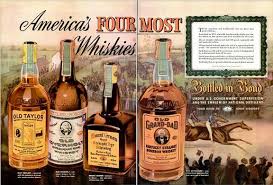
Amidst this kerfuffle yet another beloved friend has bit the dust with out much fanfare: the Grand Dad 114. The lack of a dustup might be proof that the company was right to discontinue this expression of Old Grand Dad but I images.jpgpersonally disagree.

Old Grand Dad is old. Not as in an age statement but in terms a brand. And even if you don’t think you’re familiar with the brand you’re wrong. You just know him by another name: Basil Hayden.

Basil Hayden was part of a great migration into the heart of modern day Bourbon Country. He was, like almost everyone else, a farmer first. He distilled to preserve excess grain, just like his neighbors did, with little thought to mashbill or long term aging.

After the civil war whiskey went industrial and around 1882 Basil’s grandson, Raymond, founded a distillery and named it after his Old-Grand Dad and slapped a portrait of him on the label.

After Hayden’s death the distillery passed into the hands of the Wathen’s who made medicinal Old Grand Dad through-out Prohibition and their company, American Medicinal Spirits, became the backbone for National Distillers after repeal which was one of the largest and most influential bourbon makers in American History.

After Prohibition, when whiskey stocks were nearly non-existent, a higher rye content was added to Oimages-1.jpgld Grand Dad’s mashbill in an effort to make it taste and feel like those ‘old style’ distillers in an effort to appeal to the new drinkers.
Flash forward to the late 80’s, National Distillers merged with Jim Beam and amazingly, the mashbill for Old Grand Dad has seemingly been left unaltered. And they even added to the family by introducing Basil Hayden’s in 1992.

I’ve always loved the 114. 114 proof (duh) it is spicy, powerful, dusty leather and a nutty presence that leaves your mouth bone dry, hunting for more. And even if the claim that Basil was known for making bourbon “with a high rye content” is completely unsubstantiated it is still damn good whiskey.

By now Basil Hayden’s far outshines its older iteration, at least in terms of press and sales. And with supply unable to keep up with demand a family sacrifice has been made. So good by 114.

That’s the history, but what about the future of Old Grand Dad? Well, let’s look back at the little ol’ Maker’s mark fiasco and Booker’s Rye awards.

A few months after Beam Suntory announced that the would in fact not be lowering the proof of Maker’s Mark the suddenly released Maker’s Mark Cask Strength. The release was originally very limited and sold exclusively in small format but proved so successful that it’s a full time release now, for a majorly popular brand that carries a higher price tag and slightly more prestige.

Add that to the success, and price tag, they’re having with super limited releases of major brands like Booker’s it’s hard not to see the super allocated Cask Strength Basil Hayden’s wait in the pipeline. And to not see the massive price tag it’ll carry on the shelves and even more gargantuan one it’ll have on the secondary market.images-2.jpg

This is the dark side of the whiskey boom. What helped fuel this boom was availability and price. Bourbon was unpretentious and everyone could afford a great bottle. Now, value is harder to find and more of the fans are being priced out of something they love. If we’re lucky they’ll go the Maker’s Mark route on this one and turn it into a permanent line extension but who can say? The company itself seems to have a hard time making up its mind.

I can’t tell if the glass is half full or half empty but, for tonight at least, it’s filled with Old Grand Dad 114

Just A Little Larceny

Larceny is not theft.

Let’s draw an analogy: Marketing is selling. False marketing is theft.

It’s theft of your time, your ability to make informed decisions and ultimately your money. It’s spending those things with the expectation of one product and getting something at best tangentially related. The liquor world is awash with claims that straddle this divide. American whiskey is the major culprit these days.

The whiskey world is obsessed with authenticity, real or manufactured. We want the 264 year old history of your brand, even though it was just started three years ago. Preferably in convenient sound byte form, downloaded instantly so that when we buy your $50+ bottle we can rest assured that despite it being made in a factory in Indiana we know that you found the recipe in your great grand aunt’s attic.

There are dozens of examples of brands doing it wrong but they get enough ink spent on them. Instead let’s talk about people doing it well and say again: Larceny is not theft.

So, what is Larceny?

It’s a story. A perfect marketing story. Before Prohibition there was a man named John E. Fitzgerald. He never distilled a drop and he never had a distillery. Himgres-1.jpge did have keys to a bonded warehouse where they aged whiskey and was known to “sample” barrels. Sample- read: pilfered. Despite his acts of theft being well known Fitzgerald kept his job. In fact, the company started calling particularly good barrels “Fitzgeralds” and ended up naming a brand after him, all bottled from only the best barrels. After Prohibition the brand was sold to Pappy Van Winkle where it became his flagship brand at Stitzel-Weller.

But as you know from our talk about Pappy last week, Stitzel-Weller closed in 1992. The brand, and some aging whiskey, transferred to Heaven Hill where they created a heated mash bill to keep “Old Fitzgerald” consistent. That is until 2012, when Heaven Hill removed Old Fitz from almost every market and presented us with Larceny. Same juice, but named for the crime. Not the man.

What does this have to do with the whiskey?

Not a damn thing.

It’s all marketing. All a story. John E. Fitzgerald’s Larceny has no more connection to the purported original act of theft than it does to the whiskey made at Stizel-Weller or the whiskey sold before Prohibition. But it’s a story we all tell, something that gets us talking about this bottle.

And it’s still the spirit of Old Fitz. It’s still the same whiskey they were making before the name change. It’s the same mashbill inside the bottle, different proof, no age statement and still nutty, slightly rough around the edges with a dark, dark cherry note ringing through the center. But tasting notes aren’t enough on their own.Tasting notes don’t sell, history does.

And Heaven Hill has history in abundance, what they don’t have is a brand. Jim Beam has a brand. Four Roses has a brand. Heaven Hill has stories: Evan Williams, Elijah Craig, John E. Fitzgerald, and they are very successful stories. Evan Williams is the number two selling Bourbon in the world, so how do you get to number one? Marketing.

In the end is the Larceny a theft?. No, it’s just a fresh coat of paint on a well worn Kentucky barn. It’s still the same whiskey inside.