Whiskey Wednesday: A’bunadh, Aberlour A’bunadh

Bigger is always better right? Just like the old fashioned way is the best way. Or at least that’s what Aberlour has been banking on the past two decades with their A’bunadh releases.

Despite a history stretching back nearly 140 years Aberlour still feels relatively unknown to the wider world. The distillery was founded in 1879 by James Fleming who built an extremely modern distillery for the time powered by a waterwheel driven by the Lour river . Aberlour literally means “the mouth of the chattering burn” and was supposedly named for the ancient Druids belief that the river actually spoke to them. The water for the distillery is drawn from St. Drostan’s Well, which only adds to the mythic nature of the Aberlour’s waters as the well is named after the 6th century Columbian Monk who supposedly used it as a baptismal site. So, like many Scotch distilleries there is a lot of history, myth, and legend involved.

James Fleming operated the distillery until his death 1895 and then the distillery changed hands over the years, being acquired by S. Campbell & Sons in 1945, before being sold to Pernod Ricard in 1974, who updated and expanded the distillery the following year, finally merging  the former Campbell Distilleries with the Chivas Brothers in 2001.

Aberlour is quintessentially Speyside in style and is double cask matured. Unlike the more well known Balvenie line, the Aberlour line isn’t finished in a second style of oak. Instead, the malt is fully matured in ex-bourbon or Olorosso Sherry barrels and once they are finished aging these different barrel styles are batched together. The proportion varies depending on the interation. The 12 Year is 75% Ex-Bourbon, the 16 year is 50/50, and the A’bunadh is 100% Sherry. And while the general line up of Aberlour might be less known the A’bunadh definitely has a cult following. Though it was first released in 2000 the A’bunadh story actually begins with that distillery expansion brought on by their purchase by Pernod Ricard in 1975.

During construction some workers stumbled upon some an 1898 newspaper with a story about the distillery fire that year, wrapped around a bottle of Aberlour from 1898. The workers who discovered the bottle finished off most of the bottle before guilt kicked in and they turned the bottle over to the master distiller, who immediately sent the remainder off to the laboratory for analysis. The A’bunadh is an attempt to recreate the whiskey in that bottle.

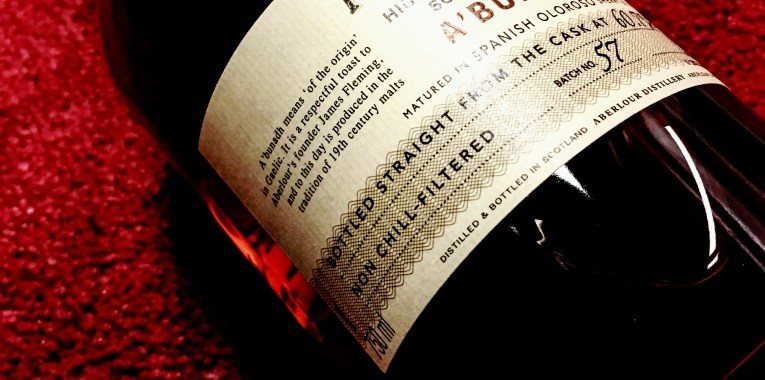
“A’bunadh” means “the original” in Gaelicand if the above story is to be believed this is the style of malt the distillery was making before it’s catastrophic fire in the late 1900s. There is no age statement, each batch is blended together from malts ranging from 5 – 25 years old, is non chill filtered, and bottled at cask strength. It is 100% Olorosso Sherry barrel aged and though there is no age statement , each batch is uniquely numbered allowing whiskey connoisseurs, otherwise known as nerds, to easily track the “best” batches.

2017 saw the release of Batch 58 but I’ve still got a few bottles of the 57 hanging around and it lives up to its predecessors. There is a massive amount of all spice and caramelized orange on the nose. There is a massive amount of that Sherry sweetness, melded with orange, dark fruit, a little bitter chocolate and heavy malt. The finish is long and sustained and with Batch 57 coming in at solid 11.42 proof the mouth is left dry and clean afterwards.

Whether or not the A’bunadh actually is like the original malt distilled at Aberlour is rather irrelevant at this point. It has certainly earned its place in the Single Malt hierarchy and deserves a little more love from those of us not constantly dreaming about our next dram.

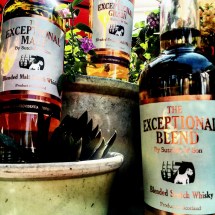
Whiskey Wednesday: The Experiential Exceptionals

I’m told my generation, (I refuse to say ‘Millennial’) values experience over material possessions. That a memory formed, or an adventure had is more important than the shiny new car. My intense desire for a Tesla would be my argument to that hypothesis but this experiential mentality is appealing and you can see it leaking into almost everything, including booze. There is definitely a trend towards one off releases and in the scotch world more small producers are creating blends not with the idea of creating decades long consistency but of constantly evolving smaller bottlings, aiming for consistent quality if not consistent flavor.

In the scotch world more small producers are creating blends not with the idea of creating decades long consistency but of constantly evolving smaller bottlings, aiming for consistent quality not consistent flavor.

Don Sutcliffe, of Sutcliffe and Sons, along with Willie Phillips, the former managing director of The Macallan, created The Exceptional Whiskies with this experiential philosophy at the forefront of mind. They say it outright. They’re not looking to create year-in, year-out consistency. They want each edition to be ‘individual’, ‘distinct’ and ‘memorable’. Since 2013 they’ve released 2 editions of the blended grain and their blended malt, and now they’ve got the first edition of their own blended scotch to add to the line up.

It follows in the same philosophical vein and draws on decades of experience and relationships. It takes grain whiskies from North British, Strathclyde and a 33 year old Cameron Bridge and blends them with single malts from seemingly all of Speyside including: Glenfarclas, Ben Nevis, Balvenie, Kininvie, Glen ddich, Alt- a’Bhainne, Auchroisk, Glenallachie,Westport, Speyside and a splash of 30 year old Macallan. Then all of that is finished in first fill Olorosso Sherry barrels. The result is fruity, rich, very light up front, with a honeycomb sweetness and a definite herbal nose.
So what’s the result? It’s good whisky. But is it any more than that?

Exceptional.jpgThe cynic in me wants to say that the whole ‘unique experience’ is marketing talk for ‘we can’t get the ingredients to make this anymore.’ That it’s just another way to cash in on the whiskey boom. But looking at how long Don and Willie have been doing this it looks more like to men tired of doing the same thing day in and day out. It has the feel of wanting to find something new, to experience and share it. So what does the millennial in me say? That it’s not a generational thing. That it’s just a human thing.

Open Bottle: Chartreuse V.E.P and #1605

If you haven’t noticed America is a little odd. We like doing a lot of things backwards. Like our current administration- or how in most of the world writes the date as day/month/year, which helps explain why May 16, or 16.05, is world Chartreuse Day.

IMG_3595.JPG

If you’re unfamiliar, Chartreuse is a liqueur made by the Carthusian Monks in the French Alps and is often considered bottled magic by many in bartending community. It’s a thing of myth, medicine, and history. It’s history starts in the year 1605.

The Carthusian Monks are an order of working monks, which means that rather then devoting themselves to missionary work they devote themselves to contemplation, prayer, and solitude and maintain that lifestyle by working.  Since the order was founded in 1084 they’ve made many things but the one they have been world famous for making for centuries is Chartreuse.

The production of Chartreuse carries all the mystery you would expect from an organization a thousand years old and devoted to quiet prayer and meditation. The recipe is based on a manuscript thought to be gifted to the monks by Francois Hann

IMG_3613.JPG
Élixir Végétal de la Grande-Chartreuser

ibal d’ Estrées, a cousin of the king at that time, which supposedly contained the recipe for “the Elixir of Long Life.” It was the high time of alchemy and the monks went to work decoding the manuscript of 130 herb and botanicals, yet the first Élixir Végétal de la Grande-Chartreuse didn’t appear until 1737. This seems like quite a gap but keep in mind the world wasn’t as connected as it is these days. Ingredients listed in the manuscript weren’t all native to the French Alps, and once the spice trade brought many of them into circulation it wasn’t a simple matter of following a tried and tested recipe. It was a lot of “a pinch of this” and a “bag of that” things that required balance.

The first Elixir, at nearly 140 proof, was sold as medicine, and is still available in French drugstores as such, and was sold from the back of mules in very limited supplies to the villages around Grande-Chartreuse. However, despite limited availability it proved so popular that the monks set about to create a more “mild” drinkable version. A liqueur of green color, at a mere 110 proof, began to be sold in 1764 and its legend grew from there. A yellow version was introduced in 1838, a defunct “white Chartreuse” was sold from 1886-1900, the monks were forced to flee post

StGermain.JPG
The O.G. St. Germain Cocktail: Green Chartreuse, Grafruit, Lemon, and Egg White

Revolution France and moved operations  to Tarragona for several years before returning to France, and then the V.E.P. (“Viellissement Exceptionnellement Prolongé”) was released in 1963. And this doesn’t account for the varieties available overseas that aren’t available in the United States. Most of which aren’t available because the F.D.A. wants to know what goes into Chartreuse and the monks are understandably closed lipped about a 400 year old recipe. The sales of Chartreuse fund all of the Carthusian Monasteries across the world and the U.S. is the second largest market for Chartreuse in the world. Understandably the company in charge of selling Chartreuse for the monks didn’t want theTTB to pull the product so they have a stalemate. The TTB grandfathered the Yellow, Green, and V.E.P.s into the country with the understanding no other Chartreuse iterations would be imported.

But what makes Chartruese so compelling in the first place? First, is the romance. Who doesn’t love a product made based on an ancient manuscript, containing 130 different botanicals, from a recipe known by only two monks who have taken a vow of silence? It’s the Coca-Cola of the booze world. But, also it’s the complexityIMG_3610.JPG of the spirit.

Chartreuse is made from 130 different botanicals. The Green uses a sugar beet base distillate while the Yellow uses a grape- spirit base (the Yellow also lowers the proof to 80, and uses more saffron and distilled honey as a sweetener). These herbs and botanicals grant a natural complexity but because Chartreuse is created by distillation and maceration it is the only spirit in the world to continue to evolve inside the bottle. Those ingredients continue to interact in unknown ways making old bottles truly unique and sought after.

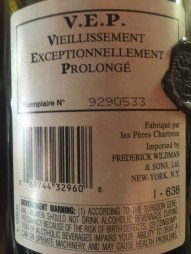
Standard Chartreuse is aged for 3-5 years in the largest liqueur aging cellar in the world (read: ONLY liqueur aging cellar in the world)  The V.E.P.s are aged from 11-20 years and while they carry no age statement you can determine a least the date of the bottling by adding 1084 to the first three digits of the numbered code on the back of the bottle.


IMG_3614.JPG
929 + 1084 = 2013

While the Yellow V.E.P. tends to be the fan favorite (a good friend once described it as “liquid space honey”) I’ve always been partial to the Green, probably because it is 108 proof. My open bottle was released in 2013 and is noticeably richer than the standard Green. Not because there’s a larger oak presence, the barrels are essentially neutral containers at this point, but because the botanicals have had more time to mature. The menthol quality takes a back seat as the warm baking spices ride along the pine and gentian notes to end on a dark, baked fruit note that leaves a sense of weight to the inside of your mouth. Drinking the Green V.E.P. is what I imagine history tastes like: bitter-sweet, earthy, slightly spicy, and heavy with the weight of time.

Chartreuse remains interesting today not just because of it’s history, or because it’s the father of an entire categorization of spirits but because of it’s complexity. And it’s impressive that the spirit can be so well understood and utilized in mixed drinks despite the lack of knowledge of how it’s produced. Sometimes the mystery is the magic and some times that magic creates complexity.

But my absolute favorite thing in the long tale of Chartreuse is that the spirit was so popular and recognizable that the color Chartreuse is actually named after the spirit. That is cultural impact at its finest.


Whiskey Wednesday: Shooting Turkey Rye in a Single Barrel

I don’t like to repeat myself, but the conversation about the Wild Turkey Kentucky Spirit Barrel a few weeks ago got me thinking. While I might not be a Wild Turkey Bourbon man at heart the rye has always tickled my fancy. I’d like to say that it’s simply because it’s damn good whiskey but that hasn’t always objectively been true.

I touched a bit on the history of Wild Turkey with the post of Kentucky Spirit (You can read about that here) but Wild Turkey’s history feels more tied with the pop culture of past decades that almost any other brand except Jack Daniel’s and Jim Beam.

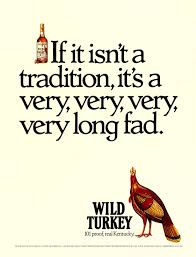
Wild Turkedownload.jpgy as a brand was said to originate in the 1940’s when an Austin Nichols executive, Thomas McCarthy, brought some choice whiskey along on a wild turkey hunting trip in South Carolina. Enamored with the samples he brought his friends kept asking for more of “that wild turkey bourbon.” More likely it was a marketing approach to appeal to hunters and the rugged, rustic type but every whiskey loves a mythical origin story.
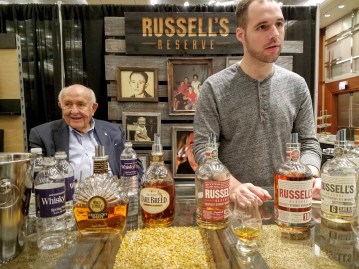
Turkey also appeals to me because it’s been the favored drink of self destructive writers for decades. Hunter S. Thompson was a known lover, Stephen King mentions it with distinction in a few books, and in his biography it’s listed as the drink of choice for perennial hipster literary icon David Foster Wallace.

Yet throughout all this pop culture iconography it’s always the bourbon they’re talking about. The rye always seems to be the unspoken younger sibling despite, at least from personal experience, it being the bartender favorite.

The Wild Turkey Rye is known as being a “barely legal” rye.  At 51% Rye/37% corn/12% barley it meets the bare minimum by law to be considered a rye whiskey. Yet, along with the brand Rittenhouse, it is a rye that kept rye alive in the decades when it was certainly not cool to drink. And it was certainly popular enough that when the 101 proof rye was dropped in 2012 there was enough of an outcry that it was reinstate a mere two years later. And now it might finally have its family champion.

Bruce Russell is the third generation of Turkey Russells and he is the current

WF-16.jpg
Like Grandfather, Like Grandson

driving force behind their rye, at least their high end stuff. While Jimmy Russell has always been unassuming and focused on the fact Wild Turkey makes two products, a Bourbon and a Rye, his son Eddie and grandson Bruce have championed the expansion of the range arguing differentiation through aging.

The idea that certain spots  in certain warehouses yield “honey” barrels is well established in Kentucky whiskey lore even if no one understands why that should be the case. But for Wild Turkey rye that took a new edge with the release of the Russell’s Reserve 6 Year rye and then even more focus with the Russell’s Reserve Single Barrel Rye.

While the single barrel carries no age statement it is clearly considered to be the upper echelon of the Turkey Family Rye. The 6-year was first introduced in 2007, the year after they raised the barrel entry proof from 105 to 115 and four years before the new distillery came online in 2011. This of course means there’s been a fair amount of flux in the production.

The rye itself is a fine example of Kentucky rye. It is all rich tobacco, which makes the old smoker in me shiver, a hint of dill, a full serving of citrus and a baked quality that ties in the darker spices and the heavy vanilla/caramel barrel notes. And it’s bottled at 104 proof which grants it the same oomph as its Wild Turkey 101 sibling.

The problem for me is twofold. 1) pricing and 2) transparency. The pricing hangup is easy for me to explain, I want quality at cost like it used to exist before the “Bourbon Boom” but that’s the old man in me yelling at the local teens to stay off my lawn: it ain’t going to happen. As for Number 2 there’s no denying that Jimmy, Eddie and now Bruce make good, and often great, whiskey but in an age where the consumer is more and more interested in the process of what ends up in their bottle the Russell’s Reserve Single Barrel Rye lacks any discerning features on the label. If a single barrel product is supposed to be different barrel to barrel I want to be able to compare barrels and bottlings, and nothing on the label gives me the ability to do that. There is no barrel number, warehouse ID, or even simply year or batch number. And these aren’t new requests. These are standard industry practices for single barrel and have been since single barrels were introduced in the 80s. Which brings me back around to the why of  why does the Wild Turkey Rye tickle my fancy so?

I think it has to do with placement. There is a wonderful sweet spot that the 101 Proof Wild Turkey Rye hits in flavor, cost, and history. While I can love the flavors and the drive to create more rye that the Russell’s Single barrel presents the balance between those things isn’t there for me yet.

But then again, aren’t we most critical of those we want the love the most?

maxresdefault
I mean if it’s good enough for Aragorn…

Whiskey Wednesday: McKenna’s Patience

Bourbon is full of history, tradition, and ancient family recipes.

Except when it’s not. (which is pretty much all the time.)

This call back to the golden days of our frontier forbearers is meant to impart some sort of permanence, stability, and a patriotic appeal to what is actually a relatively new spirit. Bourbon wasn’t defined as a unique product of the United States until the 1950’s. As far as the United States government was concerned the term “whiskey” wasn’t even defined until almost 1907. So, while the “Founding Father’s” of Bourbon were certainly making whiskey, they were following their own rules by making what felt like a good product to them. Most of the regulation like the Bottled In Bond Act were spearheaded by the distillers themselves looking for tighter control and quality of their products.

In the worst case this clarion call to the past is meant to mislead consumers, but even the best intentioned creates a consumer base deathly averse to change. This is antithetical to the alcohol industry needing to be an ever-evolving marketplace.

633175116783425504.jpg
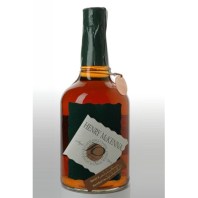
Why would you ever change this glorious label?!

I still remember my first gut reaction of, “Why the hell would you do that” in the modern whiskey world. It was the label change on Henry McKenna Bottled-In-Bond.

Henry McKenna is a name that harkens back to the early days of the Kentucky distilling world. In some circles he’s as highly regarded as George T. Stagg and William Larue Weller, (very well regarded indeed).

McKenna was an Irish immigrant that moved to the Kentucky territory in 1838. Like many Irish immigrants at the time Henry worked on the railroads helping build the country’s early infrastructure. Also like many other immigrants he went into less backbreaking work as soon as he could.

He settled with his wife in Nelson County and by 1855 was a partner in a flour mill. Looking to make use of the spent grains they soon purchased a farm and soon after that were distilling about a barrel a day from the leftovers from the gristing process.

These early whiskies were almost assuredly all wheat but by 1858 the whiskey was had proved popular enough to hire a fulltime distillery manager and had begun distilling corn as well.

images.jpgThe whiskey produced at McKenna’s Nelson County distillery never carried the name ‘Bourbon’ but it was regarded to be of the highest quality. Newspaper at the time noted that McKenna never sold a drop that wasn’t at least three years old. There was even a bill introduced to Congress in 1892 asking for unlimited bond period on aging whiskey to prevent tax penalties on whiskey aging beyond the bond. This bill was known as “The McKenna Bill.” The next year McKenna passed away at the age of 75.

He left the business to his sons who had grown up in the distilling world. They managed the company until the advent of Prohibition forced them to mothball the distillery. But following Repeal James McKenna, a ripe 79, reopened the distillery with a distiller trained by his father’s original distillery manager supposedly keeping the family recipe intact.

James died in 1940 and the family sold the distillery to Seagrams, but not the original recipe. Seagrams marketed and produced Henry McKenna for decades until they dismantled the original distillery in 1976 and sold the brand to Heaven Hill in the early 90’s.

Under Heaven Hill two versions of McKenna are still on the shelves. The 80 proof Henry McKenna and the Henry McKenna 10 Year Bottled In Bond Single Barrel. You get one guess which one I love.

Not only does the Bottled-In-Bond meet all of the bonded regulations, it’s also 10 years old which is ancient in this shifting whisky scene AND it’s a single barrel so there is the possibility that each bottle you dive into will be different, a new variation upon the McKenna theme.

I’m spoiled and was able to purchase to Private Single Barrel a few years ago and haven’t tasted a regularly available bottling in a while. So, how does it stack up to all of that history?

l-s1yona3oobf95c.jpg

The nose is redolent of salted caramel, and the mid palette is all pistachio and pecan drizzled with vanilla and a dry, oaky, tannic finish. There is still a heat, and a rough around the edges quality from the its 100 Proof nature that hasn’t been fully tamed by its ten years in the barrel. It’s a whiskey that you can sip on but feels like it loves to be tossed around in a mixing glass as well, with plenty to offer a cocktail while not losing its identity.

This is most assuredly NOT the whiskey that Henry McKenna was making when he first set out to Kentucky nearly 200 years ago, but it is good modern whiskey. The label change I originally hated has grown on me and I’m sure that its updated look helped introduce it to a modern audience. Trying to stand on tradition alone can often leave us unable to see over the crowd, but perching on it’s shoulders can help show us the stage set for the future.