
What would you do with $130,000? Buy a house? A Tesla? Travel the world? Or maybe you decide screw it and go for the most expensive bottle of whisky ever sold: the Yamazaki 50 year old single malt 2005 release.
In October of 2016 one of the 250 bottles of Yamazaki distilled in the mid-1950s claimed the Guinness World record for the most expensive standard size bottle of whisky ever sold for $129,186. That’s a nearly 1300% increase over the original sticker price of $9,500. That’s a massive return on investment, even for 50 year old whisky, but it’s made even more impressive when you consider that the Yamazaki distillery itself is less than 100 years old and the first Yamazaki single malt wasn’t released until 1984.
 Suntory founder and first master blender, Shinjiro Torii and Masataka Taketsuru, “The Father of Japanese Whisky”, founded the Yamazaki distillery in 1923. Taketsuru had studied organic chemistry in Glasgow and was found by Torii after he made inquiries to Scotland looking for a whisky expert. Torii was told there was already one fully qualified in his own country and the two worked closely to build the Yamazaki distillery. However, the first whisky produced by the new company, dubbed the Suntory Shirofuda was a resounding failure. The Japanese drinkers preference for lighter, blended whiskies was blamed as well as Taketsuru’s fixation on doing things the “Scottish way.” Taketsuru was shunted away from the distillery to a beer factory where he served out the remainder of his ten year contract before leaving to start the Nikka distilling company, Suntory’s biggest rival.
Despite these early set backs the Suntory company pressed on, releasing the Kakubin in 1937 and after being postponed by WWII, the Suntory Old Whisky in 1950. In 1961 the company send the first Japanese Whisky imports to the United States and Torii’s son Keizo Saji took over as president and Master Blender. The next few years were full of experimentation including opening the Chita Distillery in 1972, the Hakushu Distillery in 1973, and the release of Midori in the United States in 1978. The next big shift for the company comes in 1984 when Saji moved the company away from it’s focus on blends with the very first release of Suntory Single Malt Whisky Yamazaki.
The 80’s proved to be a pivotal time for Suntory not only because of the new focus on single malts but because the other distilleries opened in the 70s allowed them to produce more varied styles of whisky culminating in the first release of the Hibiki Blended Whisky in 1989. The Suntory Single Malts may be carry the highest price tags but Suntory still considers themselves to be a blending house and the Hibiki’s are what they consider to be the pinnacle of their art.
All the pieces were in place yet as you may have heard the 90’s were not the most hospitable of decades to brown spirits. It took a new millennium as well as a series of rapid-fire rewards to rocket Japanese whisky from niche good to internationally coveted whisky.
The Yamazaki is caught between a rock and a hard place; soaring success chased by the rising struggle to support the base of that success.
In 2003 Suntory’s Yamazaki Single Malt 12 year won it’s first Gold Award at the International Spirits Challenge in the UK followed relatively quickly by Suntory becoming the first Japanese whisky producer to be awarder “Distiller of the Year” by the same ISC in 2010.
The Yamazaki Distillery expanded in 2013 with the addition of four stills, bringing the 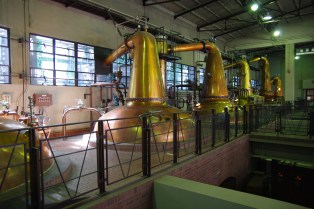 total to 12, which increased capacity about 40%. The added capacity didn’t prevent them from releasing the Non-Age Statement Yamazaki and Hakushu Distiller’s Reserve the following year just as talk of the worldwide whisky shortage began to surface. Also in 2014, Suntory purchased Beam, Inc. (home of the eponymous Jim Beam Bourbon) for $16 billion forming Beam Suntory, the third largest spirit producer in the world. This acquisition greatly expanded Suntory’s distribution lines spreading the already thin stocks of Yamazaki even thinner.
The final nail in the Japanese Whisky hype train was also driven home in 2014 when the Yamazaki Sherry Cask 2013 won the coveted Jim Murray “World Whiskey of the Year” award. With that the path is set and we’re barreling towards the inevitable $130,000 bottle.
Yet with all this focus on the mythical, never to be seen bottles that dominate the headlines, what has become of the mythical, occasionally glimpsed bottles that built the reputation of Yamazaki and Suntory in the first place?
The Yamazaki 12 Year is still liquid gold in a bottle. The whisky is aged in a combination of American ex-Bourbon, Spanish Sherry, and Japanese Mizunara oak cask. It is, you guessed it, a minimum of 12 years old and bottled at 86 proof. What has always struck me about this whisky is the amount of fruit on the nose. Ripe peach, with a touch of grapefruit and orange, followed by a rich lingering mid palette that leaves an almost toasted bread note before disappearing into a long finish that is edged with dark baking spices.
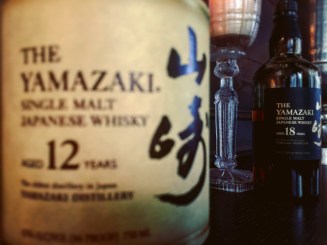 While the 12 year was once the perfect introduction to Japanese malt, before the price and the hype got in the way, it was the Yamazaki 18 year that always stirred my soul. This time roughly 80% Sherry casks with ex-Bourbon and Mizunara making up the other 20%. Here the promise of the 12 year has evolved into a stately elegance. The fruit dries out, turning to raison and apricot with dark chocolate and berries on the tongue with a touch of spice on the long march to the finish.
In the end these spirits are deserving of every award they’ve had draped around their bottles necks, yet I can’t help but feel like they are victims of their own success. The price on these bottles has steadily climbed while availability has dropped. Drinkers are driven to seek these “more available” bottles every time a headline splashes a story bottle of Yamazaki selling for more than the median household income of a small family only to be disgruntled when they turn up empty handed. Products like the Yamazaki Distillers Select, the Hibiki Harmony, or the Nikka Pure Malt may help bridge that gap in the category, but no matter how vehemently the companies talk about these products being “different” and “not replacements for age stated products” seasoned drinkers can’t help but feel that their old toys are being taken away while they’re charged more. It’s a story they see time and time again as the trend sweeps through whisk(e)y brands across the globe.
The Yamazaki is caught between a rock and a hard place; soaring success chased by the rising struggle to support the base of that success. It’s a good problem to have and one without an easy answer but it is a debate that certainly is helped with a glass of liquid gold in hand while you have it.


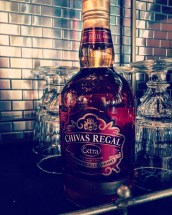 On a more approachable scale they’ve started producing the Chivas Regal Extra, a Non Age Statement blend designed to recreate the flavors of the original Chivas Regal 25 Year Blend that relies heavily on Olorosso Sherry aging. Then there is the new Mizunara.

 reflected the nature of the whiskey with a mellow, retro 70’s design. Simple. Clean, but not terribly exiting. And that’s where the change is happening to Pig’s Nose. The packaging is being aggressively overhauled to turn a few more heads. Nothing inside the bottle is changing, but with new liter bottles and a label that still looks classic yet undeniably more hip. It may seem like a small change but it is one that will get people to look past the outside to actually try the whiskey on the inside and ends up being the first label change in a long time that I actually enjoy.
 Bottled In Bond LA