Drinking Poetic: The Banana Dance

I’m prouder of the Banana Dance than almost any other drink that I’ve created. More so than I probably have any right to be. It’s an esoteric, nerdy, centrifuge requiring, relatively prep heavy drink that is ultimately delicious, complicated, and easy to batch and execute in a way that belies its complexity. Its evolution is also a damn good microcosm of my personal journey behind the bar in the past few years. 

The Banana Dance began life as the Josephine Baker as an entry for Diageo’s World Class competition three years ago. I had entered my very first competition the year before, a little competition known as World Class and having made it to the Western Regionals I was determined to make it back and prove myself. Prove that I wasn’t just some beach side Santa Monica bartender slinging Vodka Soda’s all day long. I certainly had a chip on my shoulder when I was younger. 

For my entry the following year I looked at the spirits available and decided that I wanted to play to my strengths with a stirred drink and ended up riffing on the modern classic the Chet Baker.  I knew the base was going to be Ron Zacapa Centenario and I wanted a drink name, and a flavor profile, that would compliment the story and flavors of the rum. Enter Josephine Baker. 

Josephine Baker

Josephine Baker was an African-American ex-Pat who rose to fame as a dancer and performer in Paris in the 1920’s. Earnest Hemingway once called her, “the most sensational woman anyone ever saw.” While being a multifaceted performer her most famous act, and photos, are of her dancing in a banana skirt. Josephine was more than a performer though. During WWII Josephine used the freedom granted to her as a performer to spy for the Allied troops and help smuggle refugees out of France. She was also incredibly active in the American Civil Rights movement later in life. Pairing this phenomenal woman’s story with a rum crafted by one of the few female master blenders in the world was a no brainer. 

Too add to that the Giffard Creme de Banan had just be released which provided a perfect flavor, and thematic, compliment to tie the two together. Add in a little amontillado sherry and a passable Old Fashioned style variation on the Chet Baker was born. It was serviceable but unfortunately didn’t make the cut leaving me out of the competition that year. I knew there was something special in there though and couldn’t let the idea go. 

The next year I ended up using some discretionary income to help fund Dave Arnold’s kickstarter for the Spinzall tabletop centrifuge because, well, I’m a nerd. I had already been experimenting with every technique that I possible could from Liquid Intelligence and had voraciously devoured every technique book I could get my hands on. I was actively experimenting with melding flavors in every way that I could. However, there were two pieces of technology that seemed like they would forever bne outside my reach: the rotovap and a centrifuge.  Now here was one of those unicorns just sitting on my kitchen counter. I went nuts. 

I played with infusing and clarifying everything but one of the most successful experiments was that original pairing of Sherry and banana. It was a relatively simple process, slightly overripe bananas were blended/ together with sherry and Pectin X and the resulting smoothie was run through the Spinzall clarifying the mixture. Here phenomenal fresh banana flavor married perfectly with the sherry with out adding any unnecessary sweetness like other creme products.  

The experiments took a hiatus however as I joined Team NoMad as one of the opening Bar Managers for NoMad LA. The training, translating and entire hospitality culture from NYC to LA, and opening four separate venues in a single building consumed my and my team’s attention for months. It was in this period that I also learned to collaborate in a way I never had before.  

Not only was this team larger than any I had ever worked with before, it was also the most talented. And while I was a leader this was not a program that was about me or my force of personality as so many venues I had worked on in the past were. This was about the guest experience and about working as a team to create the best product and experience possible. It was demanding, meticulous, and honestly exhausting. The light at the end of the tunnel was R&D. 

I love doing drink R&D. I love throwing things at the wall to see what sticks, I love creating crazy ingredients, and I love what seeing other people do with those ingredients. Once we were in a place to start R&Ding drinks specifically for LA I dove in head first. But you never walk into a R&D session with out a concept. The drink hiding up my sleeve that seemed to most fit this NoMad model I had learned was the Josephine Baker, updated with the new clarified Banana Sherry of course. 

If you check the NoMad compendium they make phenomenal drinks. They also rely heavily on sherry and a lot of small culinary touches. This comes from the collaborative R&D process as well as the fact that NoMad bar was birthed out of the bar at Eleven Madison Park which is absolutely driven by the mentality of its award winning kitchen. 

This was going to be the first time putting any of my drinks through this culinary tasting style with a group of incredibly talented, and opinionated, peers. I’m still amazed to this day how the process can create a drink that is both unrecognizable from the original yet still wholly in the same spirit and design. 

The first thing that became clear was that style of sherry needed to be dialed in. We quickly moved away from the darker amontillado in favor of an oloroso which left more acidity with the banana. The Banana Sherry was a crowd favorite and we decided to make it the star of the show. The banana sherry became the base of the drink instead of a modifier. 

To add back in some of the richness that the clarification process had stripped out of the sherry we turned to another classic NoMad ingredient, Brown Butter Falernum. Essentially a brown butter washed Velvet Falernum that add in baking spices, a rich mouth feel and tied back into that original idea of bruleed bananas and sherry that had inspired the flavor pairing. 

Finding the right balance was tricky because the Falernum can easily overwhelm. As a through line between the Sherry and the Falernum was added Blanc Vermouth. A touch of bitter to go with the vanilla that lengthened the flavors. It wasn’t quite bitter enough so a quarter ounce of Punt e Mes was also added to round out the effect. This firmly moved the drink out of the Old Fashioned style and into the Manhattan style, a subtle but important distinction. 

At this point I gave into my true desire to make every drink a whiskey drink and pulled the Zacapa and subbed it with Greenspot Irish Whiskey. This Pure Pot Stilled Irish Whiskey is aged in New American Oak. It has an intrinsic bright green banana note as well as the barrel tannins to be a base for all of these complex flavors to stand on. 

At this point the drink was good but the culinary drive for perfection kicked in and we went through countless more variations. The difference between them being a teaspoon of this versus a dash of that. The final touches were a teaspoon of Walnut Liquor to bring a bit more tannin and a nuttiness to compliment the banana as well as a teaspoon of Verjus Blanc to add in a hint of acidity to cut through all of the rich fruits and fats. 

The drink was now a lovely fruit forward, complex, surprisingly dry, low ABV stirred drink that still had enough depth and tannin to stand on its own as well as pair with food. It was a real crowd pleaser while still being esoteric and weird. It was my kind of drink. It just needed a garnish and a name. 

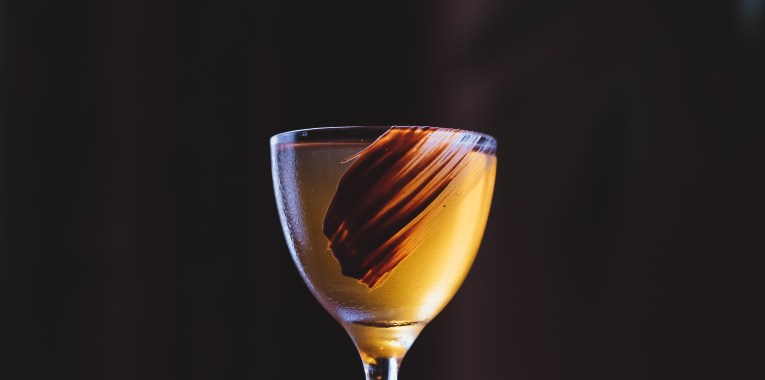
The garnish was easy. While I personally love an incredibly dry drink I know not everyone does. And the drink ingredients could read sweeter than the final product. So, to appease both types of drinkers a single brush stroke of chocolate ganache was added to the outside of the glass. This allowed the guest to choose their own adventure. If they wanted the drink slightly sweeter they could indulge in the chocolate or leave it alone. It also ads a look of elegance has an elegance that can sit just at the tip of the lips. 

The name quickly followed. While the drink had come miles and even years from its roots with Josephine her spirit, her dance, still infused every ounce of this drink and thus it was christened the Banana Dance. 

I love this drink. I think that the prep needed for it is relatively small considering the final product. Especially for the Banana Sherry. I was fortunate enough to finally utilize a version of this drink, with the Banana Sherry and Zacapa, at the World Class National Finals this past year bringing the drinks journey full circle. 

I’ll never create a drink that’s a modern classic but I hopefully will create things that inspire people and tickle their imagination. The NoMad just published a brand-new cocktail book and while sadly the Banana Dance didn’t make the cut the Banana Sherry did. Bright and bold at the top of the ingredients section is the recipe for Banana Sherry. 

Hopefully this little dance will continue to inspire people not only in my extended NoMad family but the entire cocktail community that has embraced me and given me so many opportunities this past decade. 

Photo Credit: Jordan Hughes
@highproofpreacher

The Banana Dance:

1.5 oz Banana Infused Oloroso Sherry (Preferably Lustau)
.5 oz Greenspot Pure Pot Still Irish Whiskey
.5 oz Blanc Vermouth
.5 oz Brown Butter Washed Velvet Falernum
.25 oz Punt e Mes
Tsp Verjus Blanc
Tsp Nocino

Combine All ingredients in a mixing glass.
Short stir with Kold Draft Ice.
Strain into stemmed cocktail glass painted with a chocolate ganache brushstroke.

Banana Sherry:

750 ml Oloroso Sherry
3 overripe bananas
3ml Pectin X

Blend all ingredients together.
Into the Spinzall spindle add 375ml and set to continuous mode.
Once the centrifuge reaches full speed pump the rest of the mixture in at 80ml/minute. The should run clear.
Once all liquid has been pumped into the centrifuge let it run for another 5 minutes then power down and strain the remaining liquid through a chinoios.
Bottle and store under refrigeration for up to three (3) weeks.

Brown Butter Falernum:

750ml Velvet Falernum
.5lbs unsalted butter

Cube butter and place in pot over medium heat. 
Melt and constantly whisk butter so that milk solids brown evenly
Continue to brown, whisking constantly, until as dark as the color of an almond skin
Remove from heat, and add velvet falernum
Transfer to cambro and place in freezer until the fat has risen and solidified on the top 
Remove solidified fat cap from top and discard
Bottle and store under refrigeration for up to one (1) month

Drinking Poetic (On A Christmas Wednesday): The Nutcracker

I’ve always felt disconnected from the Holiday season. While I grew up Catholic it has had been many a solstice since I identified as such. I’ve also spent the past 10+ years living 2,500+ miles from the family and friends I grew up with. As such when the holidays roll around I often find myself latching on to the traditions and celebrations of my friends. Which is why the one tradition that I do have from my childhood is so fascinating to me. 

When I was about 5 my grandfather gave me a nutcracker for Christmas. My siblings were so jealous that the next year he gave all four of us our own nutcrackers. It was a few more years, and arguments about which nutcracker belong to who, before we started putting our names on this ever-expanding collection. So while they ostensibly belonged to someone they were really just collectively ours. When my grandfather passed away my grandmother took up the tradition and it took on new meaning.  If you enter my family’s house at Christmas a veritable army of wooden soldiers, drummers, cobblers, and pirates stand ready to perform their ceremonial duty. 

Like all terrifying dolls the nutcrackers eventually escaped their Christmassy confines and spilled over into the rest of life. Currently sitting on my desk in the 70 degree California sunshine is a board short wearing, hipster beard sporting, surfer bro nutcracker that marked my first full year on the West Coast. It’s a touchstone that exists beyond its original conception. 

It also led to the creation of the Nutcracker Cocktail. 

The Nutcracker was originally conceived as a drink for the Heaven Hill Bartender of the Year competition a few years ago. I drew on all of the above thoughts about tradition and threw them into a glass. I wanted a drink that was very evocative of a time and place but that also existed outside of its “seasonality” just like the Nutcracker resting on my desk. 

I knew I wanted the drink to be based around Elijah Craig Bourbon. Not simply because it was one of the options for the competition but because it is an actual touchstone whiskey for me. The very first private barrel of whiskey I ever picked out was a barrel of Elijah Craig. It’s a whiskey that’s been my companion through my journeys behind bar since the very beginning. It carries a weight, a depth, a tannin, and an earthiness that makes it a classic backbone for a whiskey focused drink. 

Next, I wanted a solid bitter base to enhance the earthiness while also adding in an extra dry component to balance the sweet components I knew would inevitably make their way into the glass. The Clemanti China provided a suitable Manhattan-esque build while adding in a beautiful shock of the bitter. 

Next were the seasonal elements. You can’t call a drink “The Nutcracker” without any nuts so a touch of Nux Alpina Walnut Liqueur added in a discernable nuttiness to play off the base of the Elijah Craig. This Made the drink Nutty but still dry, too dry. To balance this a hint of Tempus Fugit Crème de Cacao added in both the Christmas sweetness and memories as well as a balance for the dry, dry, dry components. 

To tie it all together, and to add a hint of fruit to brighten up all of these dark nutty elements, a few finishing dashes of angostura orange bitters went into the mix. 

Now, this drink was fine. However, it didn’t evoke anything larger than itself to me. It was a wintery sipper that was Mostly just a slightly esoteric Manhattan. It needed something to pull it out of its time and place.  

I briefly considered making it a warm drink but that would have turned it into a drink that I had no interest in drinking. I almost universally hate hot beverages, from coffee to tea and everything in between. So, instead I turned to other childhood memories as well as my local Japanese grocery store. In both of those places I found chestnuts. 

Growing up there were several horse chestnut trees in my yard which when the chestnuts would fall I would end up chucking at my siblings as children do. And in the Japanese market there were wonderfully proportioned bags of roasted, soft chestnuts for the holidays. This was the missing factor for this drink. 

I pulled out the Spinzall and infused the chestnuts into the Elijah Craig, stirred everything together and expressed an orange zest over the drink tying in the underlying orange bitters. Now the drink sang. It was complex, fruity, dry with an intriguing sweetness, and was no longer simply a “Christmas Drink.” 

The Nutcracker:

1.5 oz Chestnut Infused Elijah Craig Bourbon
.5 oz Clemanti China Antique
.25 oz Hau Alperine Nux Walnut
.25 oz Tempus Fugit Crème de Cacao
2 Dash Angostura Orange Bitters

Combine all ingredients in a mixing glass.
Stir with Kold Draft Ice.
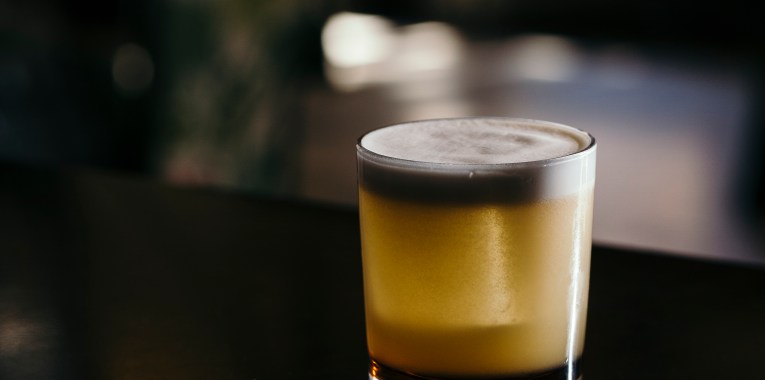
Strain into a punch glass.
Garnish with an orange twist studded with clove. 

Revisiting this drink years later there are a few changes I would make. I might add a splash of Verjus to add in more acidity to the heavy nature of the ingredients. Or I might add in a touch of Oloroso Sherry to length the drink while staying rich and stirred. 

But then again, some traditions shouldn’t be over thought. 

Drinking Poetic (on a Wednesday): The Los Angeles Sour

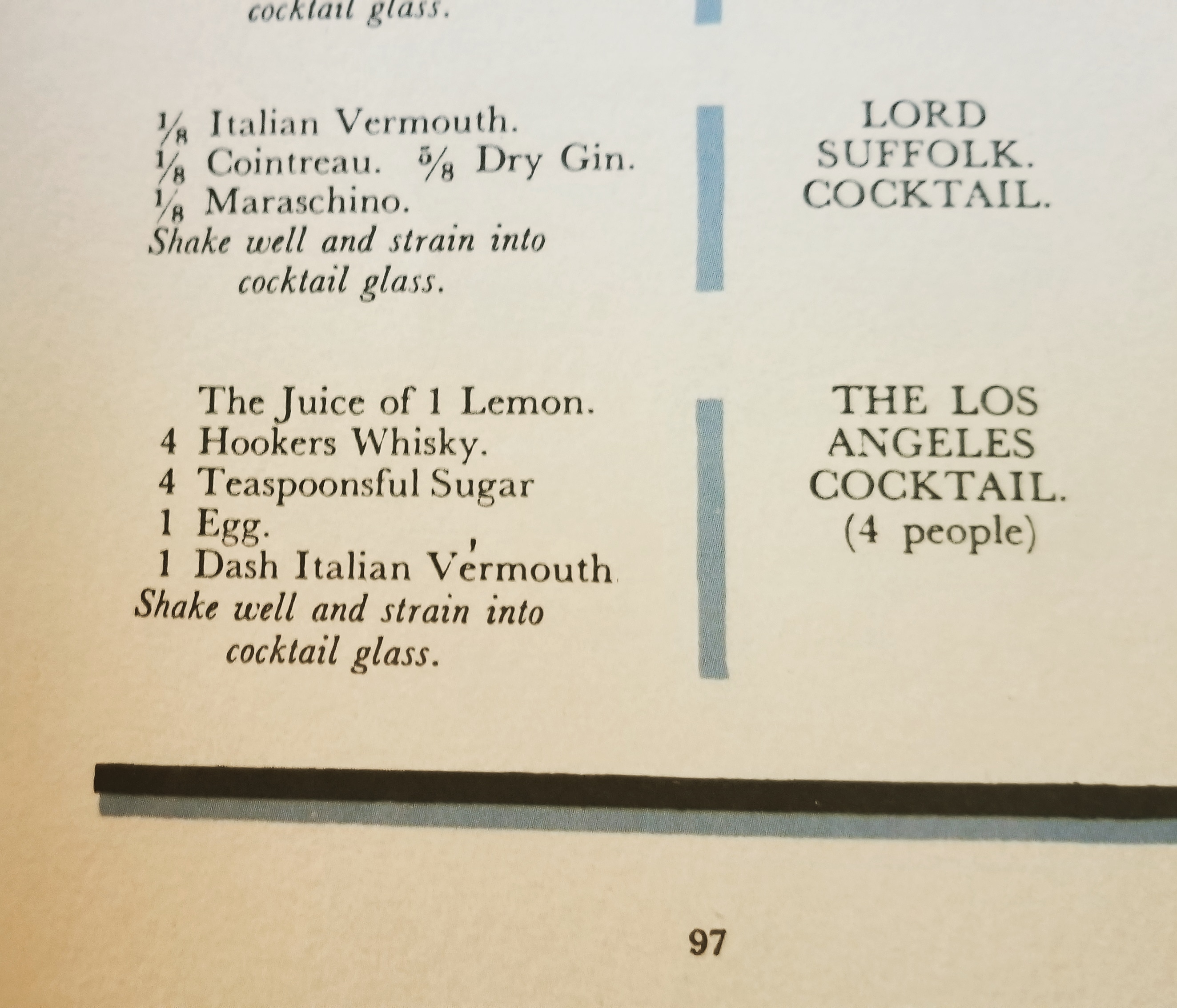
The Los Angeles Cocktail is terrible and is a perfect example of a bad drink that survives because it’s old. 

Buried within the pages of the Savoy Cocktail book, one of the quintessential drink tomes of the Golden and Modern cocktail age, is a drink that reads like a New Yorker describing their “totally real” visit to L.A. There are so many things that irritate me about this drink, the very first of which is that it’s not a damn cocktail!

A irreparably irritating recipe

Despite being listed alphabetically in the “cocktail” section there’s nothing about this drink that ties it to the traditional “cocktail” family of drinks. It contains no bitters and has enough citrus to dilute the base spirit beyond recognition. Apart from that the drink is described as serving four people, uses blended whiskey, powdered sugar, a whole egg, and only a “splash” of vermouth. It’s just a worse version of a New York Sour. While L.A. may have once been the subpar New York City that is certainly not the case any more and I think that’s what makes this drink stick in my craw.  

There are so many little things that are off about this drink that it’s stuck in my head for years. I’ve lived in LA for a decade now and I feel like I’ve earned the right to call myself an Angeleno, so if a drink is going to be named after our city it should be damn good drink. 

The first thing that I wanted to do to adapt this drink was scale it down. A drink designed for only four people is not efficient for service, though considering that L.A. often rolls twelve deep I can’t blame them for trying. Scaled down from four hookers (a measure of 2.5 ozs) to the standard 2 oz jigger of booze, a classic proportion of sour to sweet, and using an egg white instead of the whole egg creates a palatable, if completely forgettable, sour.  

This adjusted recipe reads: 

  • 2oz Whiskey 
  • 1 oz Fresh Lemon Juice
  • .75 oz Simple Syrup
  • 1 Egg White
  • 25 oz Vermouth 
  • Combine all ingredients in a mixing tin. Dry Shake. Shake With Ice. Double Strain. 

The next sticking point is that there’s nothing about this drink that actually says “L.A.” And while the same can be said about the New York Sour, which may have actually originated in Chicago, if we’re going to improve a drink why not make it more representative? With this in mind the inoffensively mediocre powdered sugar was swapped out for a 50 brix Piloncillo syrup. Pilconcillo, or panela, is an unrefined, whole cane sugar typical of Latin America. It is made from the boiling and evaporation of sugar cane juice. It is commonly used in Mexico and has more flavor than brown sugar which is often white sugar with a little added molasses. This gives the drink a richer texture while also tying it into the Latino heritage of Los Angeles. 

Elijah Craig and Dubonnet Improved Los Angeles Sour

Next up was the spirit base. The richer piloncillo syrup completely overwhelmed lighter whiskies so I turned to my trusty baseline: Elijah Craig Straight Kentucky Bourbon. This added a delightful tannin and vanilla note but was not playing nice with the vermouth and lemon. So, I traded the vermouth for the recently reconstructed American version of  Dubonnet Rouge. Served over a large rock with a float of the Dubonet the flavors were able to develop over time and the extra bitterness from the quina in the Dubonet helped tie the drink together. I actually used this drink for the regionals of the Heaven Hill Bartender of the Year competition this year and it’s absolutely delightful.

L.A. Sour: 

  • 1.5 oz Elijah Craig Small Batch 
  • .75 oz Piloncillo Syrup (50 Brix) 
  • .75 oz Fresh Lemon Juice 
  • 1 Egg White 
    • Dry Shake. Double Strain over one large ice cube. 
  • Float .75 oz Dubonnet Rouge  

There’s no practical need to go further than this. The drink is delightfully crowd pleasing, recognizable, and recreateable. I highly recommend making this version of the drink yourself.I couldn’t set the drink down though. It kept burrowing through my brain begging for attention. 

I have a natural disregard for “blended” whiskies. I find them light and forgettable but that doesn’t have to be the case. There are some beautiful blended malts  and grain whiskies on the market, and not all of them are Japanese. So, I broke down the components and built up a house whiskey blend to complement the flavors.  

It starts with an ounce of Bushmill’s 10 Year Single Malt. Irish Malt is lighter and fruiter than the more familiar Scotch malts while being more affordable than the Japanese counterparts. The Bushmills 10 also grants a solid barrel note and the vanilla that was coming from the Elijah Craig. Next, I wanted some spice and proof without overwhelming the delicate Irish malt so I added a half ounce of Old Overholt Bottled In Bond Rye. This added an oiliness, viscosity, and tannin that helped dry out the drink. 

Finally, to lengthen out the blend, a half ounce of grain whiskey was added. The Nikka Coffey Grain would have worked wonderfully, but the pricing and recent announcement that it was being discontinued shut that experiment down. Though I have recently heard that it is only discontinued in Japan with plenty of stock in the U.S. remaining so it may be worth revisiting. In the mean time I headed back to the Emerald Isle where the Teeling Single Grain offered a compliment to both the Bushmill’s Malt and the Overholt Rye bite.

This house blend was delightfully robust but the Dubonnet, instead of being a unifying factor, was now coming across as thin, just like the vermouth in the original spec. The drink needed something richer while still maintaining that vermouth bitterness and acid. It needed to be concentrated. With that in mind I turned to my favorite toy, the rotovap. Running Dolin Rouge through the rotovap produced two wonderful products.  

First a clear, concentrated vermouth flavored distillate. Second, a concentrated vermouth syrup that was left behind as the more volatile compounds were syphoned off. Both of these products are lovely, especially the syrup. However, I couldn’t imagine using this process to produce enough to maintain the volume of service that we do at NoMad LA so I went back to the drawing board. 

With this concentrated Vermouth reduction as a benchmark we found that a traditional stove top reduction with 50% sugar by weight produced a vermouth syrup that was, as my father would say, “Good enough for government work.”  

All the elements were now in place. Here was a drink that payed homage to its vintage roots, added in elements of the city it’s named for, and incorporated modern techniques, culinary thoughtfulness, and contemporary palettes and drinking styles. I’m also incredibly proud of the fact that this is the only drink I’ve ever put in front of our Bar Director Leo Robitschek that he had no tweaks for.  

The Los Angeles Sour now reads on the menu at NoMad LA as: 

  • 1 oz Bushmill’s 10 Year Single Malt 
  • .5 oz Old Overholt Bottled In Bond Rye Whiskey 
  • .5 oz Teeling Single Grain Irish Whiskey 
  • .75 oz 50 Brix Piloncillo Syrup 
  • .75 oz Fresh Lemon Juice 
  • 1 Egg White 
    • Dry Shake. Shake with Kold Draft Ice. Double Strain over one large Ice Cube
  • Float .75 oz Dolin Rouge Vermouth Reduction 

I do have to admit I’m cheating for the sake of a story. Leo did have one critique. I originally pitched the drink with aquafaba, (a vegan egg white substitute made from beans), instead of egg white because lord knows L.A. loves its dietary restrictions. Both versions of the drink past muster but the egg white variation felt more robust. But because of this original thematic pitch, and aa cheeky nod to L.A. drinkers, the Los Angeles Sour will always available “vegan upon request.”

Drinking Poetic: The Ship of Theseus


I compete in a lot of bartender competitions. Not only is it a great tool for advancing my career I also just find it fun. Like really fun. I love the whole shebang. I have a background in theater so I spend a lot of time crafting the oration and spectacle of the presentation trying to meld the drink with the competition performance. But ultimately, those 6-8 minutes presenting make up a fraction of the work that goes into competing. Because it doesn’t matter how great your soliloquy is if the drink doesn’t match up.

IMG_3469

The R&D is where the true spirit, and fun, of these competitions lay. I’m incredibly fortunate to have an amazing collaborator in the form of my lovely, talented, and extremely patient girlfriend and some, if not all, of my best drinks have come out of R&D with her for these competitions. A lot of ideas end up on the cutting room floor only to find themselves resurrected for a cocktail menu down the line. Or sometimes ideas that have been kicking around your head find the absolute perfect outlet in a competition prompt.

That was the serendipitous case with The Ship of Theseus.

One of the cocktail prompts for Heaven Hill’s Bartender of the Year 2017 was to submit a drink based on a classic cocktail. This isn’t an unusual prompt but its one that’s always been difficult for me because, in my experience, drinks based on classics are really just classics with a part replaced. Can those really be called original cocktails?

This problem of identity is something that I would think about late night, several whiskies in while closing the bar and when it came up for the competition my late night musing immediately turned my thoughts to “the Ship of Theseus.”

The original Ship of Theseus isn’t a drink but a philosophical conundrum that has been debated for centuries And it goes like this: Theseus, the classic Greek hero who slew the minotaur, has a ship. On that much everyone can agree. But after slaying the minotaur Theseus returns to port needing a few repairs on the ship and a few replacement crewmembers. He then returns to adventuring and doing more hero things. This of course leads to more repairs and replacements. This time the mast, next time the rudder, this time a first mate that foolishly headed the siren’s call. Eventually every last plank, rivet and crew member of the ship has been replaced. With none of it’s original components intact is this still the ship of Theseus? And if it’s not when did it stop being that original ship? After the first repair? After the 31st?

Let’s make it even more complicated. Lets say the shipwrights doing the repairs saved all of the pieces they replaced and built another ship out of them and the two ships now float side by side in the harbor. Which one is the original and which one is merely ‘inspired by’?

71zCI-rBVbL

While giving this long winded explanation to my girlfriend (have I mentioned how patient she is?) she casually asked if there were any ship based classic drinks which immediately brought up one of my least favorite drinks, the Remember The Maine. It first appears in Charles H. Baker’s 1939 book the Gentleman’s Companion and traditionally looks like this:

2 oz Rye Whiskey

.75 oz Sweet Vermouth

.25 oz Cherry Herring

Dash of Absinthe

Stir on ice and serve up.


Named after the U.S.S. Maine, a battleship sunk under suspicious circumstances of the coast of Cuba who’s sinking was used to insight the Spanish-American War with the battle cry “Remember the Maine, to Hell with Spain.” The drink has always fell flat for me so it seemed like the ideal ship to hit with a few “repairs.”

LWF-Feb-08.jpg

First, the Maine isn’t a true cocktail because it doesn’t contain any bitters so a few dashes of orange bitters were added. Next, the Cherry Herring in the Maine is one of my least favorite ingredients. I find it overly sweet and muddled, so I subbed it out for Kirschwasser, true cherry brandy. This made the drink brighter, more fruit forward and drier. This allowed the vermouth to be swapped to a Chinato style that added in an extra bittersweet quality to balance out the kirsch. Then the base remained rye whiskey, after all you need certain key features to be a ship, but using Rittenhouse BiB adds a depth and a back bone that is more specific than calling out for a “rye.” The drink ended up with an elegance and subtly that the absinthe in the original would have destroyed so the absinthe was dropped in favor of a chartreuse rinse on the glass to lend those floral, herbal notes with out disrupting the ships internal balance.

The new recipe looks like this:

IMG_4524.JPG

1.5 oz Rittenhouse BiB Rye

.5 oz Kirchwasser

.5 oz Alessio Chinato Vermouth

2 dash of Angostura Orange Bitters.

Stir on ice. Strain into a cocktail glass rinsed with

Green Chartreuse.

Garnish with a marasca cherry

Identity Crisis Optional

Both ships now get to float side by side completely distinct. The Ship of Theseus is clearly no longer just a variation of the Remember the Maine but I’d be hard pressed to tell you when that change over happened. It’s a conundrum that deserves a drink of mythic proportions and I think I might have just the perfect one for it.

download.jpg