Whiskey Wednesday: Changing A Pig’s Nose

Consolidation is the name of the game. Every week there is another story of a small or independent distillery being purchased by a bigger player. Most recently Bacardi purchased a minority stake in Teeling Irish Whiskey, Diageo paid nearly a billion dollars for George Clooney’s Casa Migos Tequila, and Pernod Ricard got into the mescal game with Del Maguey. No matter who the players are it always means some sort of change.

It’s not just a story of international conglomerates snapping up fast rising names either. Look at the recent merger of Spencerfield Spirits and Ian Macleod Distillers. Spencerfield was the brain child of Alex Nicol, the former marketing director of Glenmorangie. The company was built on solid, old school blended whiskey labels, like Sheep Dip and Pig’s Nose. They’ve been having explosive success with its Edinburgh Gins, which have become the #1 craft gin in all of Scotland. Alex had close ties with Ian Macleod, the makers of Tamdhu and Glengoyne, sourcing much of the whiskey for the Pig’s Nose and Sheep Dip blends and using their bottling facilities for their brands. As Spencerfield grew a more formal partnership seemed inevitable.

Compared to the massive deals mentioned above this merger is still a small player but it’s a great case study in what this kind of deals can yield. The Spencerfield Brands gain more direct, consistent access to primary ingredients for their brands, while also gaining access to a larger distribution and marketing network. Ian Macleod then expects the brands to continue to show an increase in performance to justify the money spent bringing them into the fold. And that means increased sales. Which means grabbing the attention of new consumers. Which means change.

The most dramatic example is Pig’s Nose. The brand was originally started in the 1970’s but was revitalized by Alex Nicol and is proof that good whiskey doesn’t need to be expensive, or carry a massive age statement. It just has to be made with care. Bottled at 80 proof and made up of a blend of 40% single malts to 60% grain whiskey, the Pig’s Nose has a massively high malt content for a “non-craft” blended whiskey. It’s name comes from the whiskey being “as soft as a pig’s nose” and is a great workhorse (or work pig) in the bar world. The whiskey has a subtle fruitiness that lends a extra layer onto the malty, butterscotch middle while the whole dram remains round and soft. It’s a great cocktail backbone while still enjoyable on its own. And on top of that it was always affordable. It’s a phenomenal sleeper, an unassumingly delightful whiskey.

However, its biggest struggle has always been that it is unassuming. The packagingimages.jpg reflected the nature of the whiskey with a mellow, retro 70’s design. Simple. Clean, but not terribly exiting. And that’s where the change is happening to Pig’s Nose. The packaging is being aggressively overhauled to turn a few more heads. Nothing inside the bottle is changing, but with new liter bottles and a label that still looks classic yet undeniably more hip. It may seem like a small change but it is one that will get people to look past the outside to actually try the whiskey on the inside and ends up being the first label change in a long time that I actually enjoy.

These small changes happen with every brand purchase and merger. What the change is varies from brand to brand and company to company but over time they accumulate, slowly altering the brand until it’s no longer what it was. Sometimes, like with Pig’s Nose, it’s a positive face lift. Other times, it’s a slow loss of quality, or of personality that leads to the brands identity completely shifting. It’s an ever evolving world of spirits but by watching these changes we can see where to throw support and where to abandon ship because they tides they are always a’ changin’.

 

download.jpg

Whiskey Wednesday: A’bunadh, Aberlour A’bunadh

Bigger is always better right? Just like the old fashioned way is the best way. Or at least that’s what Aberlour has been banking on the past two decades with their A’bunadh releases.

Despite a history stretching back nearly 140 years Aberlour still feels relatively unknown to the wider world. The distillery was founded in 1879 by James Fleming who built an extremely modern distillery for the time powered by a waterwheel driven by the Lour river . Aberlour literally means “the mouth of the chattering burn” and was supposedly named for the ancient Druids belief that the river actually spoke to them. The water for the distillery is drawn from St. Drostan’s Well, which only adds to the mythic nature of the Aberlour’s waters as the well is named after the 6th century Columbian Monk who supposedly used it as a baptismal site. So, like many Scotch distilleries there is a lot of history, myth, and legend involved.

James Fleming operated the distillery until his death 1895 and then the distillery changed hands over the years, being acquired by S. Campbell & Sons in 1945, before being sold to Pernod Ricard in 1974, who updated and expanded the distillery the following year, finally merging  the former Campbell Distilleries with the Chivas Brothers in 2001.

Aberlour is quintessentially Speyside in style and is double cask matured. Unlike the more well known Balvenie line, the Aberlour line isn’t finished in a second style of oak. Instead, the malt is fully matured in ex-bourbon or Olorosso Sherry barrels and once they are finished aging these different barrel styles are batched together. The proportion varies depending on the interation. The 12 Year is 75% Ex-Bourbon, the 16 year is 50/50, and the A’bunadh is 100% Sherry. And while the general line up of Aberlour might be less known the A’bunadh definitely has a cult following. Though it was first released in 2000 the A’bunadh story actually begins with that distillery expansion brought on by their purchase by Pernod Ricard in 1975.

During construction some workers stumbled upon some an 1898 newspaper with a story about the distillery fire that year, wrapped around a bottle of Aberlour from 1898. The workers who discovered the bottle finished off most of the bottle before guilt kicked in and they turned the bottle over to the master distiller, who immediately sent the remainder off to the laboratory for analysis. The A’bunadh is an attempt to recreate the whiskey in that bottle.

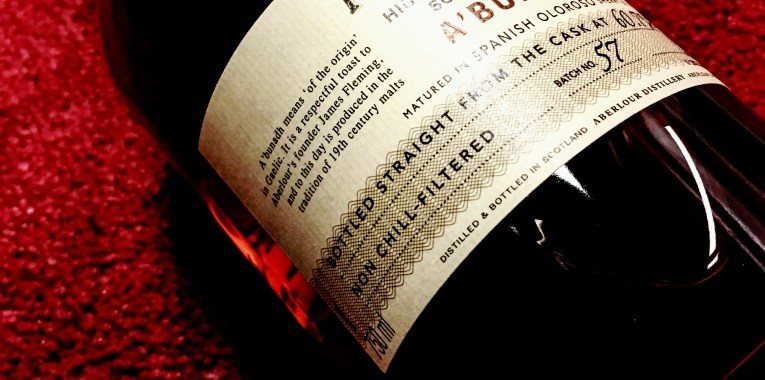
“A’bunadh” means “the original” in Gaelicand if the above story is to be believed this is the style of malt the distillery was making before it’s catastrophic fire in the late 1900s. There is no age statement, each batch is blended together from malts ranging from 5 – 25 years old, is non chill filtered, and bottled at cask strength. It is 100% Olorosso Sherry barrel aged and though there is no age statement , each batch is uniquely numbered allowing whiskey connoisseurs, otherwise known as nerds, to easily track the “best” batches.

2017 saw the release of Batch 58 but I’ve still got a few bottles of the 57 hanging around and it lives up to its predecessors. There is a massive amount of all spice and caramelized orange on the nose. There is a massive amount of that Sherry sweetness, melded with orange, dark fruit, a little bitter chocolate and heavy malt. The finish is long and sustained and with Batch 57 coming in at solid 11.42 proof the mouth is left dry and clean afterwards.

Whether or not the A’bunadh actually is like the original malt distilled at Aberlour is rather irrelevant at this point. It has certainly earned its place in the Single Malt hierarchy and deserves a little more love from those of us not constantly dreaming about our next dram.

Whiskey Wednesday: The Experiential Exceptionals

I’m told my generation, (I refuse to say ‘Millennial’) values experience over material possessions. That a memory formed, or an adventure had is more important than the shiny new car. My intense desire for a Tesla would be my argument to that hypothesis but this experiential mentality is appealing and you can see it leaking into almost everything, including booze. There is definitely a trend towards one off releases and in the scotch world more small producers are creating blends not with the idea of creating decades long consistency but of constantly evolving smaller bottlings, aiming for consistent quality if not consistent flavor.

In the scotch world more small producers are creating blends not with the idea of creating decades long consistency but of constantly evolving smaller bottlings, aiming for consistent quality not consistent flavor.

Don Sutcliffe, of Sutcliffe and Sons, along with Willie Phillips, the former managing director of The Macallan, created The Exceptional Whiskies with this experiential philosophy at the forefront of mind. They say it outright. They’re not looking to create year-in, year-out consistency. They want each edition to be ‘individual’, ‘distinct’ and ‘memorable’. Since 2013 they’ve released 2 editions of the blended grain and their blended malt, and now they’ve got the first edition of their own blended scotch to add to the line up.

It follows in the same philosophical vein and draws on decades of experience and relationships. It takes grain whiskies from North British, Strathclyde and a 33 year old Cameron Bridge and blends them with single malts from seemingly all of Speyside including: Glenfarclas, Ben Nevis, Balvenie, Kininvie, Glen ddich, Alt- a’Bhainne, Auchroisk, Glenallachie,Westport, Speyside and a splash of 30 year old Macallan. Then all of that is finished in first fill Olorosso Sherry barrels. The result is fruity, rich, very light up front, with a honeycomb sweetness and a definite herbal nose.
So what’s the result? It’s good whisky. But is it any more than that?

Exceptional.jpgThe cynic in me wants to say that the whole ‘unique experience’ is marketing talk for ‘we can’t get the ingredients to make this anymore.’ That it’s just another way to cash in on the whiskey boom. But looking at how long Don and Willie have been doing this it looks more like to men tired of doing the same thing day in and day out. It has the feel of wanting to find something new, to experience and share it. So what does the millennial in me say? That it’s not a generational thing. That it’s just a human thing.

Whiskey Wednesday: The Harmonious Hibiki Harmony

In recent years Japan, traditionally the Land of the Rising Sun could easily be called the Land of the Rising Whisky. And while that is a terrible turn of phrase, it is nevertheless true.

Ever since Glenfiddich started promoting their Single Malt in the States in 1963 whiskey drinkers- especially malt whiskey drinkers, have been hammered with the idea that Single Malts and age statements are the mark of quality. And across the globe the
Japanese were quietly and efficiently sticking with the old school blending mentality and fine tuning all of the nuts and bolts. Ten years ago it seemed like no one knew that the Japanese even made whiskey and now they are some of the rarest unicorns on the market.

mj-618_348_bill-murray-suntory-whiskey-tktktktk.jpg
Suntory Time

The big Japanese whisky houses are suffering from the same shortages and price inflation we’re seeing in the rest of the whiskey world.  With them it seems more noticeable because they only reached the mainstream consciousness here in the US so recently. But it’s not an artificial shortage. I just got back from a trip to Tokyo and even there the ol’ standards we came to rely on were nowhere to be seen.

They are moving to address this imbalance, and that’s part of the benefit of Suntory seeing themselves as a blending house as well; they have an internal system that allows them to adapt. In the US they’ve released Suntory Toki (which you can read more about here) to address our need for a Japanese Whiskey for cocktails. But the big shift for most people was discontinuing the Hibiki 12 and introducing the Hibiki Harmony.

The Hibiki’s have always been the ones that Suntory considers to be the highest form of their art and is meticulous in its attention to detail. The name Hibiki means “resonance” and is meant to represent the Suntory philosophy of living in harmony with people and nature. The goal is to create a harmonious balance between the malt and grain whiskies that make up the blend. Even the bottle is meant to represent that natural harmony. The bottle has 24 facets meant to represent the 24 seasons of the traditional Japanese calendar. This attention to detail and the quality of Hibiki didn’t go unnoticed and the 12 year especially became a fan favorite. But pricing and stocks have buried the 12 year and soon after it’s demise along comes the Hibiki Harmony.

IMG_3196.JPG
Shortage Be Damned, Hibiki 17 Minis

Beam Suntory is quick to point out that the Harmony is not meant to be a replacement for the 12 Year. The Hibiki 12 Year was actually unique among the Hibiki blends in that it utilized a small amount of whiskey aged in plum wine casks. With rising demand, depleting stock, and this blending element only being used for this one bottling the decided to just stop making the 12 Year.

The Harmony is actually meant to be a more affordable available version of the Hibiki 17 Year with its hint of Mizunara (Japanese Oak) aging.  The Hibiki blends pulls whiskey from all three Suntory distilleries: Yamazaki, Hakushu, and Chita. The Harmony utilizes Chita Light grain whiskey with Yamazaki American Oak aged whiskey as the primary malt. The supporting players are Spanish Oak and that Hint of Mizunara with Hakushu Heavily peated malt for flavoring. The result on the Harmony is a very floral nose, with a hint of tart fruit and herb. The mid palate is rich, rich honey with a confectionary note but the touch of Mizunara is what brings it home with a touch of spice that lingers. It is a great introduction to the wider world of Japanese whiskey.

And again, this isn’t an artificial shortage. The bars in Tokyo were using the Harmony just as we are here in the states.  And I can appreciate the effort to simulate the 17 Year old. It’s always been expressed to me that the pinnacle of the House of Suntory style is the Hibiki 17 Year Blend, just as the Nikka “Yoichi” 15 Year Old Malt was the perfect expression of the Nikka style. As a side note, the former is now incredibly allocated and expensive while the later has been discontinued due to supply. Take that for what it’s worth.

IMG_3176.JPG            But in a world of vanishing age statements and soaring prices  I feel it’s hard for the general consumer to not see this as a replacement of a beloved bottle by a younger whiskey at a higher price. That’s not a problem with the Harmony though. That’s just the reality of the whiskey world we now live in.