Whiskey Wednesday: Take Off of Taketsuru

Continuing this month’s conversation about Nikka comes the news that Nikka will be discontinuing the Taketsuru 17, 21, and 25 Year old expressions as of March of 2020. While some stocks will remain under “heavy allocation” all three marks will no longer be listed by the company. The Nikka Taketsuru Pure Malt, a Non-Age Statement (NAS) edition that replaced the 12 Year old Taketsuru several years ago, will also be discontinued.  

While the loss of the age statements is lamentable, it falls neatly into the familiar story of aged stocks not being able to keep up with current demand for high end whisky. But the loss of the NAS Taketsuru Pure Malt comes as a bit of a shock. The NAS was originally released in late 2015 and was meant to address the supply issue. Then in 2019 it won Jim Murray’s Japanese Whiskey Of The Year. Add to this the discontinued Nikka Miyagikyo and Yoichi Single Malts in 2015 and the temporary interruption in supply of their Coffey Malt and Grain in early 2019 and the picture of a company struggling to match pace with demand while also seeking to define its core identity emerges. 

So, what exactly is being lost with the Taketsuru’s? 

The Taketsuru line was named after the company founder Masetaka Taketsuru. They have been the core of the Nikka line up for as long as I’ve been familiar with the brand.  They’re also incredibly representative of the Japanese blending style. Every bottle is the Taketsuru line is a Pure Malt which is an old term for Blended Malts. Not to be confused with a Blended Whisky. A Blended Whisky is made up of both single malt and grain whiskey. A Blended Malt is comprised only of Single Malts. In this case the Taketsuru’s are made from a blend of malts distilled at the Yoichi and Miyagikyo distilleries. 

Japanese Whisky makers often think of themselves more as blenders than distillers. They look to layer flavor by creating a blend of whiskies to create consistent and nuanced bottling. Take the Hibiki’s as a prime example. Suntory has repeatedly said that they consider the Hibiki to be the perfect representation of their art, both in terms of distillation but more as a blend. But while the Hibiki contains a fair amount of grain whiskey the Taketsuru line is comprised of big single malts.  

One of the advantages of the centuries old whisky tradition in Scotland is 100s of distilleries that are relatively friendly with each other. This means that if a distiller wanted to make a Blended Malt with a style of malt they didn’t distill themselves there was always another distiller that did who would be willing to sell or trade. When Masataka founded Nikka in 1934 as the Dai Nippon Kaju, Co. there was no one to barter with so if he wanted different styles to create a blend he had to distill them himself. 

This eventually lead to the creation of Nikka’s second distillery, Miyagikyo, outside on Sendai in 1969. This allowed for a greater depth of flavors for blending as well as over doubling the company’s production capability. Miyagikyo is much further south than its sibling Yoichi Distillery granting a different character as the whisky ages. We can expect to see more of this style of whisky from Nikka in the future as a planned expansion on Miyagikyo should be finished in 2021 with production expected to expand by 40%. 

As for the present, the Nikka Taketsuru 17 Year Pure Malt. Award the Best Blended Malt Award by the World Whiskey Awards in 2014 it’s a blend of single malts from both the Yoichi and Miyagikyo distilleries. Aged for a minimum of 17 years this is a powerful whisky. 

NOSE:  Fresh fruit, Cedarwood, Honey
PALETTE: White Pepper, Dried Fruits, Oolong Tea, A hint of smoke
FINISH: Medium to long, rounded smoke and with dark chocolate and leather

The Taketsuru line represents NIkka’s history. It pays homage to its founding father as well as combining the art of both of the company’s distinct distilleries. The loss of the Taketsuru line is the loss of a piece of history but it does open a future. Whisky, and in particular Japanese Whisky, is having an incredibly large moment. Bit even if whisky distilled 25 years ago is being depleted left and right the world, and the flavor, that whisky represents is gone. The challenge now is to find the way to create the spirit that fills the barrel to be bottled in 25 years while still keeping the lights on in the years between. 

Whiskey Wednesday: Nikka Days of Our Lives

I love a good story and Nikka Whisky certainly has a good story. A story of both an excellently crafted whiskey but also a phenomenal story in the life of the company’s founder, Masataka Taketsuru. The month of January is especially important to the story of Taketsuru and his redheaded Scottish wife, Rita. So I thought I’d take some time and look at a few of Nikka’s offerings for the rest of January. 

In 1918 Masataka Taketsuru was sent to Scotland by the Settsu Shuzo company to learn how to make whisky from the Scottish master craftsmen. The goal was to learn from the best, return home, and create a Japanese whiskey that would be on par with the best whiskies being produced in the world. The unexpected consequence was Taketsuru meeting Jessie Roberta Cowan, known as Rita, while teaching Judo to her brother Ramsay. 

In a time when “international” marriages were rare the two fell in love. Takatsuru proposed in September of 1919 and the two were married on January 8, 1920, exactly 100 years ago. After the marriage the two moved to Campbelltown where Taketsusru completed his apprenticeship. The two returned to Japan in November of 1920, partially due to Rita’s encouragement. Taketsuru had expressed a desire to stay in Scotland with his marriage to Rita but she disagreed. “We should not stay in Scotland, she said, “We should head to Japan. Masataka-san is living a big dream, a dream to make whisky in Japan. I want to live your dream together.” 

Upon their return to Scotland the landscape had changed. The post World War II depression had set in and the Settsu Shuzo company was no longer financially able to invest in new projects, like whisky making. When he left the company in 1922 he found a job, through a friend of Rita’s, as a science teacher. The following year he was offered a job at Kotobukiya to make whisky. 

The name Kotobukiya may not be familiar to Western ears but the company it grew into, Suntory, certainly is. While Masataka helped them produce their first whiskies from the brand new Yamazaki Distillery his first wide spread release was essentially a failure and Masataka parted way after fulfilling his ten year contract. 

In 1934 the couple founded the Dai Nippon Kaju, Co., literally the “Great Japanese Juice Company, in Yoichi, Hokkaido. The two said the Yoichi, more than any other place in Japan, reminded them most of Scotland. This endeavor was made possible by investors who were introduced to Taketsuru through Rita. Both of the primary investors had family that had taken private English lessons from Rita. With the help of these investors, and the production of many apple products in the early years, Taketsuru was eventually able to release his own whisky in 1940 winning much acclaim over the years and the company formally being renamed as Nikka Distilling in 1952. 

Sadly, on January 17, 1961 Rita passed away at the age of 64. She was buried on a hill overlooking the Yoichi Distillery and Taketsuru engraved both of their names on the tombstone promising they’d be together forever. 

As much as I love a good whisky making love story, I also love duty free shopping. There is always something unique and quirky to be found. But in a world where Japanese Whisky is in ultra-high demand, and age stated malts are disappearing daily even the unique duty-free offerings are drying up. Which is why, on a recent international trip, I was so surprised to find a bottle I had never seen before, the Nikka Days. 

The Nikka Days was released in 2018 and seems to be a response to all of the factors above that are pressing in on stocks of Japanese Malt. It is a blended whiskey made of lightly peated malt and grain whiskies from both the Yoichi and Miyagikyo distilleries. 

The brand says that it has always stood at the crossroads of between East and West, tradition and innovation. Saying that each day is a journey and an opportunity to learn from previous days, and that this whisky embodies that mentality. Hence the name. 

The whiskey is certainly result of the current journey of the whisky world. So how does it taste? 

NOSE: Apple, Orange Blossom, Vanilla, Melon 
PALETTE: White Chocolate, Toffee, Citrus, a touch of smoke, and fresh apples 
FINISH: Slightly sweet, bright, with a touch of creaminess 

It is certainly fitting that apples are so prominent on the nose and palette of this whisky. Ultimately this is a very serviceable whisky but it stands in the shadow of its history and the massive malts that Nikka is known for. The price point also makes it hard to justify as a day to day sipper but it is worth the journey to spend a few days with if you are traveling. 

Whiskey Wednesday: Nikka From The Barrel and to the US

 One of the best things about traveling is seeing what is out there in the world that can’t be seen from home.

When it comes to spirits traveling abroad often means encountering ex-pat style spirits; bottlings like Blanton’s Straight From The Barrel, an Early Times bottled at 37.1 Proof, or the Wild Turkey 13 Year. These are intriguing because they’re both familiar yet unattainable but they don’t fill a void or represent something new. Their appeal is mostly just that they can’t be had at home.

Despite what the name might imply, the whisky itself is not a single barrel expression.

More frustrating to me are those spirits that I discover but have no recourse to obtain at home. These are products that are fundamentally different from the familiar yet still incredibly appealing and often made by companies that already have products in the States. Products like the Giffard Melon, the Etter Apricot Eau-de Vie, and, until this past month, the Nikka From The Barrel Japanese Whisky numbered among them.

At this point it should be very apparent that Japanese whisky is the soup du jour of the whisky world, but instead of talking about the loss of an age statement or product line being discontinued for once we’re actually seeing an expansion of a product. And not a wholly new formulation specifically designed for a market, just an honest to god expansion of availability.

I first came across the Nikka From The Barrel when traveling to France a couple years ago. Not only was I struck but how incredibly flavorful it was but by how ubiquitous it was. I erroneously assumed it was a specialty release only to hear from the bartenders that it was their mixing Japanese whisky.  Keep in mind that this was pre-Toki when the prices were rising and stock plummeting and the ability to make cocktails with Japanese whisky was dwindling. Yet here was an over-proof, affordable, mixable Japanese whisky.  And I couldn’t have it.

Despite what the name might imply, the whisky itself is not a single barrel expression. It is instead a blend, remember the Japanese whisky makers consider themselves more blenders then distillers. This is Single Malts from Nikka’s Yoichi and Miyagikyo Distilleries, as well as grain whisky from Miyagikyo that has been rested and married in an oak barrel for 3-6 months. It is coming from the blending  barrel not a single barrel.

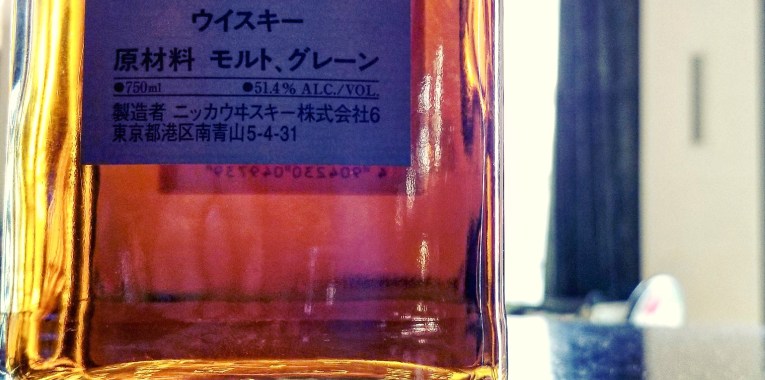
The extra aging allows the whiskies to marry and evolve together before being bottled at near cask strength, a powerful 102.8 proof. This power of proof and flavor is what made the whisky such an amazing value. There is just so much packed into its little bottle. And the bottle is little. Designed to be reminiscent of a “small lump of whisky” to visualize the concentrated power inside the bottle it is packed as 500ml. This is a bottle size so far outside the allowable norms for US production that I think this more than anything is what kept it from our shores for so long.

With its Stateside release, Nikka kept the same bottle design but simply scaled it to a 750ml size. Not quite as elegant and evocative but it’s always been what’s inside the bottle that counts.

So, what’s inside the bottle? The same blend of malt and grain married for 3-6

It’s also proof that global expansion and demand can be gracious and bring you new experiences and treasures, instead of putting up artificial boundaries.

months in oak casks. Still bottled at 51.4% alcohol this is a big hitter.

The Nose carries a hint of fresh, green fruit, with a baking spice overlay and of course a discernable oak note. The alcohol vapors can accidently overpower some of the more subtle notes if you inhale too deeply on the first sniff.

On the palate is a big, full bodied whiskey. The dark baking spice notes leap to the front. Brown sugar, caramel, and the fruit stays fresh and a touch more citrusy than expected from the nose. The distillate is incredibly clean and dry.

The finish is long, drawn out, and the oak lingers after the alcohol has burned off. A few drops of water really does help mellow this whisky and expand the range of flavor.

What’s truly great about this whisky to me is that it’s simultaneously an entry level whisky and yet not. It’s something the evolves over time, much like the person drinking it.

It’s also proof that global expansion and demand can be gracious and bring you new experiences and treasures, instead of putting up artificial boundaries.

Whiskey Wednesday: Traditional Yoichi Changes

After taking a look at what could be classified as one of the old school classics of Japanese Whisky, the new kid on the block, and the Americans jumping on the bandwagon I wanted to take a look at how things change.

            While the Japanese Whisky world is less than 100 years old it is still deeply rooted download-1.jpgin tradition, both its own and the Scotch Whisky tradition that gave birth to it, so change comes slowly. And while whiskey history is littered with mythological founding fathers modern Japanese Whisky owes it’s life and it’s tradition, to one man: Masataka Taketsuru.
     Born in 1894 Taketsuru was born the third son of a family of sake brewers in Takehara, a mere 60km outside of Hiroshima. The Taketsuru family trace their roots as sake brewers back to at least 1733 and Masataka was expected to take over the family business after his older brothers showed no interest, but like many young men Masataka became enamored with the magic of whisky. Specifically Scotch whisky.

            In 1918 Masataka seized on an opportunity to study abroad in Scotland andenrolled in the University of Glasgow to study organic chemistry. It is one of the truths of the world that no matter how hip marketing makes the booze you drink look it’s always being made by a chemist.

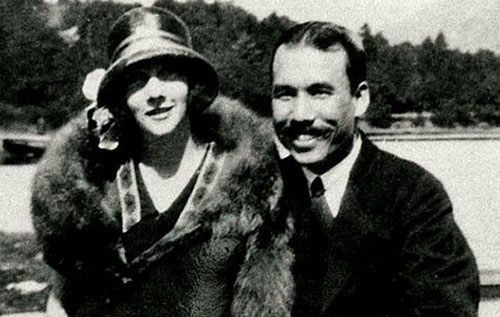
            In April 1919 he apprenticed at the Longmorn distillery in Speyside and not long after met Jesse Roberta “Rita” Cowan, a red headed Scottish beauty that he loved even more than whisky, and who would remain his muse for the rest of his life. The two supposedly fell in love when they sang Auld Lang Syne together and  married in 1920 rita-masataka-1.jpg(over objections from both families) and in May of that same year Taketsuru began an apprentice at Hazelburn distillery where he gained a greater understanding of blending whiskey as well as distilling. He and Rita returned to Japan that November with plans to help the Settsu Shozo Company set up the first Japanese Whisky distillery. These plans never came to fruition.
In 1923 Taketsuru entered a 10-year contract with Kotobukiya Limited, what we now know as Suntory, and along with Suntory’s founder and first Master Blender Shinjiro Torii helped found and build the Yamizaki Distillery. Torii had originally made inquiries for a “whisky expert” in Scotland but was told he already had one back home. The pair worked closely together to construct the Yamazaki Distillery but when their first whisky hit the market the Suntory Shirofuda was a massive dud. At the time blame was placed on the Japanese drinkers preference for lighter, blended whiskies as wells as Takesuru’s refusal to budge on doing things the ‘Scottish way.” Taketsuru was shunted away from the distillery he helped build over to a beer factory where he served out the remainder of his 10-year contract.

In 1934, finding himself free to pursue his own goals again, Taketsuru formed the Dainnippon Kajuu, Co. which roughly translates to ‘Great Japan Fruit Juice Company’ and while everyone was expecting him to make apple juice he constructed the Yoichi Distillery in Hokkaido.

yoichi_b1_2.jpg

Hokkaido was chosen because its climate reminded Takesuru so strongly of Scotland. It also gave him easy access to barley and peat and in 1940, despite the ensuing war, he released the first bottles of Nikka Whiskey. Unfortunately, the war caused all whisky to be labeled as a commodity critical to national defense and Taketsuru spent the rest of the war making cheap military ration whiskey for the troops. Another setback, but one that allowed the distillery to survive where many did not.

The company officially changed its name to the Nikka Whisky Distilling Co. in 1952 and quickly became the second largest producer of Japanese whisky, building a second distillery in Miyagikyo in 1969 and nipping at the heels of Taketsuru’s old employer’s and Suntory creating a lasting rivalry. That rivalry has in many ways led to the quality of product that is being seen in Japanese Whisky today.

But success has led to its own issues. Both Nikka and Suntory have been unable to keep up with global demand for whisky that was once merely the dream of a single man. Products that brought them to the international stage have lost their age statements or disappeared entirely.

It used to be said that if you truly wanted to get to the heart of the Suntory style you should drink Hibiki 17 and likewise if you wanted to get to the heart of Nikka pour yourself a dram of the Yoichi 15 Year single malt. Well, the former is now a unicorn of price and supply and the latter has been discontinued and replaced with a Non-Age Statement bottle simply called “Yoichi Single Malt.”

The pot stills at Yoichi are direct coal heated which are temperamental at best and the Yoichi style has always been at least slightly peated. The result is an aromatic nose that lets the smoke roll out of the glass. There’s a touch of sea salt and soot with citrus oils. On the palette the plum and apples lead, followed quickly by a salty, smoky tang reminiscent of a cold fire on a night time beach before being washed with a long, luxurious finish with the smoke becoming more savory.

It’s an elegant whisky but it doesn’t match up to the 15 year. There’s an element of time that can’t be replaced. This new Yoichi is aggressive where the old 15 year was confident and that’s a fine distinction at times.

This doesn’t mean it’s a bad whisky. It’s different. It’s a change. It’s another step in the evolution of an industry that is really just coming into its own, no matter how much tradition and expertise it draws on. And it’s a reminder that nothing, not even your 200 year old family whisky recipe, is permanent. So grab a glass, pour a dram, and contemplate the ephemeral nature of life while you can.

download-2.jpg