
For all the talk of the growth of Japanese whisky and the revival of American Bourbon and Rye the words “explosive growth” can only truly apply to Irish whiskey. This trend shows no sign of slowing down with sales expected to double by 2020. Those are some staggering gains so why doesn’t it get the same kind of geeky love that, say, a Yamazaki does? I’d say it’s because for many of us Irish whiskey isn’t a category. It’s just Jameson.
Irish whiskey has traditionally lived and died with the American market. American Prohibition was so devastating that 400 brands made by over 160 distilleries turned into essentially three brands and a whopping four distilleries. And while you may have heard of John Power and Cork Distilleries what you’ve drunk is Jameson.
You’ve drunk a lot of it. In 2014 Jameson sold nearly 18 million liters in the U.S. alone. It’s closest competitor, Bushmills, sold a paltry 1.3 million. Jameson accounts for 63% of the global Irish whiskey market. It’s a behemoth.
You may be asking, if Jameson is such a monster and there are only four distilleries cranking out all of this liquid then where are all these craft Irish whiskies coming from? The answer is Jameson. Or more accurately Irish Distillers who are the massive Irish whiskey conglomerate.
While on this side of the pond growth is being fueled by the proliferation of “craft” distilleries creating a wide range of diverse products, in the Irish segments growth and innovation is being by the big boys. And let’s not kid ourselves it’s a business decision. Premium and super-premium Irish whiskey sales have grown by nearly 600% since 2002. Which is a much more impressive way of saying no one drank it at all and now they drink it a little. They’re creating their own market, and they’re not doing it for the little guys.
That doesn’t mean it’s bad whiskey by any means. In fact I truly believe that there are Irish whiskies that can measure up to the best in the world. Look at Redbreast. It’s an example of understated elegance. The brand goes back to possibly 1903 but certainly 1912 where it was bottled by Gilbey’s using whiskey sourced from the Bow Street Distillery in Dublin, which was, you guessed it, the home of Jameson Irish Whiskey.
In the 1971 Irish Distillers decided to close all of their Dublin distilleries and consolidate their operations at a New Midleton Distillery in Cork. This lead to a disruption in supply and eventually Gilbey’s sold the rights to Redbreast to Irish Distillers in 1986. It seemed like the end of the brand but it was reintroduced in 1991 still boldly 12 years old. In a whiskey world where age statements and brands are disappearing every month the core Redbreast has never lost it’s age statement. In fact, it’s grown over the years with the introduction of a 15 year, 21 year (which is simply stunning) and even a 12 year old cask strength. Where others are contracting they are expanding.
The latest edition to the family is the Lustau Edition. It’s the same Redbreast formula: Pure Pot stilled, made from a blend of malted and unmalted barley (we can talk about the historical reasons for that later) but rather than just the bit of sherry influence carried on the standard 12 year, this whiskey is finished in first fill Lustau Olorosso Sherry casks pulling all those sherry notes to the forefront. It is rich, creamy, with a dark fruit and fig note wrestling with nougat and candied fruit. It is a lively whiskey.
At first the lack of age statement may seem like a step backwards but this Lustau Edition isn’t replacing anything. The 12 year isn’t going anywhere, this is simply an expansion. It is a way to experience and highlight many of the subtleties that exist in the Redbreast line. It is also an experiment.
Experimenting costs money and Jameson is almost certainly footing the bill on this experimental expansion. Big doesn’t always mean bad, just as craft doesn’t always mean good. Experience is one thing you can’t teach and it’s something that the craft distillery world is going to learn the hard way. The folks at Redbreast have already got it down.
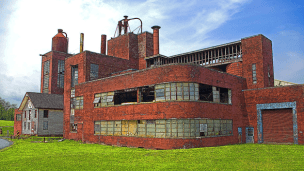 n, PA in 1753. John Sheck was doing what most farmers did at the time and was simply distilling as a way to maximize his harvest and make a little extra cash from excess grain. There was no formula to it. But over the next 163 the family grew this small operation into a full blown distillery until they were forced to close the doors in 1919 due to the beast that was Prohibition.
 brand, and Charles Everett Beam, of the Beam family fame, as master distiller. They were ready to rock and roll. Yet despite having limited success with the Michter’s Sour Mash Whiskey (which may or may not have been pot stilled) and being named a National Historic Landmark in 1980 the demand for Bourbon just wasn’t there. What may have been the oldest distillery in the United States closed its doors for good in 1989 and is now just a collection of abandoned buildings.
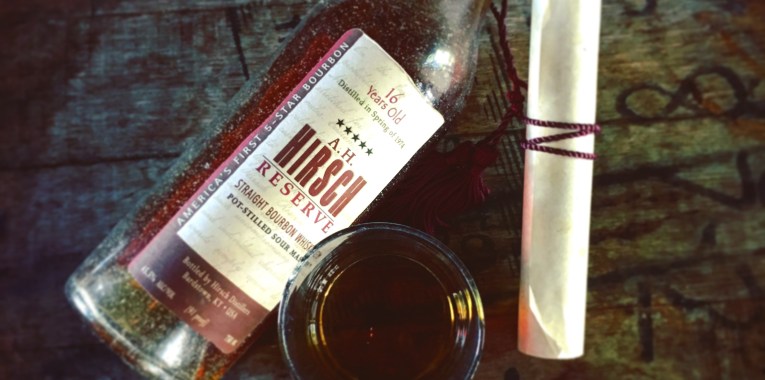
 And Hirsch never cashed that investment in. Oddly he left it aging in the warehouses, paying taxes on all 400 barrels until the distillery shuttered. Now sitting at a solid 16 years old, ancient by Bourbon standards at the time, Hirsch finally took position and sold of the stock.
 personally disagree.
 ld Grand Dad’s mashbill in an effort to make it taste and feel like those ‘old style’ distillers in an effort to appeal to the new drinkers.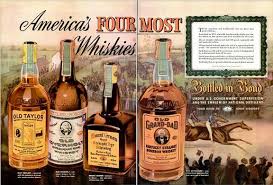

 e did have keys to a bonded warehouse where they aged whiskey and was known to “sample” barrels. Sample- read: pilfered. Despite his acts of theft being well known Fitzgerald kept his job. In fact, the company started calling particularly good barrels “Fitzgeralds” and ended up naming a brand after him, all bottled from only the best barrels. After Prohibition the brand was sold to Pappy Van Winkle where it became his flagship brand at Stitzel-Weller.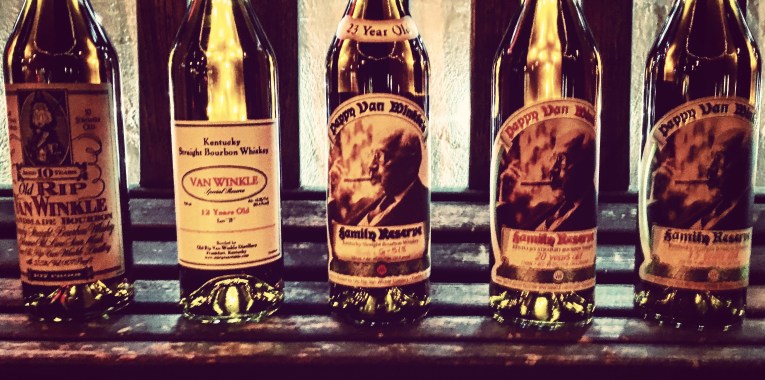
 Julian “Pappy” Van Winkle was a real man. He was involved in the whiskey business well before prohibition. He and his partner, Alex Farnsley purchased a controlling stake in W.L. Weller and Sons in 1908. At the time Weller and sons was strictly a bottler. They distilled nothing themselves but worked very closely with the Stitzel Distillery.
 Pappy’s flagship brand was Old Fitzgerald. His biggest contribution to his namesake Bourbons is his “whisper of wheat.” Every brand that came out of Stizel-Weller was a “Wheated” Bourbon as opposed to the standard mash of corn, rye, and barley. To many this produces a rounder, softer bourbon with more dark fruit and cherry.
 In the end, the cold hard fact about why Pappy Van Winkle is considered the best Bourbon in the world is because people keep saying it is. And because people keep making money off of saying it is. Those who don’t learn from history are doomed to repeat it. Think about that the next time you see it listed on someone’s menu for $150+ a pour, and maybe find a bartender you trust to help you drink your next history lesson.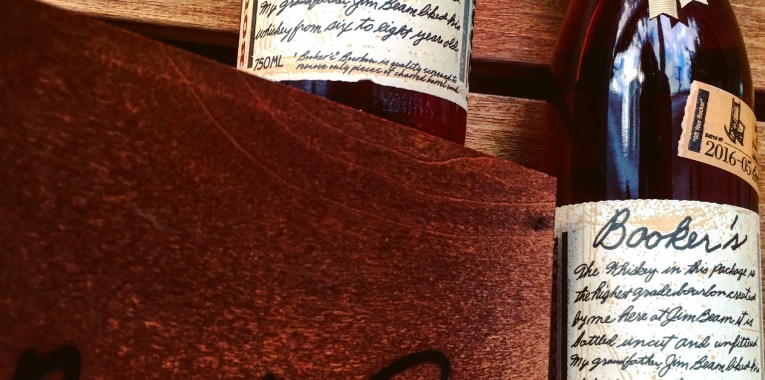

 any good. Just like being big and global doesn’t necessarily negate your quality and attention to detail. Everyone wants to start a distillery these days and I’ve got one piece of advice for you: wait. The quality of product being produced right now can’t support the number of “craft” products being produced and in about five years there’s going to be a glut of distilling equipment available for pennies on the dollar.
 FEW has always had a delightful self awareness about the fact that they’re just making booze. The distillery name gives rise to a myriad of word play about having a FEW drinks, etc. But it’s also a nod to the distilleries home in Evanston, right out side of Chicago, which was a major staging ground for the Woman’s Christian Temperance Movement and the home of woman’s suffragist and prohibitionist France Elizabeth Willard. That playfulness carries over into their rye.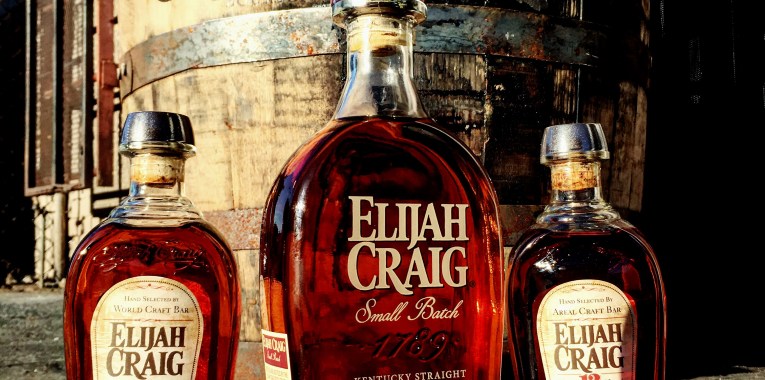
 After the war he helped lay out and plan the city of Lebanon, Virginia which eventually became Georgetown, Kentucky as the state lines and city names changed to reflect a growing country and their pride in their first President. Our Preacher founded some of the first mills west of the Appalachian Mountains that produced cloth and paper. He was also a big proponent of education. Founding the first classical school in Kentucky in 1787, which was than linked to the Rittenhouse Academy in 1798 with the help of land donated by Craig. Rittenhouse eventually morphed into Georgetown College, not to be confused with Georgetown University. He also happened to found a distillery.
 amed and marketed after the dubious claim of our good Preacher as the Father of Bourbon, the whiskey was nevertheless damn good. While “small batch” has never been a regulated term Heaven Hill has always stood by the fact that their Elijah Craig brand is never more than a 200 barrel dump per batch, which is more than most distilleries can actually distill but at least there is a number to the claim. It was also always 12 years old, which put it actual years ahead of most of it’s premium competitors.
 12 years blasted out large on the label gave it a gravitas and a certain definitiveness in what the benchmark of flavor should be. Heaven Hill insists that the new “Small Batch” Elijah will always be a blend of 8-12 year old bourbon and that the change allows them to maintain the Barrel Proof at 12 years old and eventually increase supply of the highly lucrative and delicious 18 and 23 year old single barrel variations, but it still feels like a loss.
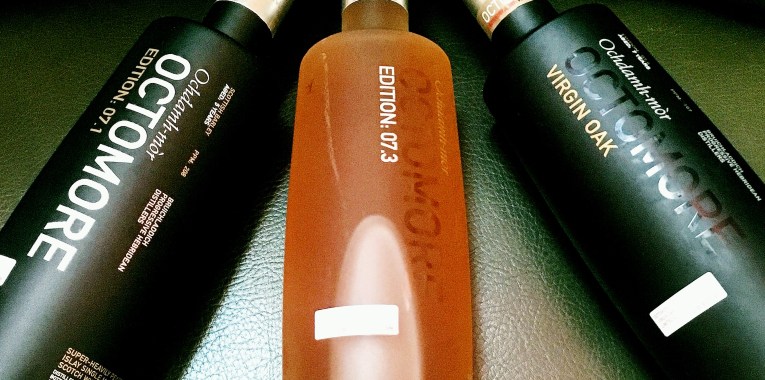
 The Octomore line sails in from the shores of Islay and the Bruichladdich distillery. Bruichladdich is old history with a new face with that spirit of this spirit running right back to its earliest days. When the distillery was founded in 1881 it was the height of modernity. A state of the art facility, especially when compared the distilleries on Islay at the time which were often just converted farm houses. Built right on the shore with uniquely tall and narrow necked stills the distillery managed to survive when many others failed. At least until 1994 when it was mothballed for being ‘surplus to requirements’.
 The Octomores are some of the most heavily peated whiskies in the world. Their phenol content (the scientific way to measure peat) have been as high as 238 but even in their “standard” range they are three times as peated as a Laphroig. Yet, even with all this smoke, and being bottled at cask strength, they avoid being one dimensional. They are sea salt air tinged with smoke and a threat of rain in the air once the sun has set while I’m reading by the fire.
 Bottled In Bond LA