Whiskey Wednesday: The Experiential Exceptionals

I’m told my generation, (I refuse to say ‘Millennial’) values experience over material possessions. That a memory formed, or an adventure had is more important than the shiny new car. My intense desire for a Tesla would be my argument to that hypothesis but this experiential mentality is appealing and you can see it leaking into almost everything, including booze. There is definitely a trend towards one off releases and in the scotch world more small producers are creating blends not with the idea of creating decades long consistency but of constantly evolving smaller bottlings, aiming for consistent quality if not consistent flavor.

In the scotch world more small producers are creating blends not with the idea of creating decades long consistency but of constantly evolving smaller bottlings, aiming for consistent quality not consistent flavor.

Don Sutcliffe, of Sutcliffe and Sons, along with Willie Phillips, the former managing director of The Macallan, created The Exceptional Whiskies with this experiential philosophy at the forefront of mind. They say it outright. They’re not looking to create year-in, year-out consistency. They want each edition to be ‘individual’, ‘distinct’ and ‘memorable’. Since 2013 they’ve released 2 editions of the blended grain and their blended malt, and now they’ve got the first edition of their own blended scotch to add to the line up.

It follows in the same philosophical vein and draws on decades of experience and relationships. It takes grain whiskies from North British, Strathclyde and a 33 year old Cameron Bridge and blends them with single malts from seemingly all of Speyside including: Glenfarclas, Ben Nevis, Balvenie, Kininvie, Glen ddich, Alt- a’Bhainne, Auchroisk, Glenallachie,Westport, Speyside and a splash of 30 year old Macallan. Then all of that is finished in first fill Olorosso Sherry barrels. The result is fruity, rich, very light up front, with a honeycomb sweetness and a definite herbal nose.
So what’s the result? It’s good whisky. But is it any more than that?

Exceptional.jpgThe cynic in me wants to say that the whole ‘unique experience’ is marketing talk for ‘we can’t get the ingredients to make this anymore.’ That it’s just another way to cash in on the whiskey boom. But looking at how long Don and Willie have been doing this it looks more like to men tired of doing the same thing day in and day out. It has the feel of wanting to find something new, to experience and share it. So what does the millennial in me say? That it’s not a generational thing. That it’s just a human thing.


Whiskey Wednesday: The Harmonious Hibiki Harmony

In recent years Japan, traditionally the Land of the Rising Sun could easily be called the Land of the Rising Whisky. And while that is a terrible turn of phrase, it is nevertheless true.

Ever since Glenfiddich started promoting their Single Malt in the States in 1963 whiskey drinkers- especially malt whiskey drinkers, have been hammered with the idea that Single Malts and age statements are the mark of quality. And across the globe the
Japanese were quietly and efficiently sticking with the old school blending mentality and fine tuning all of the nuts and bolts. Ten years ago it seemed like no one knew that the Japanese even made whiskey and now they are some of the rarest unicorns on the market.

mj-618_348_bill-murray-suntory-whiskey-tktktktk.jpg
Suntory Time

The big Japanese whisky houses are suffering from the same shortages and price inflation we’re seeing in the rest of the whiskey world.  With them it seems more noticeable because they only reached the mainstream consciousness here in the US so recently. But it’s not an artificial shortage. I just got back from a trip to Tokyo and even there the ol’ standards we came to rely on were nowhere to be seen.

They are moving to address this imbalance, and that’s part of the benefit of Suntory seeing themselves as a blending house as well; they have an internal system that allows them to adapt. In the US they’ve released Suntory Toki (which you can read more about here) to address our need for a Japanese Whiskey for cocktails. But the big shift for most people was discontinuing the Hibiki 12 and introducing the Hibiki Harmony.

The Hibiki’s have always been the ones that Suntory considers to be the highest form of their art and is meticulous in its attention to detail. The name Hibiki means “resonance” and is meant to represent the Suntory philosophy of living in harmony with people and nature. The goal is to create a harmonious balance between the malt and grain whiskies that make up the blend. Even the bottle is meant to represent that natural harmony. The bottle has 24 facets meant to represent the 24 seasons of the traditional Japanese calendar. This attention to detail and the quality of Hibiki didn’t go unnoticed and the 12 year especially became a fan favorite. But pricing and stocks have buried the 12 year and soon after it’s demise along comes the Hibiki Harmony.

IMG_3196.JPG
Shortage Be Damned, Hibiki 17 Minis

Beam Suntory is quick to point out that the Harmony is not meant to be a replacement for the 12 Year. The Hibiki 12 Year was actually unique among the Hibiki blends in that it utilized a small amount of whiskey aged in plum wine casks. With rising demand, depleting stock, and this blending element only being used for this one bottling the decided to just stop making the 12 Year.

The Harmony is actually meant to be a more affordable available version of the Hibiki 17 Year with its hint of Mizunara (Japanese Oak) aging.  The Hibiki blends pulls whiskey from all three Suntory distilleries: Yamazaki, Hakushu, and Chita. The Harmony utilizes Chita Light grain whiskey with Yamazaki American Oak aged whiskey as the primary malt. The supporting players are Spanish Oak and that Hint of Mizunara with Hakushu Heavily peated malt for flavoring. The result on the Harmony is a very floral nose, with a hint of tart fruit and herb. The mid palate is rich, rich honey with a confectionary note but the touch of Mizunara is what brings it home with a touch of spice that lingers. It is a great introduction to the wider world of Japanese whiskey.

And again, this isn’t an artificial shortage. The bars in Tokyo were using the Harmony just as we are here in the states.  And I can appreciate the effort to simulate the 17 Year old. It’s always been expressed to me that the pinnacle of the House of Suntory style is the Hibiki 17 Year Blend, just as the Nikka “Yoichi” 15 Year Old Malt was the perfect expression of the Nikka style. As a side note, the former is now incredibly allocated and expensive while the later has been discontinued due to supply. Take that for what it’s worth.

IMG_3176.JPG            But in a world of vanishing age statements and soaring prices  I feel it’s hard for the general consumer to not see this as a replacement of a beloved bottle by a younger whiskey at a higher price. That’s not a problem with the Harmony though. That’s just the reality of the whiskey world we now live in.
Whiskey Wednesday: Time For Toki

In Japanese Toki means ‘time’ and the adage goes in time everything comes back around. In a market obsessed with single malts Japanese Whisky is an ongoing example of the relevance and power of blends. Since importing whisky making from Scotland nearly a century ago distillers in Japan have been breaking down the individual components of the craft and reassembling them into works of art. Though the more disparaged styles, like grain whisky or blends, have taken a front row seat next to their single malt brethren. And they’re holding their own. This quality and craftsmanship hasn’t gone unnoticed which has lead to a massive boom in popularity. Which is great, because you can never have enough good whisky. But it’s also terrible because it’s becoming increasingly hard to find and holy hell look at that price tag!

Hoping to fill that gap is the Suntory Toki. Made by the same folks behind Hibiki, Yamazaki and Hakshu. And in fact, the component distilleries are the same as those that make up the Hibiki style blend. These are the Yamazaki and Hakushu distilleries as well as the Chita distillery, which you’ve probably never heard of. Relatively unknown in the West, Chita is the Grain Whisky distillery that is traditionally used to accent the malts produced in the Yamazaki distillery. In the Toki, however, the Chita’s ‘heavy type’ grain whisky takes center stage along with Hakushu malt aged in American white oak. They are then supported by two different Yamazaki Malts: an American Oak malt and a Spanish oak malt. All of the traditional components are there.

The result is an incredibly light whisky. Rich pear, apple and a green fruit, with a light oak presence and almost no edge. It’s incredibly approachable but not any where close to reaching the haloed status of its older siblings. But not everything needs to be a living legend. Sometimes you just want a damn good highball and there is nothing wrong with that.

A Balvenie Burns Night

Welcome to Burns Night. The annual celebration of the life and death of Robert Burns, the National Bard of Scotland and has an almost cult like following as a cultural folk hero. Not a bad legacy for a man born a poor Scottish farmer and who only lived to the age of 37.

Burns was born in 1759 and wrote his first poem after falling in love at the age of 15. He and I imgres-1.jpghave that in common. But unlike myself Burns pursued poetry, and love, with uncommon zeal. The first collection of his poems was published by subscription in 1786. While writing most of these poems in 1785 he also fathered the first of his 14 children. He was a busy man. As his biographer DeLancey Ferguson said of him, “it was not so much that he was conspicuously sinful as that he sinned conspicuously.”

Burns was immediately lauded through out England and Scotland as a “peasant-poet” and he took that success and used it to celebrate and preserve Scottish culture. Most of his poems are all written in Scots and document traditional Scottish culture. He also preserved folk songs. You can blame ol’ Rabbie Burns for why you know the words to “Auld Lange Syne” even if you don’t know the meaning. The song, which is about remembering friends from the past and not letting those times be forgotten actually has nothing to do with the holidays but is a perfect example Burns’ work. He celebrated life, love, friendship and drink all with humor and sympathy. His legacy is writ all over Scottish culture. Bobby Burns is as distinctly Scottish as the countries whisky.

mMcg5wXN6S-SFgDpBbkWkRQ.jpg            Ninety years later, on the opposite side of Scotland, another farmer was setting out to form his own legacy in a distinctly Scottish way: by quitting his job. William Grant had just quit his job as a bookkeeper at the Mortlach Distillery and purchased the land and equipment to start his own distillery. On Christmas day in 1887 the first whisky flowed from the still of the Glenfiddich distillery. Glenfiddich essentially created the Single Malt category in the 60’s and 70’s, often using ads that created a cult of personality of around the whisky and that of Sandy Grant Gordon, William’s great grandson. The company has always been incredibly savvy and it’s no wonder that they are the number one selling single malt in the world.
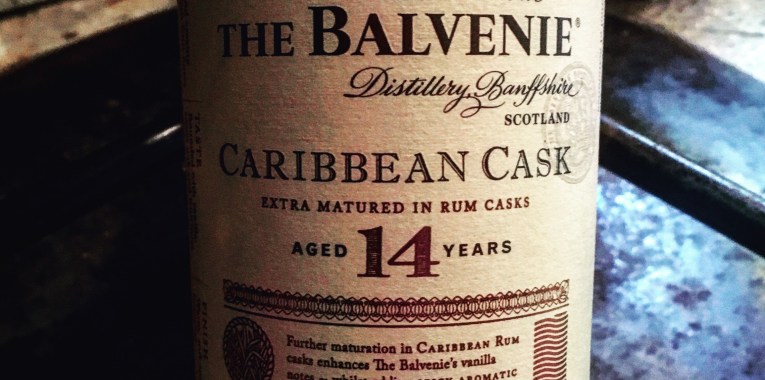
But when you are that large its hard to say that you truly have a cult following. That status today falls to Glenfiddich’s younger distillery sibling, Balvenie. Founded by William Grant a mere five years after Glenfiddich, Balvenie has always been the more experimental of the children. Balvenie is still 100% traditionally floor malted, and just like Glenfiddich they still have a Coppersmith and Coopers on site on site to keep the whole process in house. But I know people who would never touch a bottle of Glenfiddich perk right up at the mere mention of Balvenie, especially if we’re talking about the 14 year old Caribbean Cask.

The Caribbean Cask is a 14 year old single malt that has been aged in traditional oak casks, primarily ex-Bourbon, and then finished in casks that once held Caribbean Rum. These rum casks are American Oak casks that have been filled with a blend of West Indian Rums crafted by Malt Master David Stewart. Once Stewart deems the casks to be correctly seasoned the rum is dumped and the 14 year old malt whisky is added to receive its finishing touches. How long exactly is a “finish’? Well, until it’s finished, but generally about 6 months.

The result is a whisky that is massively vanilla and oaky with an evolving fruitiness and just an edge of the hobo funk that you find in truly great rums. It is flavorful without being overpowering and adds a sweetness that livens up that heavy malt that turns many people off of Scotch whisky. This whisky feels right at home in that ultimate of Burns Night celebrations: the Burns Supper.

Burns Suppers range from strenuously formal gatherings of esthetes and scholars to uproariously informal rave-ups of drunkards and louts. I’ll give you one guess as to which category I fall into. Most end up right in the middle and will follow the time honored form which includes the eating of a traditional Scottish meal, the drinking of Scotch whisky, the Toast to the Lassies, the responding Toast to the Laddies, and the recitation of works by, about, and in the spirit of the Burns.

Tonight I will be providing you with the whisky, but my brother will be providing you with the poetry. I don’t know if he wrote his first poem after a lovelorn night at the tender age of 15, but he certainly pens a verse worthy of raising a glass:

For Wintergreen Gorge

Once, illegally, on a train track bridge,

We sat with a handle a whiskey and three

Water bottles a gin, and I watched a gall midge

Land on your cheek and watched you brush it free

with your hand. Now what’s the use in holding

When we can sip and we can sit with our

Laughter and the iron and the wood to

Water sinking? Your hands get lost in folding,

Smoothing, and re-creasing the small flower

On the hem of your dress, and then you lower

Your eyes to wonder what we could do.

~Jacob Fournier


Alexander Murray and Friends

“Good friends, good books, and sleepy conscience: this is the ideal life.” ~ Mark Twain

I’d personally add good booze into that mix but starting with Twain is never a bad idea, he weaves a good story. But the problem lies in what kind of story are you trying to tell with your whisky? Are we telling a historic tale? That would start with the founding of the Caol Ila Distillery in 1846.  But that’s a little dry.

It could be a business biography. That starts in 2004 with the creation of Alexander Murray. An essential newborn in the world of independent Scotch bottlers they took a different tact. instead of focusing on small, rare bottlings they focusedIMG_0783.jpg on volume. If you’ve ever noticed that the hosue labeled Scotch whisky at Trader Joe’s and Costco was surprisingly good, that’s because it came from these guys. But business is so impersonal.

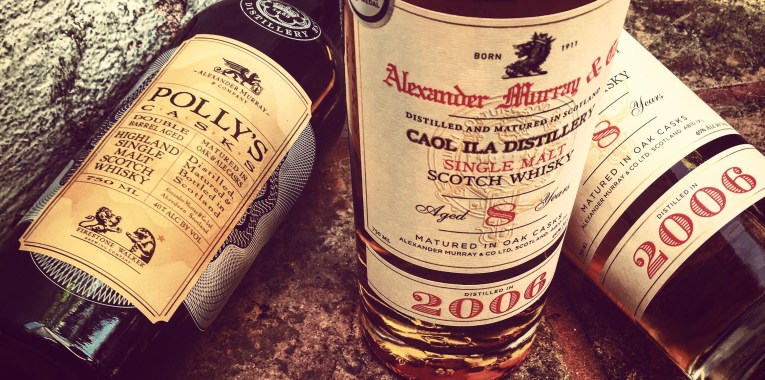
Except it’s not. While moving volume, and checking history the gang at Alexander Murray made friends. And that allowed them to grow and bring out more quality under their own label. Take their 8 Year Old Caol Ila. Some may argue that it’s an unnecessary bottling with the quality the standard issue 12 year has. But they’re like two small town friends who move away to different cities. Same underling base, but a heavier oak presence gives this a more NYC feeling bite versus the original delicate, seaside village feel that Caol Ila usually has. But even more than that’s it’s opened their eyes to larger collaborations.

Yet another friend is David Walker, of Firestone Walker Beer. Working together they took 60 barrels used for aging the Firestone DBA and finished 6-8 year old single malt in them for another 3 months to a year. The resulting ‘Polly’s Cask’ is a complex melding of friendships, even just in the character of the whisky. Beer and Whisky are natural friends, and the barrels linking them here started as ex-Bourbon, turned into beer, and then finally into Scotch barrels. If that’s not a sharing between friends I don’t know what is. The result is an exceptionally nutty malt.

Both are a great example of the best times with friends. An everyday encounter, and a special occasion, too. And as I tell my friends all the time, I don’t care what you drink as long as you drink it with me. 

Auchentoshan Three Wood Single Malt Scotch Whisky

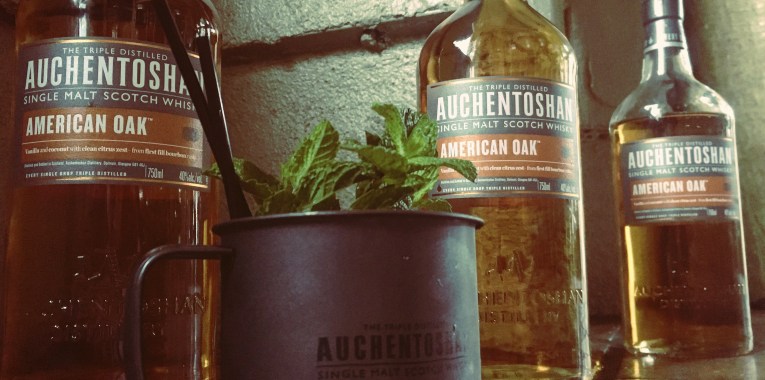
Happy accidents are all around us. They often start simple. You wander into a bar, look around, find yourself presented with better than average options, and end up with a glass full of Auchentoshan, which is surprisingly light and delicate, but with enough complexity to be no accident.

Then there are the not so simple accidents. Like the quirks of history that created the style of whisky now swirling in your glass.  Auchentoshan is one of the last remaining Lowland distilleries in Scotland, a region with a style as unique as it’s Speyside and Islay cousins, yet wholly unusual in scotch making and is fully created by the accident of it’s location. Founded in 1823 by Irish refugees on the outskirts of Glasgow it’s seen the city rise into an industrial complex, the bygone glory days of it’s shipbuilding and engineering prowess, and is still tucked away in it ‘corner of the field’ watching the trade city grow more
cosmopolitan. All of these pieces come together. The shipping and trade gave massive Clyde-Shipping-Glasgow1.jpgaccess to barrels of all kind for excellent aging but more importantly the whisky itself was primed for bigger barrel interaction by the influence of those Irish refugees and their tradition of Triple Distillation. Coming off the stills at a higher proof leaves the raw spirit lighter and more ready to soak in the plethora of barrels floating in and out of the port city.

And then there are the literal accidents. Years ago, the Head Distiller Jeremy Stevens was working on a batch of sherry finished malt. It had already spent time in ex-Bourbon barrels, and had been aging in Olorosso Sherry casks. After the initial dump he felt it need some more time in the sherry wood, ordered the malt to be rebarreled and left for a trip out of the country. When he came back he found that instead of Olorosso it had gone into Pedro Ximenez sherry barrels.Rather than losing his job the distillery discovered one of their most popular expressions: The three wood..

So, the accidents of place, time, history, barrels and communication have granted you a glass of delicate, rich toffee, with candied plums, blackcurrents and a hint of hazelnut. So let’s raise a glass to accidents. May they be few and happy.