Whiskey Wednesday: Hibiki’s Resonant Disappearance

Despite being a self avowed fanatic of American whiskey the thing I’ve
found myself writing about and drinking the most recently has been
Japanese whisky.  The last time we spoke way back in December I was
drinking poetic about the Hakushu malts and the fact that though they often seem
to be in the shadow of their Yamazaki counterparts the excellence
of their design meant that it wouldn’t be long before they too
disappeared into a puff of Unicorn smoke.

That opinion seems to have be prophetic with the recent announcement
by Beam Suntory of the “partial” discontinuation of both the Hakushu
12 year and the Hibiki 17 year expressions. While the products will
only be officially discontinued in Japan they will only have “limited
availability in the next few years.” This announcement came as a bit
of a surprise to me with the Hakushu because I haven’t seen it have
the same name recognition and brand power as the Yamazaki does in the
States. But when your distillery is only 45 years old its easy to see
how your supply of 12 year old single malt could be tight.

But the real surprise to me was the Hibiki 17.

The house of Suntory have always considered themselves to be blenders
above all else. While the Single Malts may be the high priced auction
house darling the Hibiki line has always been the jewel in Suntory’s
eye.

Meaning “resonance,” the Hibiki line was first released in 1989, 5
years after the first release of Yamazaki 12 year. Originally
comprised of just the 17-year and the 21-year, a 30-year expression
was released in 1997 and the much missed 12-year was introduced in
2009 before being announced as discontinued in 2015.

Think about that for a moment. The Hibiki 12-year appeared on the
market, soared in popularity, became a staple of the bar world, and
then completely vanished all in the space of 6 years. That’s an insane
trajectory for any brand and is perfect evidence that Japanese whisky
is a truly global product at this point.

The Non-Age Statement Hibiki Harmony hit the market slightly before
the disappearance of the 12-year and despite everyone crying, “Foul!”
many of us were willing to give Beam Suntory the benefit of the doubt
for two reasons: 1) the Hibiki 12-year was the only expression to
utilize whisky that was aged in plum wine casks. They hadn’t
projected for the popularity of the expression, so they discontinued it
because 2) the Harmony wasn’t a replacement for the 12-year. It is
meant to be a more accessible version of the 17-year.

The Hibiki line has always been a blend of whiskies from all three
of the Suntory distilleries: Yamazaki, Hakushu, and
Chita. To them it is the confluence of every unique facet of their
operation. It is meant to represent the ideal of the harmony between
people and nature. The 24 facets of the bottle represent the 24
seasons of the Japanese calendar and invoke the comparison of this
balance to the balance of the malt and grain whiskies in the Hibiki
blend that resides inside the bottle.

This attention to detail is part of what has always set the Hibiki
line apart from my disdain of other blends. And yes, you would have
had to be a real prophet 20 years ago to predict the explosive growth
of the segment, and yes, it’s a real shortage. Bars in Japan are
pouring the Harmony just like we are over here. And yes, the rise of
shochu and decrease in whisky drinking in the 80’s led to lower
production. But the line was introduced in the late 80’s when this
downturn was happening and while the 17-year is being officially
discontinued in Japan it’s “limited availability” will continue to
limp on in the United States. This speaks to the power and demand for
premium aged Japanese whisky in the US, but also can’t help but lend
a tinge of cynicism to the disappearance of the 17-year. Its as if stocks
are being pulled at a younger age to go into blends like the Harmony
to cash in on the popularity wave now versus risking a drop in demand
later.  And if that’s true who could blame them?

In Beam Suntory’s defense, the Harmony is still damn delicious and
their quality has not dropped. They have also consistently stated that
they are ramping up production and that this will be a temporary
hiccup, but how many temporary hiccups have we seen come with a flashy
return and a price hike? (I’m looking at you Old Fitz.)

None of this denies the fact that the Hibiki 17 Year is an amazingly
delicious dram. The nose is full and rich, distinct notes of honey,
with some roasted pear, a touch of smoke and ume plum.

The palette offers a touch of sweetness to go along with the initial
scents with the addition of raisin, oak, and a pithy citrus zest that
carries on to a long finish that turns into an darker
amontillado sherry note with a touch of cacao.

It’s easy to see why this blend is the crown jewel of the Hibiki line,
it’s easy to see how we drank it all out of stock, it’s easy to see
why they may have discontinued this expression to protect the more
award winning 21-year expression, and it’s easy to see why we should
all raise a glass and drink to this resonant whisky and to its equally
evocative moment in time.

Whiskey Wednesday: A Bitter-Sweet Hakushu

Life is a bittersweet balance. I’ve been hosting Whiskey Wednesday for going on six years now. It’s exposed me to more bottles and drams than I can count, constantly challenged me to stretch my creative muscles, and introduced me to some of the most delightful nerds/people that I’ve ever met.  I’ve grown as a person, a bartender, a writer and a insufferable know it all.

I never would have thought six years ago that these Wednesdays would be something that I would still be doing, let alone have my thoughts and notes for them become so expansive that they would undergo a biogenesis into a blog that people actually read. I also wouldn’t have survived all these years with some semblance of my sanity intact if things had stayed stagnant. Change, experimentation, and misplaced passion have kept me going.

And now it’s time for another change. After today, Whiskey Wednesday continues but it’ll become more abstract. Less about every scattered soul flocking to the bar once a week for a drink, and more about raising a glass from where ever we might be. So, for my last night behind the stick for the foreseeable future lets combine the past and the future and pour some Hakushu.

The Hakushu Distillery was found in 1973, 50 years after Yamazaki, it often seems to live in the shadow of its older sibling. It also lives in the shadow Mt. Kaikoma in the Japanese Southern Alps. This was a deliberate choice made by Keizo Saji, the company’s second Master Blender. He chose the site primarily because of the quality of the water. The naturally granite filtered water leant a subtlety and effervescence to the distillate but the site also offered a distinct microclimate with the surrounding forest and with it sitting at 700m above sea level its definitely one of the highest elevations for whisky distillation in the world. For comparison Scotland’s two highest distilleries, Dalwhinnie and Braeval, both sit around 355 meters above sea level.

All of this combines to create a spirit that is lighter, more delicate, and often more mellow than its Yamazaki counter points. Also, unlike Yamazaki, Hakushu utilizes peated malt. When combined with the distillery and terrior this peat takes on more of recently extinguished early morning, mountainside cooking fire than more maritime and often aggressive smokes of the Scots.

The distillery also takes to heart the Japanese respect for nature. It strives for harmony with its surroundings right down to its aging warehouses. Built into the mountain itself they utilize earthquake safe, single story tacks that are about 13 levels high. This kind of aging space, combined with the high elevation has allowed them to mature a spirit with relatively low barrel influence, especially for the age of the whiskey.

As for the whiskey itself, both Hakushu and Yamazaki import their barley, both the peated and unpeated barley. However, they do grind, mash and ferment on site. They have six pairs of stills at Hakushu with at least 4 different shapes. They then utilize five different type of aging casks while primarily focusing on ex-Bourbon and hogsheads. All of this diversity in barley, stills and barrels allows them to create what they call a combination of 40 different styles of whisky. Keep in mind Suntory’s primary craft, as they see it, is blending. And unlike Scotland where even rivals will trade barrels back and forth to get unique flavors for blends, Suntory was essentially trying to build a category from scratch. If they wanted diversity they had to make it themselves. And 44 years later it feels like Hakushu is finally coming into its own.

It may seem odd to call a 44-year-old operation “young” but when your primary marks are a 12 year and 18 year old single malt a 44 year old distillery may not be an infant but its still most certainly a toddler.  Hell, the first release of Hakushu 12 wasn’t until 1994, a solid 10 years after the release of Yamazaki 12 year. And while the Yamazaki has the experience and the award that come with it the Hakushu is certainly flexing it’s muscle.

Both the 12 year and the 18 year are primarily composed of three styles of distillate: unpeated distillate aged in sherry buts, unpeated distillate aged in hogsheads, and peated distillate aged in ex-Bourbon. These truly show off the complexity and depth of the distillery creating a whiskey that is light, yet powerful. The aroma of smoked pears wafts over a palette that is green, with a touch of citrus and smoke. The 18 draws out more of the stone fruit qualities while adding a touch more sweetness from the extra oak.

In short, Hakushu also knows what they’re doing and while it may stay in the shadows of its mountain forest home it won’t be in the shadows of its Yamazaki brethren.

So, come share a glass with me because it won’t be long before Hakushu catches up to the Yamazaki awards and it disappears like a forest mist of rarity and also because who knows where we’ll both be the next time we can.

Whiskey Wednesday: The Yamazaki Price

What would you do with $130,000? Buy a house? A Tesla? Travel the world? Or maybe you decide screw it and go for the most expensive bottle of whisky ever sold: the Yamazaki 50 year old single malt 2005 release.

In October of 2016 one of the 250 bottles of Yamazaki distilled in the mid-1950s claimed the Guinness World record for the most expensive standard size bottle of whisky ever sold for $129,186. That’s a nearly 1300% increase over the original sticker price of $9,500. That’s a massive return on investment, even for 50 year old whisky, but it’s made even more impressive when you consider that the Yamazaki distillery itself is less than 100 years old and the first Yamazaki single malt wasn’t released until 1984.

caption.jpgSuntory founder and first master blender, Shinjiro Torii and Masataka Taketsuru, “The Father of Japanese Whisky”, founded the Yamazaki distillery in 1923. Taketsuru had studied organic chemistry in Glasgow and was found by Torii after he made inquiries to Scotland looking for a whisky expert. Torii was told there was already one fully qualified in his own country and the two worked closely to build the Yamazaki distillery. However, the first whisky produced by the new company, dubbed the Suntory Shirofuda was a resounding failure. The Japanese drinkers preference for lighter, blended whiskies was blamed as well as Taketsuru’s fixation on doing things the “Scottish way.” Taketsuru was shunted away from the distillery to a beer factory where he served out the remainder of his ten year contract before leaving to start the Nikka distilling company, Suntory’s biggest rival.
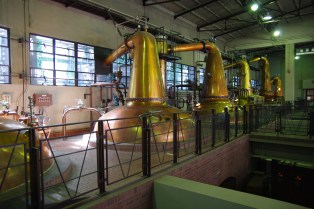
Despite these early set backs the Suntory company pressed on, releasing the Kakubin in 1937 and after being postponed by WWII, the Suntory Old Whisky in 1950. In 1961 the company send the first Japanese Whisky imports to the United States and Torii’s son Keizo Saji took over as president and Master Blender. The next few years were full of experimentation including opening the Chita Distillery in 1972, the Hakushu Distillery in 1973, and the release of Midori in the United States in 1978. The next big shift for the company comes in 1984 when Saji moved the company away from it’s focus on blends with the very first release of Suntory Single Malt Whisky Yamazaki.

The 80’s proved to be a pivotal time for Suntory not only because of the new focus on single malts but because the other distilleries opened in the 70s allowed them to produce more varied styles of whisky culminating in the first release of the Hibiki Blended Whisky in 1989. The Suntory Single Malts may be carry the highest price tags but Suntory still considers themselves to be a blending house and the Hibiki’s are what they consider to be the pinnacle of their art.

All the pieces were in place yet as you may have heard the 90’s were not the most hospitable of decades to brown spirits. It took a new millennium as well as a series of rapid-fire rewards to rocket Japanese whisky from niche good to internationally coveted whisky.

The Yamazaki is caught between a rock and a hard place; soaring success chased by the rising struggle to support the base of that success.

In 2003 Suntory’s Yamazaki Single Malt 12 year won it’s first Gold Award at the International Spirits Challenge in the UK followed relatively quickly by Suntory becoming the first Japanese whisky producer to be awarder “Distiller of the Year” by the same ISC in 2010.

The Yamazaki Distillery expanded in 2013 with the addition of four stills, bringing the imgp9795.jpgtotal to 12, which increased capacity about 40%. The added capacity didn’t prevent them from releasing the Non-Age Statement Yamazaki and Hakushu Distiller’s Reserve the following year just as talk of the worldwide whisky shortage began to surface. Also in 2014, Suntory purchased Beam, Inc. (home of the eponymous Jim Beam Bourbon) for $16 billion forming Beam Suntory, the third largest spirit producer in the world. This acquisition greatly expanded Suntory’s distribution lines spreading the already thin stocks of Yamazaki even thinner.
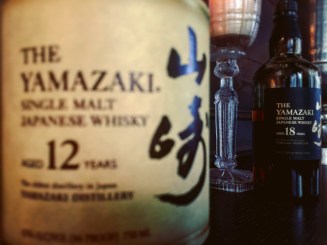
The final nail in the Japanese Whisky hype train was also driven home in 2014 when the Yamazaki Sherry Cask 2013 won the coveted Jim Murray “World Whiskey of the Year” award. With that the path is set and we’re barreling towards the inevitable $130,000 bottle.

Yet with all this focus on the mythical, never to be seen bottles that dominate the headlines, what has become of the mythical, occasionally glimpsed bottles that built the reputation of Yamazaki and Suntory in the first place?

The Yamazaki 12 Year is still liquid gold in a bottle. The whisky is aged in a combination of American ex-Bourbon, Spanish Sherry, and Japanese Mizunara oak cask. It is, you guessed it, a minimum of 12 years old and bottled at 86 proof. What has always struck me about this whisky is the amount of fruit on the nose. Ripe peach, with a touch of grapefruit and orange, followed by a rich lingering mid palette that leaves an almost toasted bread note before disappearing into a long finish that is edged with dark baking spices.

IMG_4145.JPGWhile the 12 year was once the perfect introduction to Japanese malt, before the price and the hype got in the way, it was the Yamazaki 18 year that always stirred my soul. This time roughly 80% Sherry casks with ex-Bourbon and Mizunara making up the other 20%. Here the promise of the 12 year has evolved into a stately elegance. The fruit dries out, turning to raison and apricot with dark chocolate and berries on the tongue with a touch of spice on the long march to the finish.

In the end these spirits are deserving of every award they’ve had draped around their bottles necks, yet I can’t help but feel like they are victims of their own success. The price on these bottles has steadily climbed while availability has dropped. Drinkers are driven to seek these “more available” bottles every time a headline splashes a story bottle of Yamazaki selling for more than the median household income of a small family only to be disgruntled when they turn up empty handed. Products like the Yamazaki Distillers Select, the Hibiki Harmony, or the Nikka Pure Malt may help bridge that gap in the category, but no matter how vehemently the companies talk about these products being “different” and “not replacements for age stated products” seasoned drinkers can’t help but feel that their old toys are being taken away while they’re charged more. It’s a story they see time and time again as the trend sweeps through whisk(e)y brands across the globe.

The Yamazaki is caught between a rock and a hard place; soaring success chased by the rising struggle to support the base of that success. It’s a good problem to have and one without an easy answer but it is a debate that certainly is helped with a glass of liquid gold in hand while you have it.

Whiskey Wednesday: The Harmonious Hibiki Harmony

In recent years Japan, traditionally the Land of the Rising Sun could easily be called the Land of the Rising Whisky. And while that is a terrible turn of phrase, it is nevertheless true.

Ever since Glenfiddich started promoting their Single Malt in the States in 1963 whiskey drinkers- especially malt whiskey drinkers, have been hammered with the idea that Single Malts and age statements are the mark of quality. And across the globe the
Japanese were quietly and efficiently sticking with the old school blending mentality and fine tuning all of the nuts and bolts. Ten years ago it seemed like no one knew that the Japanese even made whiskey and now they are some of the rarest unicorns on the market.

mj-618_348_bill-murray-suntory-whiskey-tktktktk.jpg
Suntory Time

The big Japanese whisky houses are suffering from the same shortages and price inflation we’re seeing in the rest of the whiskey world.  With them it seems more noticeable because they only reached the mainstream consciousness here in the US so recently. But it’s not an artificial shortage. I just got back from a trip to Tokyo and even there the ol’ standards we came to rely on were nowhere to be seen.

They are moving to address this imbalance, and that’s part of the benefit of Suntory seeing themselves as a blending house as well; they have an internal system that allows them to adapt. In the US they’ve released Suntory Toki (which you can read more about here) to address our need for a Japanese Whiskey for cocktails. But the big shift for most people was discontinuing the Hibiki 12 and introducing the Hibiki Harmony.

The Hibiki’s have always been the ones that Suntory considers to be the highest form of their art and is meticulous in its attention to detail. The name Hibiki means “resonance” and is meant to represent the Suntory philosophy of living in harmony with people and nature. The goal is to create a harmonious balance between the malt and grain whiskies that make up the blend. Even the bottle is meant to represent that natural harmony. The bottle has 24 facets meant to represent the 24 seasons of the traditional Japanese calendar. This attention to detail and the quality of Hibiki didn’t go unnoticed and the 12 year especially became a fan favorite. But pricing and stocks have buried the 12 year and soon after it’s demise along comes the Hibiki Harmony.

IMG_3196.JPG
Shortage Be Damned, Hibiki 17 Minis

Beam Suntory is quick to point out that the Harmony is not meant to be a replacement for the 12 Year. The Hibiki 12 Year was actually unique among the Hibiki blends in that it utilized a small amount of whiskey aged in plum wine casks. With rising demand, depleting stock, and this blending element only being used for this one bottling the decided to just stop making the 12 Year.

The Harmony is actually meant to be a more affordable available version of the Hibiki 17 Year with its hint of Mizunara (Japanese Oak) aging.  The Hibiki blends pulls whiskey from all three Suntory distilleries: Yamazaki, Hakushu, and Chita. The Harmony utilizes Chita Light grain whiskey with Yamazaki American Oak aged whiskey as the primary malt. The supporting players are Spanish Oak and that Hint of Mizunara with Hakushu Heavily peated malt for flavoring. The result on the Harmony is a very floral nose, with a hint of tart fruit and herb. The mid palate is rich, rich honey with a confectionary note but the touch of Mizunara is what brings it home with a touch of spice that lingers. It is a great introduction to the wider world of Japanese whiskey.

And again, this isn’t an artificial shortage. The bars in Tokyo were using the Harmony just as we are here in the states.  And I can appreciate the effort to simulate the 17 Year old. It’s always been expressed to me that the pinnacle of the House of Suntory style is the Hibiki 17 Year Blend, just as the Nikka “Yoichi” 15 Year Old Malt was the perfect expression of the Nikka style. As a side note, the former is now incredibly allocated and expensive while the later has been discontinued due to supply. Take that for what it’s worth.

IMG_3176.JPG            But in a world of vanishing age statements and soaring prices  I feel it’s hard for the general consumer to not see this as a replacement of a beloved bottle by a younger whiskey at a higher price. That’s not a problem with the Harmony though. That’s just the reality of the whiskey world we now live in.