Whiskey Wednesday: A Tale of Two Elmer’s

            I received a text this week from a friend that without preamble said, “Did Elmer T. Lee get worse?”

            My gut reaction was, “Of course not! How dare you besmirch the name of the dearly departed father of modern Bourbon!?” After calming myself with a hefty dram I remembered that despite centuries of tradition whiskey making is a constantly evolving art and barrel aging is by no means an exact science. To add to that, there were claims of “cork taint” by members of the Reddit whiskey community in 2016.  The popularity of Elmer T. Lee has also exploded in recent years so the odds are that it’s younger stock than previous years. By the end of the glass the question was less of an attack and more of a probability.

Son, we’re not hiring today.”

            This could have remained a simple thought experiment but a recent trip to the Liquor Locker left me with a bottle of 2014 Elmer and the ability to do a little compare and contrast. But first a little context.

What exactly is Elmer T. Lee? Elmer T. Lee is both a Single Barrel Kentucky Straight Bourbon, and the deceased former Master Distiller of the distillery we now know as Buffalo Trace. 

“Son, we’re not hiring today.” Is how Col. Albert B. Blanton first greeted Elmer in 1949, but at the instance of his friend at the distillery he showed up to work the next week anyway.  Over the years Elmer grew from a maintenance engineer to the distilleries first Master Distiller. He officially “retired” in 1985 but not before releasing the world’s first Single Barrel Bourbon, Blanton’s, named after the man who didn’t hire him.

After Blanton’s became a hit the distillery honored its Master Distiller emeritus with his own namesake Single Barrel. Elmer was still heavily involved with the distillery and would come in every Tuesday to taste barrels and make selections for his namesake release.

Before Blanton’s, and Elmer, the concept of a “Single Barrel” Bourbon didn’t exist.  Remember, barrel aging isn’t an exact science. Every barrel ages differently depending on where in the rickhouse it sits, the quality of the barrel, the temperature swings over the years, all of these factors contribute to each barrel being a unique specimen But the whole idea of a bottled whiskey is consistency so generally barrels are blended, or batched, together to recreate a specific flavor profile. For a Single Barrel all of the whiskey in the bottle comes from one single barrel and has to stand on its own individual merits. While there will always be some variation, it is a sign of the skill of the distillery to be able to produce quality single barrels that are still consistent.

Both Blanton’s and Elmer share the same DNA. They’re both Buffalo Trace Mashbill #2 which is slightly higher in rye content (about 15%) and are both technically co-owned and produced with Age International. They’re both single barrels and they’re both non-age statement Bourbon’s so we know they’re at least older than four years. But two things separate them from each other: aging and proof.

Drinking is such an individual experience. It’s can be a social activity but the act of tasting is something intrinsically personal.

Blanton’s is always aged in Warehouse H, which was commissioned by Blanton himself. It  is a fully metal clad warehouse which allows for greater heat transfer and, supposedly, more rapid aging. Elmer has no such restrictions on what warehouse it must be aged in which theoretically allows for a larger variation in flavors.

Elmer is also bottled at 90 proof (45% ABV) where as Blanton’s is bottled at 93 Proof (46.5% ABV). While this difference seems small the alcohol is where the flavor is. A few extra proof points can make a world of difference and a whiskey can open up with just a few more drops of water. That isn’t to say that higher proof is always better, just like older doesn’t always mean better, it just means a different flavor profile. Interestingly, Elmer was said to drink his Bourbon at 60 Proof as he felt that was the point when he could taste all the flavor with out the alcohol getting in the way.

Now that all the intellectual foreplay is out of the way, how do they actually taste?

Four Years can really change a bottle.

2014

  NOSE: Oak and Clove

  PALETTE: Earthy, Dark Chocolate, Coffee, Tobacco

  FINISH: Long, slightly damp and musty

2018

            NOSE: Oak, Stone fruit, Vanilla

            PALETTE: Rye Spice, Stone Fruit, Tobacco, Coffee

            FINISH: Light, Spicy

Surprisingly, the 2014 is livelier in the glass, with a bigger spice on the nose and a more rounded midpalette. However, the 2018 carries a darker earthiness, more of the tobacco I associate with Elmer’s and a longer finish. Yet they are both still Elmer. In fact, pouring the two together creates an almost uber-Elmer that is exactly what I expect Elmer to taste like all the time.

Drinking is such an individual experience. It’s can be a social activity but the act of tasting is something intrinsically personal. Where you are at, what time of the year, and how much effort you put into finding the bottle all effects how the spirit tastes. So, back to my friends original question. Did Elmer T. Lee get worse? I’d say no, but it is different. But then again, so am I.

Whiskey Wednesday: A Midwinter’s Night Dram

When it comes to the whiskey world the two most maligned words are  “sourced” and “blended.” Yet, one of the most respected distilleries to come out of the past decade of craft distilling is easily Utah’s own High West, a distillery that  exclusively bottles “sourced” and “blended” whiskey. So how did they rise above? Honesty, quality, and experimentation.

Founded in 2006 in Park City, Utah the High West Distillery is the first legal distillery in Utah since 1870. Founder David Perkins fell in love with the idea of applying his work in biochemistry to distilling after a visit to Maker’s Mark in 2001 and they began distilling on their 250 gallon pot still in 2007. If that doesn’t sound like a very big still for the amount of product High West produces it’s not. You might also ask how their first product, Rendezvous Rye, won Double Gold at the San Francisco  Spirits Competition in 2008.  The answer to both questions is sourcing.

In 1933 it was Utah that provided the 36th vote to the Amendment ending Prohibition saying, “No other state shall take away this glory from Utah.”

It’s an open secret these days that many of the “craft” distilleries are actually just bottlers.  Places buy whiskey on the open market, either directly or through brokers, and then finish and bottle it under their own label. This isn’t anything new. Up until the micro distillery explosion of the past two decades there were only 8 distilleries producing 300 brands of American Whiskey. Sourcing and blending has always been the name of the game. In fact, Perkins claims it was Jim Rutledge, the legendary former Master Distiller of Four Roses, who first suggested he purchase whiskey from other distilleries. The idea was to create a quality product to keep the lights on while Perkin’s own distillate reached maturity.

While it may seem outlandish for the man credited with taking Four Roses from a rotgut brand to quite possibly the finest American Bourbon on the market today to suggest sourcing and blending,  it fits with Rutledge’s own style. Four Roses essentially created a one stop shop for sourcing and blending under their own roof. They use two different mashbills and five different strains of yeast to produce ten bourbons each with their own unique flavor profile. These are all blended together in various proportions to create the various expressions of the Four Roses line up. Which again makes sense as Jim Rutledge learned distilling while Four Roses was part of the Seagrams distilling empire, which was most famous for it’s blends.

When Seagrams collapsed in the late 90’s, Four Roses was purchased by Kirin and began its resurgence while it’s sister plant, now known as MGP, in Lawrenceburg, Indiana set off down a different path: providing whiskey to other distilleries.  It turns out that Seagrams produced excellent distillers and that a lot of the whiskies that they were using as blending agents were damn tasty all on their own. Their most infamous style is a rye whiskey made from 95% Rye and 5% malted barley which if you are paying attention is the mashbill for such famous brands as Bulleit, Templeton, and High West.

The fact that High West was sourcing from the same supply as some less than forthright new “distilleries” caused them to be lumped in with the chaff and disregarded. However, Perkins, and his Master Distiller Brendan Coyle, took Rutledge’s advice and started blending. They spread their nets wide and pulled in a variety of styles, particularly rye, from distilleries across the country.

The problem with sourcing whiskey though is that you don’t control the supply. Take that original release of Rendezvous Rye. It was a 92 Proof, non-chill filtered blend of the MGP 95% Rye 5% Malted Barley as well as a 16 year old 80% Rye from the Barton Distillery in Kentucky. The name actually comes from the meeting, the rendezvous, of these two ryes. However, over the years the proportions and blend has changed until now the Rendezvous Rye is officially listed as “a blend of straight rye whiskeys ranging in age from 4-7 years old.” Certainly more vague but it allows for more wiggle room when stocks fluctuate.

What makes this process unique to High West is that none of this is information that you need to dig for. It’s all available front and center on their official website. This level of transparency, along with the quality of the liquid in the bottles, is what helped separate High West from the pack. But even for a blender the need to control stock is paramount.

A Midwinter Night’s Dram Act 6 Scene 6 was the first release of the Midwinter’s to contain some of High West’s own whiskey in the mix.

In 2015, this distillery made famous by blending opened a second distilling site with a 1,600 gallon copper pot still. The blenders were scaling up. As older stock is being drunk with greater abandon they have slowly been inserting their own distillate into their blends. In fact this year their Double Rye, which was a blend of 2-year old MGP Rye and the last of that 16 Year Old Barton Rye, will now officially be the first blend containing their own whiskey which was completely fermented, distilled, and aged in house. Their own whiskey is finally coming of age but they’re treating it as just another one of the many tools at their disposal, giving them yet another flavor to paint with in their blends.

While this honesty and quality is what helped High West survive I think what has made them truly unique is their desire to experiment. One of my favorite examples of this is the A Midwinter’s Night Dram and not just because I’m a sucker for puns. The Midwinter’s Dram is the basic Rendezvous Rye blend further finished in used Port barrels made from French Oak. This once a year release was the first in a series of barrel experiments that High West has released over the years and in my opinion is their best work. It’s also a fantastic example of how small tweaks can elevate a whiskey. At its best blending is about creating something that is larger than the sum of its parts and when it comes to that High West is certainly on the front lines.

While it may be odd to think about a distillery in Utah breaking new ground in the whiskey world just remember that in 1933 it was Utah that provided the 36th vote to the Amendment ending Prohibition saying, “No other state shall take away this glory from Utah.” So maybe it’s time to have a dram and let your preconceptions about blending, sourcing, and Utah be challenged.

A Midwinter Night’s Dram Act 6 Scene 6 was the first release of the Midwinter’s to contain some of High West’s own whiskey in the mix. So how does it taste?

NOSE: Rich, candied fruit with a touch of that rye baking spice

PALETTE: Dark Fruit, with a decadent mouth feel. The port and French oak add a more nuanced character to the traditional rye bomb. There’s a slight nuttiness and the through line of spice.

FINISH: Spiced clove, ripe fruit and a lingering warmth that is perfect for a roaring fireplace and a leather chair.

Whiskey Wednesday: Elijah Craig: NoMad Edition

I sat down and did this almost exactly a year ago and it’s time again for the annual arrival of a privately selected Elijah Craig Barrel. This one, like all of them, is special because it is a 100% unique bottling but it’s also the culmination of an insane year.

Elijah Craig is the whiskey I’ve probably written about the most so I’ll skip the folklore and brand history, you can read about those here. Instead I want to get personal and talk about the time since the last barrel rolled into my hands.

I started buying single barrels of whiskey years ago.  Elijah Craig was the first barrel I bought and it lit a fever in me. It was pretty easy to track where I had been working using this as a metric. As time went on as the list of “House Single Barrels” would balloon seemingly overnight. Last year was full of first for me. This year has been about constant change.

20180102_170727
Training Tome

When the last barrel of Elijah Craig showed up to Faith & Flower I already new that in a few months I would be leaving it behind and traveling blocks away to the corner of 7th and Olive as one of the opening bar managers for NoMad Los Angeles. What I didn’t know was what that really meant.

I knew that I was joining a well-established,well-regarded, restaurant and bar team. I knew Leo Robitschek mostly by reputation and I knew the program; Pietro Collina, Nathan O’Neil and the rest of the team in NYC had built one of the most impressive bar programs not just in the country but the world. I knew it was going to be a lot of pressure and an immeasurable amount of work. What I didn’t know was how I fit into the equation.

My partner-in-bar Dave Purcell had already been a part of the team for months before I was brought on and given my crash course in everything NoMad. Three weeks after I started training I had pivoted learning to teaching. We were now training a barstaff that was 55 people large on an opening cocktail menu that was nearly 60+ drinks (not counting house specs on classic drinks) spread across four bars and not enough back bar space.

Every single member of that opening team was a goddamn rockstar and every member of our team, nearly a year later, is a member of that opening squad. It speaks to their professionalism and skill that they have risen above and beyond as the restaurant has constantly changed around them. Constant Reinvention is one of our guiding principles after all.

IMG_20180122_021945_794.jpg
A lot of late night exits.

Our Head Bartenders, who moved across the country from to be a part of this project, are some of the hardest working, most dedicated hospitality professionals I have ever met and I couldn’t imagine a better crew to get this beast off the ground with.

But even after opening I still didn’t know where I fit in. I wasn’t behind the bar and the Head Bartenders embodied the program and the culture so much more deeply than I felt that I did. They had simply been living with it for longer then I had. As far as I could tell I was here to herd a pack of wild bartenders and to help make the NoMad more LA. The first inkling of what that might actually mean happened when the team at Heaven Hill approached me about buying another barrel this year.

I immediately leapt at the idea and pitched it to Dave and Leo. After some debate, and extended tasting sessions, we settled on this bottle that now sits before me. An Eight Year Old Elijah Craig Single Barrel aged on the 6th Floor of Rickhouse “S” outside the Heaven Hill bottling plant in Bardstown, KY.

It has a heavy caramel nose and an upfront sweetness yet also a delightful earthiness and tannic finish that allows it to be sipped on it’s own but also to be built into cocktails which are surely the lifeblood of any NoMad bar.

Elijah Craig has been an integral part of the history of NoMad. The only drink to have never left the menu at NoMad is the Start Me Up, a Whiskey Sour variation with ginger, honey, Strega, rum and of course Elijah Craig. Using this barrel really drives home those whiskey notes in this drink. Here was something that I could contribute to the NoMad lexicon that was still wholly the NoMad and also intrinsically me.

This year also had it’s fair amount of travel, back to Pennsylvania for my Grandmother’s 90th birthday, a trip to the Cook Island’s (look it up it’s a real place) and a chance to return to France with my always more intelligent than me girlfriend.

There were less competitions, opening four bars in less than three months eats up a lot of free time, but I now have a rotovap as part of my tool set and know more about working with sherry than I could have ever imagined. As I sit here sipping this whiskey I am incredibly proud to see the NoMad symbol on its label.

Last year I declared I hate change and this year I find myself wondering if the new norm is constant change. I don’t have an answer to the question but I do look forward to what next year’s barrel of Elijah Craig brings.

IMG_20180706_210048_991.jpg
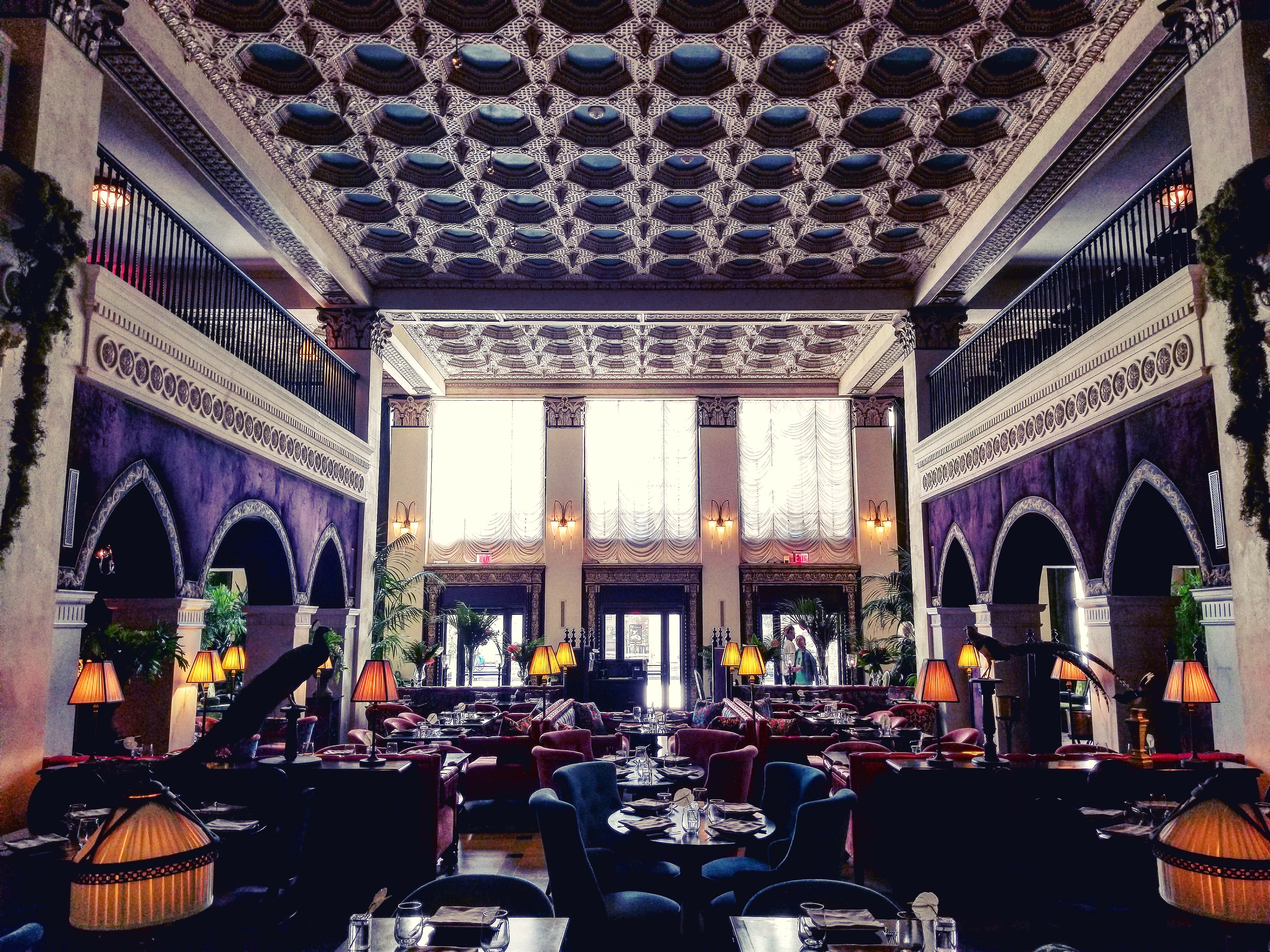
NoMad Los Angeles

Whiskey Wednesday: Early Times Proof of Concept

I’ve talked about it before but I’m really into traveling. Travel opens our eyes to new things, it also shines a new light on the familiar and common place. While most people filter this experience through art or culture being a bartender and a boozehound I end up seeing it through the glass at the bottom of a bottle.

Proof is often erroneously conflated with quality

Spirits nerds, especially us whiskey focused ones, love to talk about “the rules.” Your spirit can’t be a Scotch if it isn’t made in Scotland, your spirit can’t be whiskey unless it’s made from some type of grain, your corn whiskey can’t be Bourbon unless it uses a brand new, freshly charred barrel, etc., etc,. We love these rules because they help us clearly delineate the teams and offer an offer a definitive right vs. wrong answer in any debate.

These rules also offer consumer protection. Ever wonder why most spirits in the US are bottled at 80 proof (40% ABV)? It’s because that’s the legal minimum. In the EU that minimum is 37.5% so you will see products, even ones that are traditionally 40%, packaged at the lower threshold. Why? The answer as it so often is, is taxes.

Proof is often erroneously conflated with quality. While the higher the alcohol content the more intense the intrinsic flavors of the sprit will be this is not the sole indicator of quality. If it was Everclear would be the number one premium spirit in the world. But it is true that spirits used to be sold at much higher alcohol content. The old standard of “proof” used to be if gunpowder soaked in the spirit would still light on fire. This ensured that rum rations on ships wouldn’t interfere with the firing of it’s canons but also that the spirit hadn’t been watered down. This proof point is 57%.

All of these taxes, traditions, and experiences coalesced over the years until it was finally turned into law with the double whammy of the Bottled in Bond Act of 1897 and the Safe Food and Drug Act of 1906

57% being proof is slightly intellectually irritating though so for ease of use in the US the scale was reduced to 50%=100 proof for easier conversions for, you guessed it, tax purposes. And before you could simply buy a prepackaged bottle of booze from the store you used to take an empty bottle to the store and fill it up directly from the barrel. Diluting the spirit to 40% again made the math easier. A 26oz bottle filled with 40% alcohol will always contain 10oz of alcohol so you always know exactly how much to pay in taxes. But why settle on 40% instead of 50%? That’s the ABV strength where ethanol mixed with water lights on fire at room temperature.

All of these taxes, traditions, and experiences coalesced over the years until it was finally turned into law with the double whammy of the Bottled in Bond Act of 1897 and the Safe Food and Drug Act of 1906 which finally legally defined all of the nefarious white lightning, applejack, and whiskies floating around the American country side. And while this does a wonderful job of maintain a threshold of quality, and safety, it ends up excluding flavors and drinking traditions that fall outside these norms.

For instance, The EU ended up with a lower proof point to respect many of the Eastern European vodka makers, and it should be noted that most international councils, like Scotch and Cognac, have their own rules and minimums that have to be met. And in one of my favorite anecdotes Elmer T. Lee, one of the Father’s of Modern Bourbon, supposedly only drank his Bourbon at 60 proof because he felt that was the perfect point where the alcohol burn didn’t get in the way of the flavor. The guy knew a few things so lets take a look at something that falls outside of almost all of these rules.

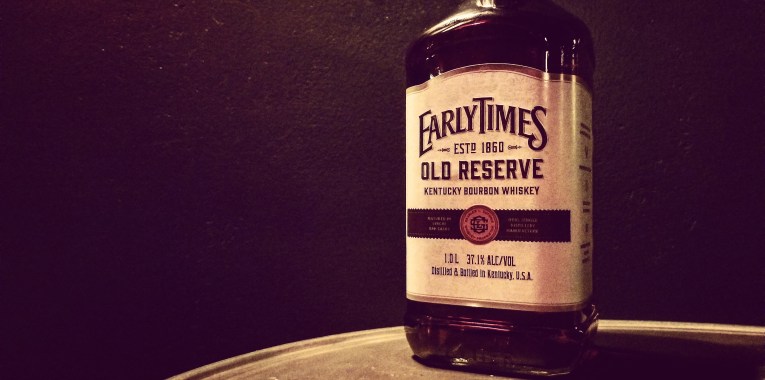
On a recent trip to the Cook Islands (look it up) in the second Duty Free store in an airport with only two gates I came across this bottle of Early Times. Now Duty Free is often a testing grounds for new products, premium bottlings, and a place to dump large amounts of product that aren’t moving.

Despite what the label says this bottle of Early Times is not a Bourbon, at least not in the United States. And this is where confusion comes in, does it follow the rest of the Bourbon laws? I have no idea so let’s assume it’s produced exactly the way regular Early Times is.

Regular Early Times is also not a Bourbon. It is produced in Kentucky by the Brown-Forman Corporation at the same distillery that produces Old Forester, which is a Bourbon. What separates the two is the barrel. Early Times is aged in reused Bourbon barrels so already it’s legally “just” a whiskey. But it’s packaged below the EU threshold of spirits at 37.1%, which means that this bottle isn’t even legally a whiskey. For the sake of novelty and the equivalent of nine American dollars I brought this bad boy across the ocean, through customs, and back home to the United States.

images.jpg

The reused barrels effect on the whiskey is immediately obvious as it’s color is lighter, more straw and hay than a full aged Bourbon that has those deep dark barrel influences.

On the nose there are all of those traditional whiskey aromas: vanilla, caramel, and a touch of stone fruit but they’re less intense due to the barrel. The spirits corn base is readily apparent even on the nose.

On the palette is sweet corn, a hint of spice, a touch of caramel, and not much else. It meats the flavor points of whiskey.

The finish is short but inoffensive. This isn’t terrible whiskey, but it is exactly the kind of whiskey an Old Fashioned cocktail was designed to enhance. Though it this case it would require a delicate touch because everything about this is so light that it would be easy to overwhelm the spirit with just a hair heavy dash of bitters.

I picked this bottle up because the proof point was amusing to me but in the end do those 2.9% points really make a difference? Yes, but there’s so much else going on with Early Times that they’re not going to make or break this spirit. It is putting in the minimum effort.

Ultimately, that’s why people look down on these bare minimum bottlings. It doesn’t feel special. They’re offering an experience that is just meeting a requirement. But sometimes all it takes is crossing an ocean for a requirement to transform into an unique, glass bottomed lens and let you see things in a new light.

Whiskey Wednesday: Overholt’s Bond

Bottled in Bond has jumped the shark. Before what’s sure to be Jack Daniel’s latest premium priced bottled in bond hits Duty Free shelves worldwide let’s look back to a much more innocent time when a BiB release truly excited me. A time known as six months ago…

Before we jump in the Short Way Back Machine what exactly does Bottled-In-Bond mean? Well, here’s a link to a video of some fools talking about it, but here’s a quick refresher. The Bottled in Bond Act of 1897 was spearheaded by a group of distillers, lead by Col. E.H. Taylor, to instate a form of quality control on products calling themselves whiskey, as well as to give consumers the confidence that whiskey sold in this new contraption known as a mass produced glass bottle was reliable and un-tampered with.

Working with the U.S. Government they came up with a list of regulations to be labeled as Bottled-In Bond.

  • The spirit must meet all the legal requirements for that spirit.
  • It must be the product of a single distillery in a single distilling season.
  • It must be aged for a minimum of 4 years in a government bonded warehouse.
  • It must be bottled at 100 Proof
  • Every bottle must list the DSP (the distillery identification number) for both the location of distillation and location of bottling.

Follow all these rules and you get a tax break and US government slaps its seal of approval on the bottle in the form of a tax stamp to show that the liquid has not been tampered with after it was bottled.

The bonded warehouse is an interesting thing to note. In the olden days this meant that the warehouse was physically locked and could only be accessed by a tax assessor (see the above tax breaks, to ensure that there was no “unauthorized removal.” This Tax Man had the keys to the warehouse and it could only be opened with their help, which is how we end up with such delightful stories as that of Old Fitzgerald.

Bottled in Bond began to thrive. It was a mark of quality, and a mark of the distiller’s skill. However, after prohibition when stocks and profits were low distillers looked for ways to stretch out the remaining supply and to reduce costs. See: blended whiskey and applejack. The required aging and proof of bottled in bond raised the quality but also the price, and being unable to blend across distilling seasons meant there was less ability to utilize backstock. Brands that were once proudly Bottled-in-Bond began reducing proof and age and slowly disappeared. Most of those that survived have been consolidated under the ownership of Heaven Hill but also lost their premium status and became your “Granddad’s Whiskey” which despite what the current whiskey boom will tell you used to be an incredibly uncool thing to say.

On the flip side, the current whiskey and cocktail boom has reinvigorated interest in Bottled In Bond as a mark of quality and in mixing. This has lead to a rash of reintroduction of Bottled In Bond products but often at a steep mark up, which I believe misses the point and utility of Bottled In Bond. They’re meant to be versatile and approachable. One of the rereleases that got this right was Old Overholt.

Old Overholt is owned by Beam Suntory, which is the parent company of the largest Bourbon producer in the world, Jim Beam. And while Overholt is truly an old brand it doesn’t usually stand out for me.

It’s a barely legal rye, meaning it’s 51% rye in the mashbill, which isn’t necessarily a bad thing. Rittenhouse Rye is also barely legal and is a bottle I can’t live without. But bottled at 80 proof I’ve often found the Overholt to be oily and incredibly earthy. However, this past January Beam Suntory added a Bottled In Bond version of the Overholt, so lets see how it stacks up.

On the nose it smells definitively like a Jim Beam product. I associate this smell with the Jim Beam yeast strains. There is a woodsy, yeasty, nutty quality that carries through almost everything in the Jim Beam lineup. There is also an oakiness and dark wood scent that lingers.

On the palette the oiliness is still very much present, but it’s cut through with a heavy alcohol burn that dries out a vanilla and caramel while complimenting the rye natural spiciness. The finish is surprisingly short, leaving an alcohol tingle and a touch of green apple.

This new Overholt is a vast improvement over the old Overholt. However, this new bottle is undeniably a whiskey drinker’s whiskey. It is mean and uncompromising and honestly tastes a lot like what I would get if I blended the 80 proof Overholt with a bottle of Rittenhouse. Its price point makes it incredibly versatile as well. The new proof boost lets it stand up in cocktails while offering a flavor profile the is unique enough to justify including it on the back bar. Bottled in Bond is clearly becoming a hip term and producing a bonded version of a known branded may help boost sales, but that boost doesn’t mean it has to come with an inflated price tag or loss of character.

Just remember, not every reboot is terrible. And while something may jump the shark it doesn’t negate the quality of everything that came before the leap.

Whiskey Wednesday: Willett Of The Past

Age adds value.

That doesn’t just mean a dollar value, I personally own dozens of books, papers, and social media accounts that only still exist because they’ve essentially become a time capsule. They’re important simply because they’ve survived.

Before NDP, Non-Distilling Producer, was short hand for overblown marketing these producers were some of the most celebrated.

I started collecting whiskey when I got back into bartending in 2011. I suddenly found myself with income surplus for the first time in years and set about recreating the back bar I had at work in my tiny Venice apartment. I ended up with more whiskey then I conceivably drink on my own, which leads directly to the fact that I have dozens of bottles in my overblown collection that are there because anytime I pick them up I think to myself, “I can’t drink that! I’ve had it forever.”

This is directly antithetical to my belief that all whiskey is for drinking, not hoarding. So I thought it was high time to revive that spirit and open some “old” spirits.

Before NDP, Non-Distilling Producer, was short hand for overblown marketing these producers were some of the most celebrated. And none have reached the cult status of the Willet Distillery.

willett-distillery.jpg

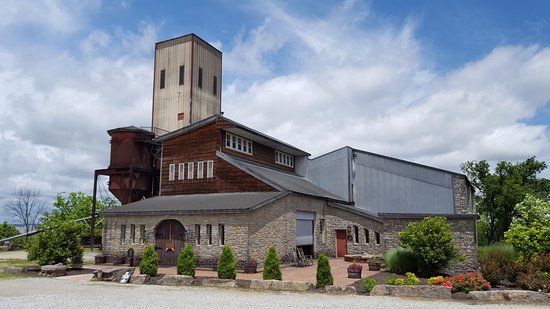
Officially know as the Kentucky Bourbon Distillers the distillery is most closely associated with it’s Willet Family Reserve line of premium whiskies. And that’s not marketing. The distillery was founded in 1935 by the Willet family as the Old Bardstown Distillery, which produced its first bourbon in March of 1936. Flash forward to 2016 and the old distillery is still family owned and some of the first whiskey distilled on site rolled down the line all over again.

How do you do something for the first time twice? You stop producing whiskey in the 70’s to make ethanol during the fuel shortage. Then the fuel prices drop, the bottom falls out from under the market, and you’re left flat footed.

From the 1980’s until about 2012 the “distillery” was just in fact an independent bottler, a NDP. They began by relying on the back stock of their own product that was still aging and began to source excess whiskey from neighbor distilleries. Most notably they were sourcing from Heaven Hill, which is so close you could roll a Bourbon barrel down the hill and hit a rickhouse. During this time Willet/KBD continued to produce award winning whiskies like Noah’s Mill, Rowan’s Creek, the formerly eponymous Old Bardstown, and turned the Willet brand into a coveted line of old, premium, single barrel whiskies.

While they may not have been producing liquid in-house the team at Willet showed

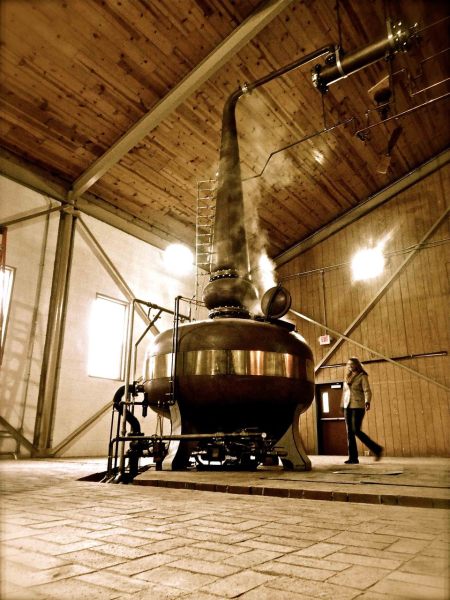
The Willet Pot Still…was incidentally also how I thought anyone who sat in front of my bar for years about what a “Pot Still” looked like.

remarkable skill in aging. The single barrels and older expressions of whiskey that they put together have long stood out as some of the best bottlings of the past two decades. But as the Bourbon boom ramped up the writing was on the wall for people trying to source whiskey. More was going to the in house brands and in 2012 KBD fired up its own set of stills and now 6 years later we are seeing bottles of old brands with new juice.

But lets get back in the way back machine to right before these stills started producing to when I bought this bottle of Willet Pot Still Bourbon.

The Willet line was already well established as a premium category but they were also pricey. The Willet Pot Still, introduced in 2008, was a non-age statement variation that could introduce people to the line with out breaking the bank. It was incidentally also how I thought anyone who sat in front of my bar for years about what a “Pot Still” looked like.

This bottle is a Single Barrel versus its modern counterpart, which is simple a “small batch.” Bottled at 94 proof, 47% alcohol, this whiskey has nearly as many awards for its packaging as it does for the Bourbon itself. So, after 7 years how does it taste?

Willett_Distillery20_ff71ed32-5056-a36f-2340837825148b38.jpg

On the nose is a sweet corn, yet dusty oak presence. The alcohol burn is larger than I would expect for something bottle at 94 proof, and for something that’s been in the bottle for three quarters of a decade. But under that burn is a touch of coffee and toffee.

On the palette the alcohol is much les noticeable. A large oak, vanilla, and slight char carry all the way through the dram with some darker fruit, a touch of cherry and almost blackberry, before giving sway to a musty, earthy, barn house sense.

The finish is light fades quickly leaving the oak on the tongue and the alcohol on the sides of the mouth.

It’s a good whiskey, something I wouldn’t be upset picking up off the shelf and drinking today but it’s not transcendent on its own. What is transcendent is the act of opening the bottle, pouring, and reminiscing as I sip on where I was at in my life when I bought this bottle and on all the events that have transpired since.

Nothing is precious on its own, the spirit we imbue it with verifies that value. And for something to have value it must have some use. So let’s raise a glass and reminisce.

Whiskey Wednesday: Nikka From The Barrel and to the US

 One of the best things about traveling is seeing what is out there in the world that can’t be seen from home.

When it comes to spirits traveling abroad often means encountering ex-pat style spirits; bottlings like Blanton’s Straight From The Barrel, an Early Times bottled at 37.1 Proof, or the Wild Turkey 13 Year. These are intriguing because they’re both familiar yet unattainable but they don’t fill a void or represent something new. Their appeal is mostly just that they can’t be had at home.

Despite what the name might imply, the whisky itself is not a single barrel expression.

More frustrating to me are those spirits that I discover but have no recourse to obtain at home. These are products that are fundamentally different from the familiar yet still incredibly appealing and often made by companies that already have products in the States. Products like the Giffard Melon, the Etter Apricot Eau-de Vie, and, until this past month, the Nikka From The Barrel Japanese Whisky numbered among them.

At this point it should be very apparent that Japanese whisky is the soup du jour of the whisky world, but instead of talking about the loss of an age statement or product line being discontinued for once we’re actually seeing an expansion of a product. And not a wholly new formulation specifically designed for a market, just an honest to god expansion of availability.

I first came across the Nikka From The Barrel when traveling to France a couple years ago. Not only was I struck but how incredibly flavorful it was but by how ubiquitous it was. I erroneously assumed it was a specialty release only to hear from the bartenders that it was their mixing Japanese whisky.  Keep in mind that this was pre-Toki when the prices were rising and stock plummeting and the ability to make cocktails with Japanese whisky was dwindling. Yet here was an over-proof, affordable, mixable Japanese whisky.  And I couldn’t have it.

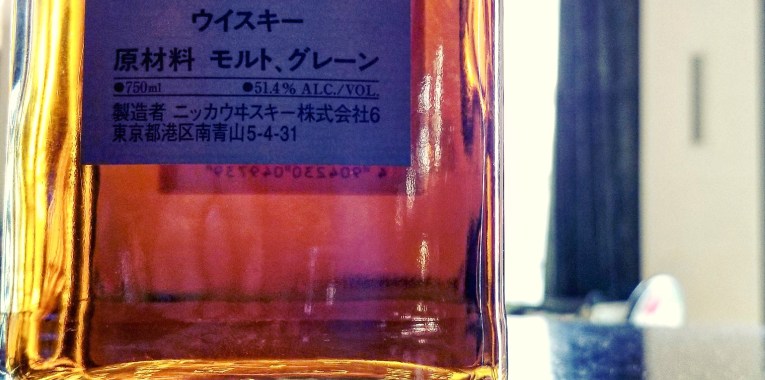
Despite what the name might imply, the whisky itself is not a single barrel expression. It is instead a blend, remember the Japanese whisky makers consider themselves more blenders then distillers. This is Single Malts from Nikka’s Yoichi and Miyagikyo Distilleries, as well as grain whisky from Miyagikyo that has been rested and married in an oak barrel for 3-6 months. It is coming from the blending  barrel not a single barrel.

The extra aging allows the whiskies to marry and evolve together before being bottled at near cask strength, a powerful 102.8 proof. This power of proof and flavor is what made the whisky such an amazing value. There is just so much packed into its little bottle. And the bottle is little. Designed to be reminiscent of a “small lump of whisky” to visualize the concentrated power inside the bottle it is packed as 500ml. This is a bottle size so far outside the allowable norms for US production that I think this more than anything is what kept it from our shores for so long.

With its Stateside release, Nikka kept the same bottle design but simply scaled it to a 750ml size. Not quite as elegant and evocative but it’s always been what’s inside the bottle that counts.

So, what’s inside the bottle? The same blend of malt and grain married for 3-6

It’s also proof that global expansion and demand can be gracious and bring you new experiences and treasures, instead of putting up artificial boundaries.

months in oak casks. Still bottled at 51.4% alcohol this is a big hitter.

The Nose carries a hint of fresh, green fruit, with a baking spice overlay and of course a discernable oak note. The alcohol vapors can accidently overpower some of the more subtle notes if you inhale too deeply on the first sniff.

On the palate is a big, full bodied whiskey. The dark baking spice notes leap to the front. Brown sugar, caramel, and the fruit stays fresh and a touch more citrusy than expected from the nose. The distillate is incredibly clean and dry.

The finish is long, drawn out, and the oak lingers after the alcohol has burned off. A few drops of water really does help mellow this whisky and expand the range of flavor.

What’s truly great about this whisky to me is that it’s simultaneously an entry level whisky and yet not. It’s something the evolves over time, much like the person drinking it.

It’s also proof that global expansion and demand can be gracious and bring you new experiences and treasures, instead of putting up artificial boundaries.

Whiskey Wednesday: The Declaration of Jim Beam’s 200th Anniversary.

“We hold these truths to be self-evident, that all men are created equal, that they are endowed by their Creator with certain unalienable Rights, that among these are Life, Liberty and the pursuit of Happiness. — That to secure these rights, Governments are instituted among Men, deriving their just powers from the consent of the governed, — That whenever any Form of Government becomes destructive of these ends, it is the Right of the People to alter or to abolish it, and to institute new Government, laying its foundation on such principles and organizing its powers in such form, as to them shall seem most likely to effect their Safety and Happiness.”

There are some words, some achievements, that are worth celebrating, even if their modern iteration doesn’t live up to its ideals in the popular imagination. It’s hard to find a more iconic American brand than Jim Beam. It’s the #1 selling Bourbon in the world and in many ways the Beam story, both that of the family and of the whiskey, parallels the story of America.

download-3.jpgThe story begins with members of the Böhm family, German immigrants who would latter change the spelling of their name to “Beam,” settled in the Kentucky territory in the late 18th century. The family patriarch, Johannes “Reginald” Beam, was a farmer. And like many farmers of the time he started producing corn whiskey as a way of preserving crops. This side venture lead to the first Beam whiskey to start flowing from the Old Tub Distillery in 1795.
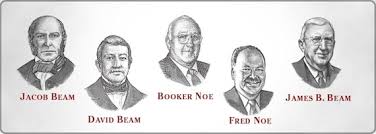
Known as Old Jake Beam Sour Mash, this whiskey proved successful enough that when David Beam took over the family business not only was he able to expand the distribution he was also able to construct a new distillery in Nelson County in 1854. This move came amidst an industrial boom in the country which allowed for modernization of production, and the move to Nelson County allowed for greater use of the massively expanding rail system in the States.

The eponymous James Beauregard Beam over saw the family business both before and after the Great Failed American Experiment of Prohibition. Prohibition interrupted the family production but James was able to rebuild the distillery in 1933 in Clermont, Kentucky in a mere 120 days. It was at this point where “Jim Beam” entered the international lexicon and a member of the Beam family has been at the still, and half the other whiskey stills in the country, ever since.

download-2.jpg

The Beam family has spearheaded this spirit for over 220 years now. However, the actual company hasn’t been owned by a Beam since 1945 when it was purchased by Harry Blum, a Chicago Spirits Merchant. It’s changed hands several times throughout the decades but currently it is a subsidiary of Suntory Holdings known as Beam Suntory. The most American of products is now owned by the second largest international beverage corporation in the world.

Flash back to the mid 90’s. Bourbon wasn’t the hip, award winning, auction breaking behemoth that its turned into today, yet it was still worth celebrating. In 1995 Beam released a 200th anniversary edition decanter and it’s like a little time capsule of Bourbon Past crossed with where Bourbon Future.

Decanters used to be the industry gimmick. When no one wanted to drink Bourbon you made the bottle so irresistible that you had to snatch it up. Compare that to the specialty releases of today where a warehouse surviving a tornado is cause for an award winning bottling.

It was a unique bottling. Bottled at 95 Proof and aged for 75 months, also known as 6.25 years. A higher than standard proof and emphasize on aging, albeit in an archaic ,confusing way. Yet ,the most interesting difference is that there is almost no information about this bottle online. No mashbill info, no tasting notes, and only a smattering of secondary market offerings.

We can assume this was the standard Beam mashbill, which puts us at something like a 76% Corn, 12% Rye, 10% Malted Barley with a #4 Barrel Char.

On the nose there is a farm house quality, along with a dusty oak and touch of sweet caramel. The palette gives way to a familiar barrel char, dark stone fruit, and a lively backbone. The liquid is still very much alive even after 20 years in the bottle. The finish is clean and lingers for just an extra moment and leaves the yeasty, dusty feel that, to me at least, is an indelible part of the Beam DNA. In the end this is a bottle that simply, and eloquently, celebrates the style of whiskey that Jim Beam made, makes, and continues to make.

The Declaration of Independence was a larger enough summer blockbuster that it will inevitably get a sequel. And I hope that this time we truly do mean all humankind are created equal, and that the casting is colorblind.

This is a whiskey made by a family of immigrants, who traveled to a new country, set down roots and became synonymous with one of the most iconic, and living, pieces of Americana to ever exist. A hometown hero on the international stage. I just returned from a trip to the Cook Islands which is in the middle of nowhere South Pacific and they had one bourbon: Jim Beam. Yet, this All American Bourbon isn’t even American owned. To me this doesn’t take away from it’s Americanness, in fact in just speaks to how tightly we are tied to the rest of the world. No matter how much we fight it, there is no “Us” and “Them” any more. We’re all in this together.

As I sit sipping this whiskey musing on the fireworks, hot dogs, and pool side celebrations I can’t help but think that the Declaration of Independence was a larger enough summer blockbuster that it will inevitably get a sequel. And I hope that this time we truly do mean all humankind are created equal, and that the casting is colorblind.

Whiskey Wednesday: Decanting Old Fitzgerald Bottled In Bond

Growing old is an interesting proposition.

It’s right there in our language. We GET older, we GROW up whether we like it or not. But these phrases imply a gift. The imply that it is a privilege to age and that we are constantly changing and growing.

Contrast that with the utter fear of aging that our culture exhibits. It’s also right there in our language. We don’t just develop. We deteriorate, mellow, and mature. And at every point along the journey we can’t help but express disbelief at how many chronological ticker marks we’ve accrued. Our own experience is that we are always the oldest that we have ever been, so exclamations like, “I can’t believe 90’s kids can legally drink!” or “Holy Shit, it’s been nearly five years since Old Fitzgerald Bottled-In-Bond was discontinued!” make us feel old and make those older than us roll their eyes at the young ‘uns.

Even in whiskey we want our spirits older, but not too old. Age at a certain point becomes a novelty act, reacting to a new release almost as if to your great-great aunts 97th Birthday, “A 27 Year old Bourbon you say? That’s adorable.” Yet we bemoan the loss of every single age statement, and doubly so when it’s a rocksteady brand that’s stood the test of time yet is still dropped in favor of something new, young, and millennial.

The loss of the Old Fitzgerald Bottled-In-Bond was a loss I felt personally and deeply. While never technically discontinued the Old Fitz was removed from most markets over the past five years in favor of it’s cousin Larceny. Same liquid inside, even still has the Fitzgerald name on the bottle still. It’s technically John E. Fitzgerald’s Larceny, referring to the legend that the original brand was named for.

In short, this tastes like Old Fitzgerald, which is a blessing and a curse

John E. Fitzgerald was a tax bondsman for the U.S. government, which meant that he was one of two people on site at the Old Judge Distillery to have keys to the bonded warehouse. This ensured that there was no theft, since no one could enter the warehouse with out him, and that the government was properly collecting it’s taxes on the whiskey production. However, the workers kept noticing certain honey barrels, the especially tasty ones, were coming up short and that Old Fitz always seemed to have some extra tasty liquid on hand. These barrels became known as “Fitzgeralds” and a brand of whiskey was eventually named after the man and his harmless acts of larceny.

The brand went on to become a working class hero. Bourbon Legend says that the brand was originally sold only to steamships, rail workers, and private clubs. After Prohibition the brand was purchased by Stitzel-Weller, the famed distillery owned by the notorious Pappy Van Winkle. In fact, during his tenure at the Stizel-Weller Distillery Pappy didn’t sell any Pappy. He sold Old Fitzgerald and it was by far their most successful brand. Like all the whiskies made at Stitzel-Weller Old Fitz had that “whisper of wheat” in the mashbill that made their whiskey so unique at the time.

old_fitzgerald_bottled_in_bond_bourbon_large.jpg

During the whiskey dark ages of the 70’s and 80’s the brand was purchased by United Distillers, which through several mergers and acquisitions eventually became the behemoth that is Diageo. United Distillers/Diageo closed the Sitzel-Weller distillery in 1994, moved production of Old Fitzgerald to the Bernheim Distillery. Then in 1999 they sold the Bernheim Distillery, and the Old Fitzgerald brand, to Heaven Hill. Heaven Hill continues to make wheated bourbon and releases it under the Old Fitzgerald name to this day.

ftcyrn5wmsfx.jpg

The story hasn’t changed. The whiskey hasn’t changed. But the age, the label, and the price certainly have. While Larceny is still a very reasonably priced bottle of whiskey it doesn’t carry the massive bang for your buck that the old Bottled-In-Bond did. And by freeing up the Fitzgerald name from a bargain priced Bottled-In-Bond the team at Heaven Hill have been able to make attempts to push the premiumization of the brand. Some of them more successful than others.

They tested the waters with the one off release of John E. Fitzgerald’s 20 Year Old Bourbon which was some of the last whiskey actually distilled at Stizel-Weller which was released to mixed reviews. And now comes the release of the long awaited Fitzgerald Bottled-In-Bond Decanter Series.

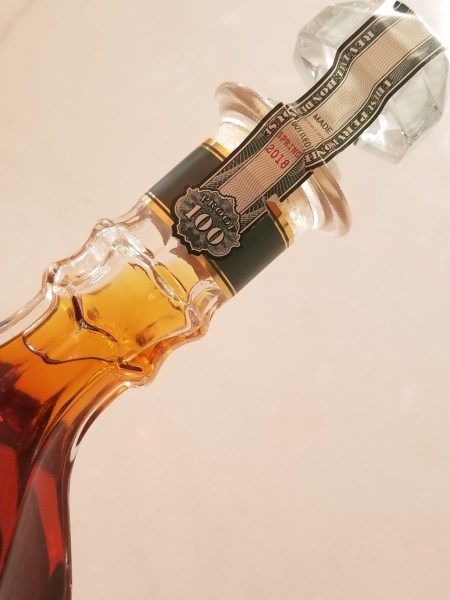
The series will be a limited release each Spring and Fall for the next few years. The throw back to the old label name also comes with a throw back to another old Bourbon tradition: fancy decanters. More important than the glassware though is that this is a Bottled-In-Bond whiskey, it’s 11 years old, and it’s got the price tag to prove it with a suggested retail price of $110.

So how does it stack up?

20180602_164023The packaging and labeling are fantastic. It’s like seeing an old friend after the divorce now that they’ve started working out and gotten a haircut. It still looks like them but a cleaner, fitter, more attractive version of them.

The nose has all the oak you’d expect from an 11-year old, but also a touch of apricot and butter. On the mid palette is black pepper, stone fruit, a hint of nuttiness and a slightly thin caramel which leads into an aggressively woody finish that lingers hot and with a slight exhalation of cherry.

In short, this tastes like Old Fitzgerald, which is a blessing and a curse.

On the one hand I’m incredibly happy to have something that tastes like my old timey Bottled-In-Bond back but at the rarity prices it’s not something I would necessarily pick up off the shelf, and it’s certainly not an every day drinker like it used to be. The extra aging has made the product deeper and mellower but it’s also made it richer and pricier. Much like your recently divorced friend it doesn’t seem interested with hanging out with the same crowd it used to.

In the end I’m happy to see the return of Old Fitzgerald in a semi regular release but it does feel like the difference between hanging out with your college buddies and your great-great aunt. The one you want to see every weekend, the other you’ll drop in on at the holidays. Maybe. If the plane tickets aren’t too expensive.

Whiskey Wednesday: Hibiki’s Resonant Disappearance

Despite being a self avowed fanatic of American whiskey the thing I’ve
found myself writing about and drinking the most recently has been
Japanese whisky.  The last time we spoke way back in December I was
drinking poetic about the Hakushu malts and the fact that though they often seem
to be in the shadow of their Yamazaki counterparts the excellence
of their design meant that it wouldn’t be long before they too
disappeared into a puff of Unicorn smoke.

That opinion seems to have be prophetic with the recent announcement
by Beam Suntory of the “partial” discontinuation of both the Hakushu
12 year and the Hibiki 17 year expressions. While the products will
only be officially discontinued in Japan they will only have “limited
availability in the next few years.” This announcement came as a bit
of a surprise to me with the Hakushu because I haven’t seen it have
the same name recognition and brand power as the Yamazaki does in the
States. But when your distillery is only 45 years old its easy to see
how your supply of 12 year old single malt could be tight.

But the real surprise to me was the Hibiki 17.

The house of Suntory have always considered themselves to be blenders
above all else. While the Single Malts may be the high priced auction
house darling the Hibiki line has always been the jewel in Suntory’s
eye.

Meaning “resonance,” the Hibiki line was first released in 1989, 5
years after the first release of Yamazaki 12 year. Originally
comprised of just the 17-year and the 21-year, a 30-year expression
was released in 1997 and the much missed 12-year was introduced in
2009 before being announced as discontinued in 2015.

Think about that for a moment. The Hibiki 12-year appeared on the
market, soared in popularity, became a staple of the bar world, and
then completely vanished all in the space of 6 years. That’s an insane
trajectory for any brand and is perfect evidence that Japanese whisky
is a truly global product at this point.

The Non-Age Statement Hibiki Harmony hit the market slightly before
the disappearance of the 12-year and despite everyone crying, “Foul!”
many of us were willing to give Beam Suntory the benefit of the doubt
for two reasons: 1) the Hibiki 12-year was the only expression to
utilize whisky that was aged in plum wine casks. They hadn’t
projected for the popularity of the expression, so they discontinued it
because 2) the Harmony wasn’t a replacement for the 12-year. It is
meant to be a more accessible version of the 17-year.

The Hibiki line has always been a blend of whiskies from all three
of the Suntory distilleries: Yamazaki, Hakushu, and
Chita. To them it is the confluence of every unique facet of their
operation. It is meant to represent the ideal of the harmony between
people and nature. The 24 facets of the bottle represent the 24
seasons of the Japanese calendar and invoke the comparison of this
balance to the balance of the malt and grain whiskies in the Hibiki
blend that resides inside the bottle.

This attention to detail is part of what has always set the Hibiki
line apart from my disdain of other blends. And yes, you would have
had to be a real prophet 20 years ago to predict the explosive growth
of the segment, and yes, it’s a real shortage. Bars in Japan are
pouring the Harmony just like we are over here. And yes, the rise of
shochu and decrease in whisky drinking in the 80’s led to lower
production. But the line was introduced in the late 80’s when this
downturn was happening and while the 17-year is being officially
discontinued in Japan it’s “limited availability” will continue to
limp on in the United States. This speaks to the power and demand for
premium aged Japanese whisky in the US, but also can’t help but lend
a tinge of cynicism to the disappearance of the 17-year. Its as if stocks
are being pulled at a younger age to go into blends like the Harmony
to cash in on the popularity wave now versus risking a drop in demand
later.  And if that’s true who could blame them?

In Beam Suntory’s defense, the Harmony is still damn delicious and
their quality has not dropped. They have also consistently stated that
they are ramping up production and that this will be a temporary
hiccup, but how many temporary hiccups have we seen come with a flashy
return and a price hike? (I’m looking at you Old Fitz.)

None of this denies the fact that the Hibiki 17 Year is an amazingly
delicious dram. The nose is full and rich, distinct notes of honey,
with some roasted pear, a touch of smoke and ume plum.

The palette offers a touch of sweetness to go along with the initial
scents with the addition of raisin, oak, and a pithy citrus zest that
carries on to a long finish that turns into an darker
amontillado sherry note with a touch of cacao.

It’s easy to see why this blend is the crown jewel of the Hibiki line,
it’s easy to see how we drank it all out of stock, it’s easy to see
why they may have discontinued this expression to protect the more
award winning 21-year expression, and it’s easy to see why we should
all raise a glass and drink to this resonant whisky and to its equally
evocative moment in time.