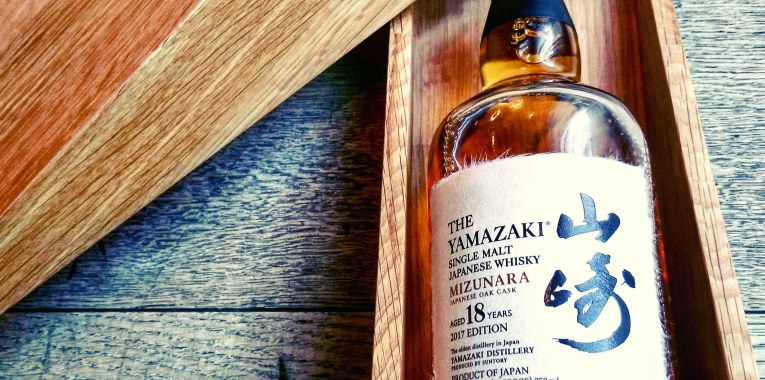
Open Bottle: Yamazaki 18 Year Single Malt Mizunara Cask

In today’s edition of things you’ll never get to taste: Yamazaki 50 Year Old!

            On Friday August 17th 2018 a bottle of 1st edition Yamazaki 50 Year Old, one of only 50 bottles to exist, sold at auction for $312, 519.87. This is now the most expensive bottle of Japanese whisky ever sold at auction, beating the previous record set a mere three months earlier with the sale of bottle of 52-year old Karuizawa and blowing the previous record for Yamazaki set in 2016 out of the water.

But none of these can touch the record for most expensive bottle ever sold at auction, also set in May of 2018, for a bottle of MaCallan 60 Year old. The malt was distilled in 1926, bottled in 1986, featured a label created by Valerio Adami, is one of only 12 bottles in existence, and sold for $1.1 million USD.

Thirsty yet? Wish you could taste what must be the Elixir of Youth? Well, you can’t so lets talk about something absurd that you still might be able to put in your mouth: The Yamazaki Mizunara Cask.

To many drinkers and collectors Yamazaki is the quintessential Japanese whiskey. You can read more about their specific history, here, here, and here. Yet something that’s even more quintessentially Japanese than Yamazaki, kaiju, and anime is mizunara wood.

download-1
Quercus mongolica

Scientifically known as Quercus mongolica, this is a species of oak native to Japan, central and northern China, Korea, eastern Mongolia, and eastern Siberia. The infancy of the Japanese whiskey industry butted up against the outbreak of World War 2 and while imports of European and American oak barrels for aging were drying up whisky consumption was on the rise and became the main drink consumed by the Japanese army. Barrels were needed so the distillers turned to their native oak.

Up until then mizunara had been used primarily in the manufacturing high end furniture and when transferring to whisky making the distillers ran into a few problems. First up, it takes a good 200 years for a mizunara oak to fully mature for a good cask, and it doesn’t grow straight, making it difficult to form proper staves. On top of that, Japanese oak has a higher moisture content than it’s cousins making it more difficult to work with. It’s also more porous meaning the casks are more susceptible to leaking.

Despite all these setbacks it turns out what mizunara really needs to shine is the thing that it’s hardest to give: time. The true flavors of mizunara really start to shine after prolonged ageing. This has lead to it being an essential player in the blended/pure malts that Japanese producers are so found of but also rocketed it into the stratosphere of some of the most sought after style of aged Japanese whisky in the world.

As the world of rare whisky comes to mirror more and more the world of fine art and bottles are becoming collectors pieces to be admired but never enjoyed it’s worthwhile to be reminded that the true joy of a dram is in the drinking and the sharing.

Due to the maturation time needed and the problems of working with the wood itself there aren’t many whiskies that are fully aged in exclusively mizunara but the allure and price tag of whiskies aged in mizunara have led to multiple producers releasing mizunara seasoned releases that carry the name but not the refinement that is so readily apparent in the older Yamazaki releases.

Take for instance their 2017 Yamazaki Mizunara release. The 2017 release is an 18 year old single malt aged exclusively in mizunara oak. Their Chief Blender, Shinji Fukuyo, tasted through hundreds of mizunara aged whiskies and put together this malt that may legally only be only 18 years but is stated to contain at least a small portion of 50 year old malt. Bottled at 96 proof and with a price tag slightly north of $1000 this is certainly not an everyday whisky- but can it clue us into the hype and auction fees of its unobtainable brethren?

NOSE: The nose is rich, fragrant and has a touch of sandal wood and greenery. An undertone of fresh baking spice is also present. The mizunara is already making itself known.

PALATE: A silky texture, with dry red fruit, coconut, citrus marmalade, a sweetness of caramel and a rich texture that is reminiscent of condensed milk with out the heavy feeling.

FINISH: It ends with a decisive spiciness, it’s reminiscent of Japanese incense, the lighter wood notes from the nose return and linger with the baking spice as you exhale.

This is a truly elegant pour of whisky. It is a prime example of how much patience is needed to truly coax the beauty of the mizunara out of the cask and into the glass. When I drink this I understand why Suntory is scouring Japan for old mizunara furniture to turn into more barrels.

I’ll probably never know how this stacks up to the most expensive Japanese whisky ever sold but it will always have something more noteworthy about it than that auction bottle ever will: I can actually drink it. As the world of rare whisky comes to mirror more and more the world of fine art and bottles are becoming collectors pieces to be admired but never enjoyed it’s worthwhile to be reminded that the true joy of a dram is in the drinking and the sharing.

This bottle is by no means commonplace and the price is nothing to scoff at but I can think of at least four places around Los Angeles where this is a bottle that can transport your evening and remind you that patience is sometimes its own reward.

And if you ask nicely I might even tell you where those places are before I drink it all myself.

Whiskey Wednesday: Overholt’s Bond

Bottled in Bond has jumped the shark. Before what’s sure to be Jack Daniel’s latest premium priced bottled in bond hits Duty Free shelves worldwide let’s look back to a much more innocent time when a BiB release truly excited me. A time known as six months ago…

Before we jump in the Short Way Back Machine what exactly does Bottled-In-Bond mean? Well, here’s a link to a video of some fools talking about it, but here’s a quick refresher. The Bottled in Bond Act of 1897 was spearheaded by a group of distillers, lead by Col. E.H. Taylor, to instate a form of quality control on products calling themselves whiskey, as well as to give consumers the confidence that whiskey sold in this new contraption known as a mass produced glass bottle was reliable and un-tampered with.

Working with the U.S. Government they came up with a list of regulations to be labeled as Bottled-In Bond.

  • The spirit must meet all the legal requirements for that spirit.
  • It must be the product of a single distillery in a single distilling season.
  • It must be aged for a minimum of 4 years in a government bonded warehouse.
  • It must be bottled at 100 Proof
  • Every bottle must list the DSP (the distillery identification number) for both the location of distillation and location of bottling.

Follow all these rules and you get a tax break and US government slaps its seal of approval on the bottle in the form of a tax stamp to show that the liquid has not been tampered with after it was bottled.

The bonded warehouse is an interesting thing to note. In the olden days this meant that the warehouse was physically locked and could only be accessed by a tax assessor (see the above tax breaks, to ensure that there was no “unauthorized removal.” This Tax Man had the keys to the warehouse and it could only be opened with their help, which is how we end up with such delightful stories as that of Old Fitzgerald.

Bottled in Bond began to thrive. It was a mark of quality, and a mark of the distiller’s skill. However, after prohibition when stocks and profits were low distillers looked for ways to stretch out the remaining supply and to reduce costs. See: blended whiskey and applejack. The required aging and proof of bottled in bond raised the quality but also the price, and being unable to blend across distilling seasons meant there was less ability to utilize backstock. Brands that were once proudly Bottled-in-Bond began reducing proof and age and slowly disappeared. Most of those that survived have been consolidated under the ownership of Heaven Hill but also lost their premium status and became your “Granddad’s Whiskey” which despite what the current whiskey boom will tell you used to be an incredibly uncool thing to say.

On the flip side, the current whiskey and cocktail boom has reinvigorated interest in Bottled In Bond as a mark of quality and in mixing. This has lead to a rash of reintroduction of Bottled In Bond products but often at a steep mark up, which I believe misses the point and utility of Bottled In Bond. They’re meant to be versatile and approachable. One of the rereleases that got this right was Old Overholt.

Old Overholt is owned by Beam Suntory, which is the parent company of the largest Bourbon producer in the world, Jim Beam. And while Overholt is truly an old brand it doesn’t usually stand out for me.

It’s a barely legal rye, meaning it’s 51% rye in the mashbill, which isn’t necessarily a bad thing. Rittenhouse Rye is also barely legal and is a bottle I can’t live without. But bottled at 80 proof I’ve often found the Overholt to be oily and incredibly earthy. However, this past January Beam Suntory added a Bottled In Bond version of the Overholt, so lets see how it stacks up.

On the nose it smells definitively like a Jim Beam product. I associate this smell with the Jim Beam yeast strains. There is a woodsy, yeasty, nutty quality that carries through almost everything in the Jim Beam lineup. There is also an oakiness and dark wood scent that lingers.

On the palette the oiliness is still very much present, but it’s cut through with a heavy alcohol burn that dries out a vanilla and caramel while complimenting the rye natural spiciness. The finish is surprisingly short, leaving an alcohol tingle and a touch of green apple.

This new Overholt is a vast improvement over the old Overholt. However, this new bottle is undeniably a whiskey drinker’s whiskey. It is mean and uncompromising and honestly tastes a lot like what I would get if I blended the 80 proof Overholt with a bottle of Rittenhouse. Its price point makes it incredibly versatile as well. The new proof boost lets it stand up in cocktails while offering a flavor profile the is unique enough to justify including it on the back bar. Bottled in Bond is clearly becoming a hip term and producing a bonded version of a known branded may help boost sales, but that boost doesn’t mean it has to come with an inflated price tag or loss of character.

Just remember, not every reboot is terrible. And while something may jump the shark it doesn’t negate the quality of everything that came before the leap.

Whiskey Wednesday: The Declaration of Jim Beam’s 200th Anniversary.

“We hold these truths to be self-evident, that all men are created equal, that they are endowed by their Creator with certain unalienable Rights, that among these are Life, Liberty and the pursuit of Happiness. — That to secure these rights, Governments are instituted among Men, deriving their just powers from the consent of the governed, — That whenever any Form of Government becomes destructive of these ends, it is the Right of the People to alter or to abolish it, and to institute new Government, laying its foundation on such principles and organizing its powers in such form, as to them shall seem most likely to effect their Safety and Happiness.”

There are some words, some achievements, that are worth celebrating, even if their modern iteration doesn’t live up to its ideals in the popular imagination. It’s hard to find a more iconic American brand than Jim Beam. It’s the #1 selling Bourbon in the world and in many ways the Beam story, both that of the family and of the whiskey, parallels the story of America.

download-3.jpgThe story begins with members of the Böhm family, German immigrants who would latter change the spelling of their name to “Beam,” settled in the Kentucky territory in the late 18th century. The family patriarch, Johannes “Reginald” Beam, was a farmer. And like many farmers of the time he started producing corn whiskey as a way of preserving crops. This side venture lead to the first Beam whiskey to start flowing from the Old Tub Distillery in 1795.

Known as Old Jake Beam Sour Mash, this whiskey proved successful enough that when David Beam took over the family business not only was he able to expand the distribution he was also able to construct a new distillery in Nelson County in 1854. This move came amidst an industrial boom in the country which allowed for modernization of production, and the move to Nelson County allowed for greater use of the massively expanding rail system in the States.

The eponymous James Beauregard Beam over saw the family business both before and after the Great Failed American Experiment of Prohibition. Prohibition interrupted the family production but James was able to rebuild the distillery in 1933 in Clermont, Kentucky in a mere 120 days. It was at this point where “Jim Beam” entered the international lexicon and a member of the Beam family has been at the still, and half the other whiskey stills in the country, ever since.

download-2.jpg

The Beam family has spearheaded this spirit for over 220 years now. However, the actual company hasn’t been owned by a Beam since 1945 when it was purchased by Harry Blum, a Chicago Spirits Merchant. It’s changed hands several times throughout the decades but currently it is a subsidiary of Suntory Holdings known as Beam Suntory. The most American of products is now owned by the second largest international beverage corporation in the world.

Flash back to the mid 90’s. Bourbon wasn’t the hip, award winning, auction breaking behemoth that its turned into today, yet it was still worth celebrating. In 1995 Beam released a 200th anniversary edition decanter and it’s like a little time capsule of Bourbon Past crossed with where Bourbon Future.

Decanters used to be the industry gimmick. When no one wanted to drink Bourbon you made the bottle so irresistible that you had to snatch it up. Compare that to the specialty releases of today where a warehouse surviving a tornado is cause for an award winning bottling.

It was a unique bottling. Bottled at 95 Proof and aged for 75 months, also known as 6.25 years. A higher than standard proof and emphasize on aging, albeit in an archaic ,confusing way. Yet ,the most interesting difference is that there is almost no information about this bottle online. No mashbill info, no tasting notes, and only a smattering of secondary market offerings.

We can assume this was the standard Beam mashbill, which puts us at something like a 76% Corn, 12% Rye, 10% Malted Barley with a #4 Barrel Char.

On the nose there is a farm house quality, along with a dusty oak and touch of sweet caramel. The palette gives way to a familiar barrel char, dark stone fruit, and a lively backbone. The liquid is still very much alive even after 20 years in the bottle. The finish is clean and lingers for just an extra moment and leaves the yeasty, dusty feel that, to me at least, is an indelible part of the Beam DNA. In the end this is a bottle that simply, and eloquently, celebrates the style of whiskey that Jim Beam made, makes, and continues to make.

The Declaration of Independence was a larger enough summer blockbuster that it will inevitably get a sequel. And I hope that this time we truly do mean all humankind are created equal, and that the casting is colorblind.

This is a whiskey made by a family of immigrants, who traveled to a new country, set down roots and became synonymous with one of the most iconic, and living, pieces of Americana to ever exist. A hometown hero on the international stage. I just returned from a trip to the Cook Islands which is in the middle of nowhere South Pacific and they had one bourbon: Jim Beam. Yet, this All American Bourbon isn’t even American owned. To me this doesn’t take away from it’s Americanness, in fact in just speaks to how tightly we are tied to the rest of the world. No matter how much we fight it, there is no “Us” and “Them” any more. We’re all in this together.

As I sit sipping this whiskey musing on the fireworks, hot dogs, and pool side celebrations I can’t help but think that the Declaration of Independence was a larger enough summer blockbuster that it will inevitably get a sequel. And I hope that this time we truly do mean all humankind are created equal, and that the casting is colorblind.

Whiskey Wednesday: Hibiki’s Resonant Disappearance

Despite being a self avowed fanatic of American whiskey the thing I’ve
found myself writing about and drinking the most recently has been
Japanese whisky.  The last time we spoke way back in December I was
drinking poetic about the Hakushu malts and the fact that though they often seem
to be in the shadow of their Yamazaki counterparts the excellence
of their design meant that it wouldn’t be long before they too
disappeared into a puff of Unicorn smoke.

That opinion seems to have be prophetic with the recent announcement
by Beam Suntory of the “partial” discontinuation of both the Hakushu
12 year and the Hibiki 17 year expressions. While the products will
only be officially discontinued in Japan they will only have “limited
availability in the next few years.” This announcement came as a bit
of a surprise to me with the Hakushu because I haven’t seen it have
the same name recognition and brand power as the Yamazaki does in the
States. But when your distillery is only 45 years old its easy to see
how your supply of 12 year old single malt could be tight.

But the real surprise to me was the Hibiki 17.

The house of Suntory have always considered themselves to be blenders
above all else. While the Single Malts may be the high priced auction
house darling the Hibiki line has always been the jewel in Suntory’s
eye.

Meaning “resonance,” the Hibiki line was first released in 1989, 5
years after the first release of Yamazaki 12 year. Originally
comprised of just the 17-year and the 21-year, a 30-year expression
was released in 1997 and the much missed 12-year was introduced in
2009 before being announced as discontinued in 2015.

Think about that for a moment. The Hibiki 12-year appeared on the
market, soared in popularity, became a staple of the bar world, and
then completely vanished all in the space of 6 years. That’s an insane
trajectory for any brand and is perfect evidence that Japanese whisky
is a truly global product at this point.

The Non-Age Statement Hibiki Harmony hit the market slightly before
the disappearance of the 12-year and despite everyone crying, “Foul!”
many of us were willing to give Beam Suntory the benefit of the doubt
for two reasons: 1) the Hibiki 12-year was the only expression to
utilize whisky that was aged in plum wine casks. They hadn’t
projected for the popularity of the expression, so they discontinued it
because 2) the Harmony wasn’t a replacement for the 12-year. It is
meant to be a more accessible version of the 17-year.

The Hibiki line has always been a blend of whiskies from all three
of the Suntory distilleries: Yamazaki, Hakushu, and
Chita. To them it is the confluence of every unique facet of their
operation. It is meant to represent the ideal of the harmony between
people and nature. The 24 facets of the bottle represent the 24
seasons of the Japanese calendar and invoke the comparison of this
balance to the balance of the malt and grain whiskies in the Hibiki
blend that resides inside the bottle.

This attention to detail is part of what has always set the Hibiki
line apart from my disdain of other blends. And yes, you would have
had to be a real prophet 20 years ago to predict the explosive growth
of the segment, and yes, it’s a real shortage. Bars in Japan are
pouring the Harmony just like we are over here. And yes, the rise of
shochu and decrease in whisky drinking in the 80’s led to lower
production. But the line was introduced in the late 80’s when this
downturn was happening and while the 17-year is being officially
discontinued in Japan it’s “limited availability” will continue to
limp on in the United States. This speaks to the power and demand for
premium aged Japanese whisky in the US, but also can’t help but lend
a tinge of cynicism to the disappearance of the 17-year. Its as if stocks
are being pulled at a younger age to go into blends like the Harmony
to cash in on the popularity wave now versus risking a drop in demand
later.  And if that’s true who could blame them?

In Beam Suntory’s defense, the Harmony is still damn delicious and
their quality has not dropped. They have also consistently stated that
they are ramping up production and that this will be a temporary
hiccup, but how many temporary hiccups have we seen come with a flashy
return and a price hike? (I’m looking at you Old Fitz.)

None of this denies the fact that the Hibiki 17 Year is an amazingly
delicious dram. The nose is full and rich, distinct notes of honey,
with some roasted pear, a touch of smoke and ume plum.

The palette offers a touch of sweetness to go along with the initial
scents with the addition of raisin, oak, and a pithy citrus zest that
carries on to a long finish that turns into an darker
amontillado sherry note with a touch of cacao.

It’s easy to see why this blend is the crown jewel of the Hibiki line,
it’s easy to see how we drank it all out of stock, it’s easy to see
why they may have discontinued this expression to protect the more
award winning 21-year expression, and it’s easy to see why we should
all raise a glass and drink to this resonant whisky and to its equally
evocative moment in time.

Whiskey Wednesday: A Bitter-Sweet Hakushu

Life is a bittersweet balance. I’ve been hosting Whiskey Wednesday for going on six years now. It’s exposed me to more bottles and drams than I can count, constantly challenged me to stretch my creative muscles, and introduced me to some of the most delightful nerds/people that I’ve ever met.  I’ve grown as a person, a bartender, a writer and a insufferable know it all.

I never would have thought six years ago that these Wednesdays would be something that I would still be doing, let alone have my thoughts and notes for them become so expansive that they would undergo a biogenesis into a blog that people actually read. I also wouldn’t have survived all these years with some semblance of my sanity intact if things had stayed stagnant. Change, experimentation, and misplaced passion have kept me going.

And now it’s time for another change. After today, Whiskey Wednesday continues but it’ll become more abstract. Less about every scattered soul flocking to the bar once a week for a drink, and more about raising a glass from where ever we might be. So, for my last night behind the stick for the foreseeable future lets combine the past and the future and pour some Hakushu.

The Hakushu Distillery was found in 1973, 50 years after Yamazaki, it often seems to live in the shadow of its older sibling. It also lives in the shadow Mt. Kaikoma in the Japanese Southern Alps. This was a deliberate choice made by Keizo Saji, the company’s second Master Blender. He chose the site primarily because of the quality of the water. The naturally granite filtered water leant a subtlety and effervescence to the distillate but the site also offered a distinct microclimate with the surrounding forest and with it sitting at 700m above sea level its definitely one of the highest elevations for whisky distillation in the world. For comparison Scotland’s two highest distilleries, Dalwhinnie and Braeval, both sit around 355 meters above sea level.

All of this combines to create a spirit that is lighter, more delicate, and often more mellow than its Yamazaki counter points. Also, unlike Yamazaki, Hakushu utilizes peated malt. When combined with the distillery and terrior this peat takes on more of recently extinguished early morning, mountainside cooking fire than more maritime and often aggressive smokes of the Scots.

The distillery also takes to heart the Japanese respect for nature. It strives for harmony with its surroundings right down to its aging warehouses. Built into the mountain itself they utilize earthquake safe, single story tacks that are about 13 levels high. This kind of aging space, combined with the high elevation has allowed them to mature a spirit with relatively low barrel influence, especially for the age of the whiskey.

As for the whiskey itself, both Hakushu and Yamazaki import their barley, both the peated and unpeated barley. However, they do grind, mash and ferment on site. They have six pairs of stills at Hakushu with at least 4 different shapes. They then utilize five different type of aging casks while primarily focusing on ex-Bourbon and hogsheads. All of this diversity in barley, stills and barrels allows them to create what they call a combination of 40 different styles of whisky. Keep in mind Suntory’s primary craft, as they see it, is blending. And unlike Scotland where even rivals will trade barrels back and forth to get unique flavors for blends, Suntory was essentially trying to build a category from scratch. If they wanted diversity they had to make it themselves. And 44 years later it feels like Hakushu is finally coming into its own.

It may seem odd to call a 44-year-old operation “young” but when your primary marks are a 12 year and 18 year old single malt a 44 year old distillery may not be an infant but its still most certainly a toddler.  Hell, the first release of Hakushu 12 wasn’t until 1994, a solid 10 years after the release of Yamazaki 12 year. And while the Yamazaki has the experience and the award that come with it the Hakushu is certainly flexing it’s muscle.

Both the 12 year and the 18 year are primarily composed of three styles of distillate: unpeated distillate aged in sherry buts, unpeated distillate aged in hogsheads, and peated distillate aged in ex-Bourbon. These truly show off the complexity and depth of the distillery creating a whiskey that is light, yet powerful. The aroma of smoked pears wafts over a palette that is green, with a touch of citrus and smoke. The 18 draws out more of the stone fruit qualities while adding a touch more sweetness from the extra oak.

In short, Hakushu also knows what they’re doing and while it may stay in the shadows of its mountain forest home it won’t be in the shadows of its Yamazaki brethren.

So, come share a glass with me because it won’t be long before Hakushu catches up to the Yamazaki awards and it disappears like a forest mist of rarity and also because who knows where we’ll both be the next time we can.

Whiskey Wednesday: The Darkest (Bowmore) Timeline

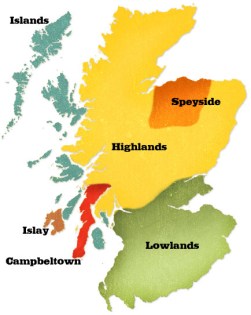
Remember when the regions of Scotland were a thing?  Highlands, Lowlands, Islands, Campbelltown, Speyside, and Islay? For years brand ambassadors and whisky makers preached the golden gospel of the distinct styles of the six regions of Scotland.

ey-region-map

The first problem a lot of people see with this list is that three of the regions are technically just small regions of the other three. Speyside is part of the Highlands, Campbelltown is part of the Lowlands, and Islay is very much an Island. If these three places can have their own unique style why can’t the plot of land down the road have its own style? The truth of the matter is that style is more about the distiller and blender than anything to do with the arbitrary geographical location.

Let’s look at Islay, quite possibly the most distinct and memorable Scotch style. The mere mention of the word Islay causes people’s tastes buds to shiver at the onslaught of peat, smoke, and saltiness of the most famously peated Scotch’s in the world. Yet many of the whiskies coming off the island are completely unpeated. Bunnahabhin is very famously unpeated. Everything coming out of the Bruichladdich distillery that is bottled as “Bruichladdich” is currently unpeated. They have to save up all that smoke for the Octomore. Even amongst the “peat bombs” there is a massive variety of style for such a tiny island.

Lagavulin is like a misty, damp marshland while Laphroig is like a dusty campfire and The Octomore is like smoke gently resting on the briny salt air. And then somewhere in the middle of all this is Bowmore.

Founded in 1779 the Bowmore distillery has been in continual operation except for a brief pause in the World War II to host the RAF Costal Command. It’s never risen to the same height of fame as say, a Laphroig, but they consistently put out great whiskey that seems to walk the line between the styles and practices other distilleries are doing with more flash.

They’re sourcing a good portion of their barley from Islay, similar to Bruichladdich, and they’re giving a the whisky a healthy dose of peat, just like the island island is known for, but they’re also throwing in a fair amount of Sherry barrel aging which is more commonly associated with those Speyside malts on the other side of the country. The Bowmore 15 “The Darkest” hits all these notes perfectly.

It is a 15 year old single malt aged in ex-Bourbon and Sherry barrels for 12 years. The malt is then married together for three years in Olorosso sherry cask that imparts a deep color and melds a gentle smoke together with raisins, dried cherry, and stone fruit with a touch of saltiness and a note of bitter chocolate on the finish. It’s a bottle that can be enjoyed by lovers of peat and lovers of Sherry. Or by lover of Islay or lovers of Speyside malts.

We like easy boxes and categories to help define what we like and don’t like. But just like any complex creation style isn’t about where you come from. It’s about what you make of yourself.

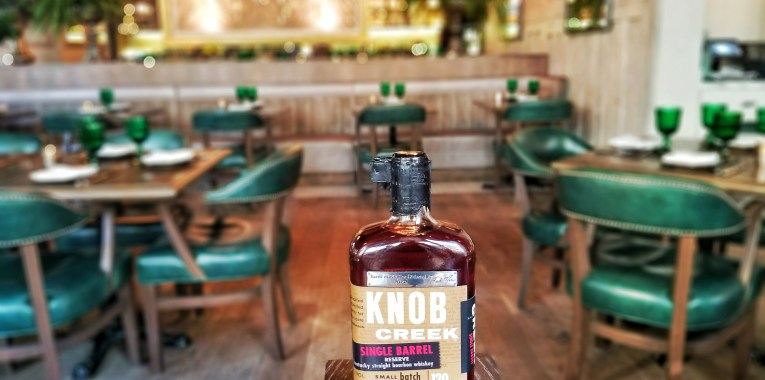
Whiskey Wednesday: Knob Creek 25th Anniversary

Bourbon is an old tradition, dating back hundreds of years to our rugged frontier forefathers and foremothers who proved their American spirit by making a distinct product using brilliant recipes and methods that they would pass down unchanged to us to be poured into a glass for our drinking pleasure today. At least according to the marketing materials  it is… the truth is a bit more complicated.

Although the term “Bourbon” is associated with whiskey as early as the 1820s, “Bourbon” was only declared the native spirit of the United States by Congress 53 years ago with the passing of a 1964 resolution. And the definition of “Whiskey” as a spirit distilled from grain, and Bourbon as a spirit distilled from 51% corn is only 108 years old. President William Howard Taft put the definition in place in 1909 as part of the Safe Food and Drug Administration Act of 1906. Yes, it took him three years to come up with the definition of “Bourbon whiskey.” But with the start of Prohibition a mere 11 years away its questionable how many people would have enjoyed whiskey that lived up to these new regulations. Think about that the next time someone tells you their whiskey is “Pre-Prohibition Style.”

All of this is to say that tradition is long and constantly changing and in the adjusted timeline some landmarks are bigger than they appear at first. Like, for instance, Knob Creek’s 25th Anniversary.

images

Knob Creek was the whiskey child of Booker Noe, grandson of Jim Beam who tookover as Head Distiller of his grandfather’s distillery in 1965. Booker, along with Elmer T. Lee and Jimmy Russell, is credited with the revitalization of the Bourbon market at the end of the 80s with the introduction of now iconic brands of Bourbon. Booker first released Booker’s Bourbon in 1988 to much acclaim, and this was quickly followed up with Baker’s, then Basil Hayden’s and Knob Creek in 1992. These are the heart and soul of the Jim Beam Small Batch collection, which led the way in many respects for the premiumization of Bourbon.  None of these have survived to their 25th year with out some alteration.

Knob Creek is named after the stream that ran alongside Abraham Lincoln’s childhood home in Kentucky and is Booker’s take on  “Pre-Prohibition Style” whiskey. A term that we can now see is as nebulous as those early definitions of whiskey.

In this case it meant a Bourbon whiskey bottled at 100 proof and carrying an age statement of 9 years. Traditional Knob Creek is a deep caramel color, with a nose that carries a lot of oak, along with a touch of maple and baking spice, a super vanilla, white pepper, and dark cherry palette with a earthiness and dustiness that I can only associate with Jim Beam yeast, and a gripping, dry finish that is a bit bracing at 100 proof. It’s iconic. Immutable.

Except it wasn’t. In 2001 Booker, who had continued to oversee the brand well into his 70’s, passed the torch to his son Fred. And shortly after the Bourbon boom that Booker had helped create hit full force.

Knob Creek expanded. In 2010 Knob Creek Single Barrel hit the market. It was a natural expansion, still 9 years old but bottled at 120 proof from a single barrel. Then they began releasing a non age statement Knob Creek Rye in 2012, followed in 2013 by ae008e3717aca1adfe229d4d561643efthe Knob Creek Smoked Maple, a bourbon flavored liquor bottled at 90 proof. Then camethe inevitable. In 2016, just shy of 25 years, Beam Suntory announced that Knob Creek would be dropping its age statement. That same year the Knob Creek 2001 was released; a 13 year, Cask Strength release comprised of the last barrel that Booker Noe laid down before passing the torch to his son.

Jim Beam has followed up with a 25th Anniversary release appropriately named Knob Creek 25thAnniversary. It’s a limited release of 300 barrels, all between 12-13 years old and bottled between 120-125 proof that is exactly what it sounds like: bigger, more intense, Knob Creek.

Whether you’re going by the centuries old “traditional” definition or adhering  to a more modern practice twenty five years is still a milestone worth celebrating in the midst of so much change. Hell, maybe a few more milestones like this will help us truly appreciate that some change is as much a part of Bourbon heritage as all those pre-Prohibition style ways of making it are.

Whiskey Wednesday: The Yamazaki Price

What would you do with $130,000? Buy a house? A Tesla? Travel the world? Or maybe you decide screw it and go for the most expensive bottle of whisky ever sold: the Yamazaki 50 year old single malt 2005 release.

In October of 2016 one of the 250 bottles of Yamazaki distilled in the mid-1950s claimed the Guinness World record for the most expensive standard size bottle of whisky ever sold for $129,186. That’s a nearly 1300% increase over the original sticker price of $9,500. That’s a massive return on investment, even for 50 year old whisky, but it’s made even more impressive when you consider that the Yamazaki distillery itself is less than 100 years old and the first Yamazaki single malt wasn’t released until 1984.

caption.jpgSuntory founder and first master blender, Shinjiro Torii and Masataka Taketsuru, “The Father of Japanese Whisky”, founded the Yamazaki distillery in 1923. Taketsuru had studied organic chemistry in Glasgow and was found by Torii after he made inquiries to Scotland looking for a whisky expert. Torii was told there was already one fully qualified in his own country and the two worked closely to build the Yamazaki distillery. However, the first whisky produced by the new company, dubbed the Suntory Shirofuda was a resounding failure. The Japanese drinkers preference for lighter, blended whiskies was blamed as well as Taketsuru’s fixation on doing things the “Scottish way.” Taketsuru was shunted away from the distillery to a beer factory where he served out the remainder of his ten year contract before leaving to start the Nikka distilling company, Suntory’s biggest rival.
Despite these early set backs the Suntory company pressed on, releasing the Kakubin in 1937 and after being postponed by WWII, the Suntory Old Whisky in 1950. In 1961 the company send the first Japanese Whisky imports to the United States and Torii’s son Keizo Saji took over as president and Master Blender. The next few years were full of experimentation including opening the Chita Distillery in 1972, the Hakushu Distillery in 1973, and the release of Midori in the United States in 1978. The next big shift for the company comes in 1984 when Saji moved the company away from it’s focus on blends with the very first release of Suntory Single Malt Whisky Yamazaki.

The 80’s proved to be a pivotal time for Suntory not only because of the new focus on single malts but because the other distilleries opened in the 70s allowed them to produce more varied styles of whisky culminating in the first release of the Hibiki Blended Whisky in 1989. The Suntory Single Malts may be carry the highest price tags but Suntory still considers themselves to be a blending house and the Hibiki’s are what they consider to be the pinnacle of their art.

All the pieces were in place yet as you may have heard the 90’s were not the most hospitable of decades to brown spirits. It took a new millennium as well as a series of rapid-fire rewards to rocket Japanese whisky from niche good to internationally coveted whisky.

The Yamazaki is caught between a rock and a hard place; soaring success chased by the rising struggle to support the base of that success.

In 2003 Suntory’s Yamazaki Single Malt 12 year won it’s first Gold Award at the International Spirits Challenge in the UK followed relatively quickly by Suntory becoming the first Japanese whisky producer to be awarder “Distiller of the Year” by the same ISC in 2010.

The Yamazaki Distillery expanded in 2013 with the addition of four stills, bringing the imgp9795.jpgtotal to 12, which increased capacity about 40%. The added capacity didn’t prevent them from releasing the Non-Age Statement Yamazaki and Hakushu Distiller’s Reserve the following year just as talk of the worldwide whisky shortage began to surface. Also in 2014, Suntory purchased Beam, Inc. (home of the eponymous Jim Beam Bourbon) for $16 billion forming Beam Suntory, the third largest spirit producer in the world. This acquisition greatly expanded Suntory’s distribution lines spreading the already thin stocks of Yamazaki even thinner.
The final nail in the Japanese Whisky hype train was also driven home in 2014 when the Yamazaki Sherry Cask 2013 won the coveted Jim Murray “World Whiskey of the Year” award. With that the path is set and we’re barreling towards the inevitable $130,000 bottle.

Yet with all this focus on the mythical, never to be seen bottles that dominate the headlines, what has become of the mythical, occasionally glimpsed bottles that built the reputation of Yamazaki and Suntory in the first place?

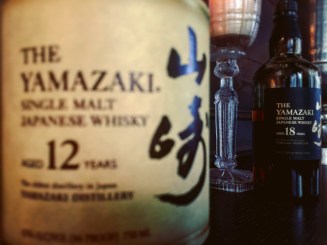
The Yamazaki 12 Year is still liquid gold in a bottle. The whisky is aged in a combination of American ex-Bourbon, Spanish Sherry, and Japanese Mizunara oak cask. It is, you guessed it, a minimum of 12 years old and bottled at 86 proof. What has always struck me about this whisky is the amount of fruit on the nose. Ripe peach, with a touch of grapefruit and orange, followed by a rich lingering mid palette that leaves an almost toasted bread note before disappearing into a long finish that is edged with dark baking spices.

IMG_4145.JPGWhile the 12 year was once the perfect introduction to Japanese malt, before the price and the hype got in the way, it was the Yamazaki 18 year that always stirred my soul. This time roughly 80% Sherry casks with ex-Bourbon and Mizunara making up the other 20%. Here the promise of the 12 year has evolved into a stately elegance. The fruit dries out, turning to raison and apricot with dark chocolate and berries on the tongue with a touch of spice on the long march to the finish.


In the end these spirits are deserving of every award they’ve had draped around their bottles necks, yet I can’t help but feel like they are victims of their own success. The price on these bottles has steadily climbed while availability has dropped. Drinkers are driven to seek these “more available” bottles every time a headline splashes a story bottle of Yamazaki selling for more than the median household income of a small family only to be disgruntled when they turn up empty handed. Products like the Yamazaki Distillers Select, the Hibiki Harmony, or the Nikka Pure Malt may help bridge that gap in the category, but no matter how vehemently the companies talk about these products being “different” and “not replacements for age stated products” seasoned drinkers can’t help but feel that their old toys are being taken away while they’re charged more. It’s a story they see time and time again as the trend sweeps through whisk(e)y brands across the globe.

The Yamazaki is caught between a rock and a hard place; soaring success chased by the rising struggle to support the base of that success. It’s a good problem to have and one without an easy answer but it is a debate that certainly is helped with a glass of liquid gold in hand while you have it.

Whiskey Wednesday: Time For Toki

In Japanese Toki means ‘time’ and the adage goes in time everything comes back around. In a market obsessed with single malts Japanese Whisky is an ongoing example of the relevance and power of blends. Since importing whisky making from Scotland nearly a century ago distillers in Japan have been breaking down the individual components of the craft and reassembling them into works of art. Though the more disparaged styles, like grain whisky or blends, have taken a front row seat next to their single malt brethren. And they’re holding their own. This quality and craftsmanship hasn’t gone unnoticed which has lead to a massive boom in popularity. Which is great, because you can never have enough good whisky. But it’s also terrible because it’s becoming increasingly hard to find and holy hell look at that price tag!

Hoping to fill that gap is the Suntory Toki. Made by the same folks behind Hibiki, Yamazaki and Hakshu. And in fact, the component distilleries are the same as those that make up the Hibiki style blend. These are the Yamazaki and Hakushu distilleries as well as the Chita distillery, which you’ve probably never heard of. Relatively unknown in the West, Chita is the Grain Whisky distillery that is traditionally used to accent the malts produced in the Yamazaki distillery. In the Toki, however, the Chita’s ‘heavy type’ grain whisky takes center stage along with Hakushu malt aged in American white oak. They are then supported by two different Yamazaki Malts: an American Oak malt and a Spanish oak malt. All of the traditional components are there.

The result is an incredibly light whisky. Rich pear, apple and a green fruit, with a light oak presence and almost no edge. It’s incredibly approachable but not any where close to reaching the haloed status of its older siblings. But not everything needs to be a living legend. Sometimes you just want a damn good highball and there is nothing wrong with that.

Old Grand Dad’s Goodbye

It’s been an interesting few months for the “Beam” portion of Beam Suntory.

Back in October the had a full worker strike at Jim Beam, it only lasted a single week before both sides reconciled their differences but it also happened to be the same week that Booker’s Rye was named Jim Murray’s World Whiskey of the Year.

The prestige of that super allocated release, as well as the price tag, seemed to add fuel to Beam’s announcement at the end of last year that standard issue Booker’s Bourbon was going to see a production cut and double in price in 2017. This announcement was met with such backlash that the company quickly back tracked, now saying that the price would more gradually increase over the year with only a $20 increase to start off the year. This about face has left many people disgruntled, feeling that they were some how manipulated into snatching up bottles. As if they were forced into buying the whiskey by the announcement.

Add this to the Maker’s Mark brushfire in 2013 where the same company announced that they’d be cutting the proof of Maker’s Mark to increase supply only to quickly change their tune due to community pushback and you seem to have a company with an inte
rnal struggle between the accountants and the physical producers.

Amidst this kerfuffle yet another beloved friend has bit the dust with out much fanfare: the Grand Dad 114. The lack of a dustup might be proof that the company was right to discontinue this expression of Old Grand Dad but I images.jpgpersonally disagree.

Old Grand Dad is old. Not as in an age statement but in terms a brand. And even if you don’t think you’re familiar with the brand you’re wrong. You just know him by another name: Basil Hayden.

Basil Hayden was part of a great migration into the heart of modern day Bourbon Country. He was, like almost everyone else, a farmer first. He distilled to preserve excess grain, just like his neighbors did, with little thought to mashbill or long term aging.

After the civil war whiskey went industrial and around 1882 Basil’s grandson, Raymond, founded a distillery and named it after his Old-Grand Dad and slapped a portrait of him on the label.

After Hayden’s death the distillery passed into the hands of the Wathen’s who made medicinal Old Grand Dad through-out Prohibition and their company, American Medicinal Spirits, became the backbone for National Distillers after repeal which was one of the largest and most influential bourbon makers in American History.

After Prohibition, when whiskey stocks were nearly non-existent, a higher rye content was added to Oimages-1.jpgld Grand Dad’s mashbill in an effort to make it taste and feel like those ‘old style’ distillers in an effort to appeal to the new drinkers.
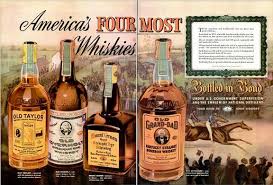
Flash forward to the late 80’s, National Distillers merged with Jim Beam and amazingly, the mashbill for Old Grand Dad has seemingly been left unaltered. And they even added to the family by introducing Basil Hayden’s in 1992.

I’ve always loved the 114. 114 proof (duh) it is spicy, powerful, dusty leather and a nutty presence that leaves your mouth bone dry, hunting for more. And even if the claim that Basil was known for making bourbon “with a high rye content” is completely unsubstantiated it is still damn good whiskey.

By now Basil Hayden’s far outshines its older iteration, at least in terms of press and sales. And with supply unable to keep up with demand a family sacrifice has been made. So good by 114.

That’s the history, but what about the future of Old Grand Dad? Well, let’s look back at the little ol’ Maker’s mark fiasco and Booker’s Rye awards.

A few months after Beam Suntory announced that the would in fact not be lowering the proof of Maker’s Mark the suddenly released Maker’s Mark Cask Strength. The release was originally very limited and sold exclusively in small format but proved so successful that it’s a full time release now, for a majorly popular brand that carries a higher price tag and slightly more prestige.

Add that to the success, and price tag, they’re having with super limited releases of major brands like Booker’s it’s hard not to see the super allocated Cask Strength Basil Hayden’s wait in the pipeline. And to not see the massive price tag it’ll carry on the shelves and even more gargantuan one it’ll have on the secondary market.images-2.jpg

This is the dark side of the whiskey boom. What helped fuel this boom was availability and price. Bourbon was unpretentious and everyone could afford a great bottle. Now, value is harder to find and more of the fans are being priced out of something they love. If we’re lucky they’ll go the Maker’s Mark route on this one and turn it into a permanent line extension but who can say? The company itself seems to have a hard time making up its mind.

I can’t tell if the glass is half full or half empty but, for tonight at least, it’s filled with Old Grand Dad 114