Whiskey Wednesday: The Darkest (Bowmore) Timeline

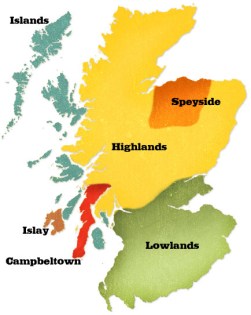
Remember when the regions of Scotland were a thing?  Highlands, Lowlands, Islands, Campbelltown, Speyside, and Islay? For years brand ambassadors and whisky makers preached the golden gospel of the distinct styles of the six regions of Scotland.

ey-region-map

The first problem a lot of people see with this list is that three of the regions are technically just small regions of the other three. Speyside is part of the Highlands, Campbelltown is part of the Lowlands, and Islay is very much an Island. If these three places can have their own unique style why can’t the plot of land down the road have its own style? The truth of the matter is that style is more about the distiller and blender than anything to do with the arbitrary geographical location.

Let’s look at Islay, quite possibly the most distinct and memorable Scotch style. The mere mention of the word Islay causes people’s tastes buds to shiver at the onslaught of peat, smoke, and saltiness of the most famously peated Scotch’s in the world. Yet many of the whiskies coming off the island are completely unpeated. Bunnahabhin is very famously unpeated. Everything coming out of the Bruichladdich distillery that is bottled as “Bruichladdich” is currently unpeated. They have to save up all that smoke for the Octomore. Even amongst the “peat bombs” there is a massive variety of style for such a tiny island.

Lagavulin is like a misty, damp marshland while Laphroig is like a dusty campfire and The Octomore is like smoke gently resting on the briny salt air. And then somewhere in the middle of all this is Bowmore.

Founded in 1779 the Bowmore distillery has been in continual operation except for a brief pause in the World War II to host the RAF Costal Command. It’s never risen to the same height of fame as say, a Laphroig, but they consistently put out great whiskey that seems to walk the line between the styles and practices other distilleries are doing with more flash.

They’re sourcing a good portion of their barley from Islay, similar to Bruichladdich, and they’re giving a the whisky a healthy dose of peat, just like the island island is known for, but they’re also throwing in a fair amount of Sherry barrel aging which is more commonly associated with those Speyside malts on the other side of the country. The Bowmore 15 “The Darkest” hits all these notes perfectly.

It is a 15 year old single malt aged in ex-Bourbon and Sherry barrels for 12 years. The malt is then married together for three years in Olorosso sherry cask that imparts a deep color and melds a gentle smoke together with raisins, dried cherry, and stone fruit with a touch of saltiness and a note of bitter chocolate on the finish. It’s a bottle that can be enjoyed by lovers of peat and lovers of Sherry. Or by lover of Islay or lovers of Speyside malts.

We like easy boxes and categories to help define what we like and don’t like. But just like any complex creation style isn’t about where you come from. It’s about what you make of yourself.

Whiskey Wednesday: Tyrconnell’s Long Odds

Every now and then I like to remind myself that Irish Whiskey isn’t spelt “Jameson’s.” I’ve talked about the explosive growth of Irish Whiskey before but here are some quick facts.

While everyone is gaga for Japanese whiskey as a luxury product Irish whiskey is expecting to double its sales by 2020. In 2014 Jameson’s sold 18 million liters in the US alone. The Scots and the Irish will fight until the Sun goes cold over who first created whiskey but there’s no debating the fact that it was Irish monks that tought most of the Western World how to distill. Hell, even the word “whiskey” is an Anglicization of “uisge beatha” which is Gaelic for water of life. The Irish are indelibly linked to whiskey so what’s the problem? It’s a monoculture.

Need proof? In 2014 Jameson’s closest competitor, Bushmill’s, sold a whopping 1.3 million cases. Jameson’s currently accounts for 63% of the global Irish whiskey market. Monocultures are great for business but are incredibly susceptible to full scale collapse. Look at what’s happening to the Chiquita bananas or how the agave industry is actively working to reinvigorate the gene pool with the Bat project.

Irish whiskey has traditionally lived and died with the American market and like so many other things it was ruined by Prohibition. On top of that throw in the Irish War for independence, a civil war, trade disputes with Great Britain, and you end up with an industry made up of over 160 distilleries and 400 brands reduced to a mere two distilleries in the mid-70’s.

The remains of the Irish whiskey industry banded together to form Irish Distillers which was then purchased by Pernod Ricard in the late 80’s. They then began the massive push to get people to drink Irish. It worked and since 1990 Irish whiskey has been the fastest growing spirit in the world. It’s ballooned the industry with 32 new or proposed distilleries across Ireland. Not bad for an industry long sustained by only four distilleries and of those four only one has been in operation longer that 1975.

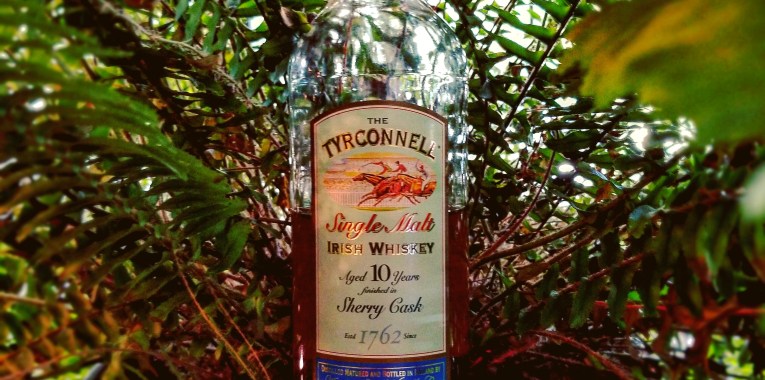
It’s a old industry with new blood and the near death of the industry left many historic brands and styles in the grave. Irish Single Malts and Tyrconnell are great examples. Tyrconnell was the flagship brand of the Old Watts Distillery, It takes it name from a racehorse who won the National Produce Stakes in 1876 at literally  at 100 to 1 odds. It was incredibly popular in the US, there are photos of Yankee Stadium at the turn of the century with Tyrconnell ads on the billboards. But prohibition shuttered the brand and the distillery in 1925. The Brand was revived by the Cooley distillery in the 80’s.

It’s made in traditional Single Malt Style, 100% malted barley and double copper pot still distillation with no peat, and then aged in ex-Bourbon Barrels. The 10 Year Old Madeira Cask Finish is my real jam though. A light, fruit forward whiskey with bitter chocolate, green, tropical fruit, and a incredibly creamy finish. It’s one of those whiskies that slips below the radar while being incredibly excellent. And they’ve gotten to the place where they are now planning on a limited release of a 16-year old Single Malt. And maybe that’s the silver lining to the Jameson’s problem.

All of this growth in the Irish whiskey world is being fueled and often literally paid for by sales of Jameson’s. For many people that’s all Irish whiskey will ever be which leaves a lot of hidden gems to be found flowing from the Emerald Isle. The world has caught on to Bourbon, its caught on the Japanese whisky, hell its even caught on to Taiwanese whiskey, but not Irish. Not yet anyway…

The days of Yamazaki and Weller Antique being undervalued have faded and instead of being sipped and shared it’s now being hoarded and auctioned. And i miss sipping and sharing. And at least with Tyrconnell I still can.

Drinking Poetic: West of Brooklyn

I’m sentimental in my head. I say head because I’m less emotionally sentimental and more intellectually sentimental, meaning that I hold on to things because I feel like I’m supposed to. This often means I find myself with collections of stuff that sometimes seem to stick around simply because it’s already stuck around.

Enter The West of Brooklyn, a drink that is now pushing its 6th consecutive year on my cocktail menus.

It certainly wasn’t planned that way and if you had asked me five years ago what drink of mine I’d still be making half a decade later it wouldn’t have been this one. I was young(er) and getting super into bespoke cocktails and was currently working my way through the Neighborhood Series and thought, “I want in on that.”

The Neighborhood Series was lineup of drinks from the Milk & Honey family and friends in New York that gave us some modern classics like the Cobble Hill, The Green Point, and the Red Hook. All of these drinks grew out of one simple fact: The Brooklyn Cocktail is terrible.

The classic Brooklyn Cocktail was first printed in 1910 in Jack’s Manual and is often modernly interpreted as:

2 oz Rye Whiskey (Preferably a Bottled-In-Bond)

.5 oz Dry Vermouth

.25 oz Maraschino

.25 oz Amer Picon

Looking at this you can see that it’s not the Brooklyn’s Fault that it’s terrible. Today we’re missing a vital ingredient: old school Amer Picon.

Amer Picon is a classic bitter orange French liqueur that also has notes of gentian, cinchona, and quinine that is no longer available in the States. But even if you were to get your hands on a bottle of it from France the recipe was changed in the 1970’s reducing the proof and making it sweeter. This means it doesn’t make the same drink. I’ve been fortunate to have classic Amer Picon and a classic Brooklyn thank to Andrew Willet over at Elemental Mixology and it’s a damn tasty drink. And for what it’s worth Andrew believes that CioCiaro makes a Brooklyn that more closely matches the classic.

Looking at this family of drinks and personally loving stirred drinks that add a subtle element of citrus or fruit I set about to add my own Neighborhood Cocktail.

At the time I was just getting started at Areal a mere block from the Pacific Ocean and was living in Venice Beach. I had moved West instead of to NYC where I would have more than likely settled in Brooklyn so before I started I already had a name: The West of Brooklyn. It was only later that I realized that Manhattan is also ‘West of Brooklyn’ but I will retroactively take credit for being that clever.

My base was clearly going to be Rittenhouse BIB Rye but knowing I was never going to get my hands on pre-70s Picon I looked for a more readily available substitute. Bigalett’s China-China had just hit the market so I pulled out a bottle of that and started mixing. I was enamored of Blanc Vermouth at the time so that joined the Bigalett and being in California and also being rather disparaging of maraschino, I looked around for a orange liqueur and ended up with a bottle of Solerno Blood Orange and thought, “That’ll do.”

That pretty much sums up my mentality about this whole drink with this first pass. I didn’t put enough thought into it. It looked like this:

2 oz Rittenhouse BIB Rye

.5 oz Bigalett China-China

.25 oz Blanc Vermouth

.25 oz Solerno Blood Orange

Stir. Served up with a Lemon Zest.

It ended up being a bit of an aggressively blunt instrument but it went on the menu and people seemed to enjoy it. It fit the bitter and stirred category and I let it be. I replaced it on the next printed menu but we had a cocktail board in the bar at Areal with drawings for every drink and our artist had been so pleased with her artwork that she wanted to leave it on the wall. I shrugged and gave it no thought.

809EA2AE-9EF9-4512-98CE-2400E3B9704C

People would continue to order the drink but it wasn’t until I had a customer come in and tell me that he had been in several times over the past months just for the drink because he liked it so much that I realized I had been making the drink for two years. I felt like I should revisit it.

I found the Bigallet was completely taking over the drink, but any attempt to dial it down just caused it to be lost. So I went back to the drawing board looking for a Grand Bitters to take its place and I started playing with the Clementi China Antica. The Clemanti focuses more on the bitter quinine notes without the orange which turned out to be perfect for the drink since I was adding the orange notes with the Solerno. But again any attempt to use less than a half ounce caused it to be lost when butting heads with the power of Rittenhouse so the drink remained a blunt instrument, albeit a drier more whiskey-focused one.

I left it at that an ended up leaving that bar. I honestly thought that would be the end of the drink. But as we were doing R&D for my first menu at Faith and Flower my friend Ryan Wainwright and I were doing an event at Seven Grand LA celebrating the Manhattan and lo and behold the drink came up. The night was being sponsored by Buffalo Trace and Sazerac Rye and suddenly the drink clicked.

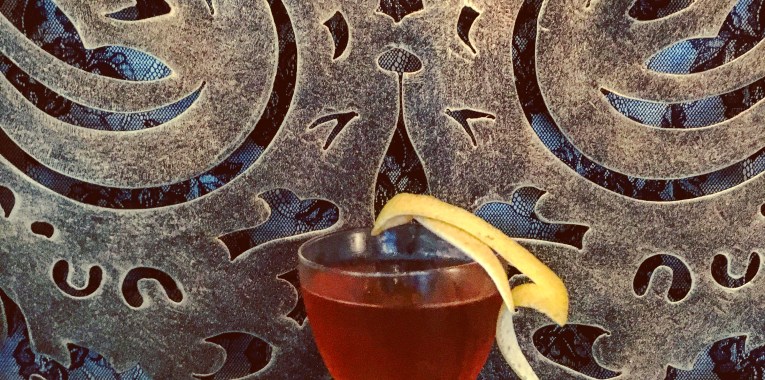
In the years since I first got into the LA bar scene Sazerac Rye was highly allocated so trying to use it in a featured menu drink was a touchy proposition and that mentality stuck with me even as the rye became more available. Sazerac is a lighter, less aggressive rye than Rittenhouse with more of a green apple spice, and edges that bleed into ripe fruit. Switching out Sazerac allowed me to dial down the Clemanti Antica and bring up the blanc vermouth making it more true to its family of drinks while leaving it elegant, with a white pepper spice tied with a subtle fruit that has a perceived sweetness before drying on the palette. It now looked like:

2 oz Sazerac Rye Whiskey

.5 oz Dolin Blanc Vermouth

.25 oz Clemanti China Antica

.25 oz Solerno Blood Orange

Stir with ice. Strain into a Nic and Nora glass with a lemon zest.

The drink perfectly fit the summer time Manhattan vibe we were looking for the menu and it was resurrected. And as I sit here doing R&D for the Fall/Winter menu it finally looks like the drink will truly come off the menu for the first time in five years. Until I change it again…

Whiskey Wednesday: Unicorns, Whales, and Narwhales

Unicorns are all around. You can see them prancing through the Instagram forest, taunting you with delicious rivulets running down the sides of a glistening Glencairn glass yet the moment you emerge into the fields of the liquor stores they become a distant fable. What happened to these legendary bottles?

The short answer is: they became legendary. As humans we often seem driven to obtain the unobtainable. We strive to climb the highest mountain, to put a man on Mars, and to score a bottle of Pappy Van Winkle for our home bar. Pappy might not be as lofty a goal as the first manned mission to Mars but the spirit is the same. This mentality to obtain the best doesn’t just drive the whiskey market either.

In the world of craft beer the legendary brews are known as ‘whales’ and if you ever wanted to see a brewmaster roll their eyes and grit their teeth ask them

When everyone wants a unicorn what happens to all the workhorses?

about the notorious ‘Whale Hunters.’ These Sudsy Ahabs sail the special event scene, spear the rarest beer on tap, drain the keg and disappear, often without supporting the breweries core beer and usually never to be seen again. They don’t add value to the bar, or even necessarily to the brand, they’re just looking to score something that they feel only they can appreciate before anyone else can be exposed to it.

While the Unicorn and Whale market have certainly spurred growth, especially in the craft scenes, and have been some of the biggest drivers of the infamous Booze Black Market they have an unseen downside. When everyone wants a unicorn what happens to all the workhorses?

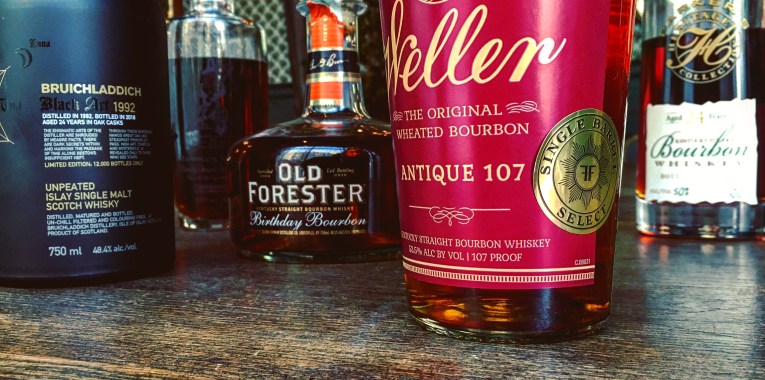
Unicorn bottles like the Pappy’s, or the Parker’s Heritage, or the Old Forester

The current whiskey boom has created a feedback loop where what were once reliable bottles are becoming, maybe not unicorns but certainly narwhales.

Birthday Bourbons are great special occasion bottles but they can’t support a distillery on their own. You need good product, at a good price, that people want to drink frequently yet responsibly. The current whiskey boom has created a feedback loop where what were once reliable bottles are becoming, maybe not unicorns but certainly narwhales.

Take the W.L. Weller line up. Created by William Larue Weller the brand has existed since the 1840’s and enjoyed great popularity at the time. Julian ‘Pappy’ Van Winkle joined the Weller Company as a salesman in 1893 and after W.L. Weller passed away in 1899 Pappy and Alex T. Farnsley purchased the company in 1908. A. Ph. Stitzel had been under contract to produce whisky for the Weller Company and after a merger in 1933 the infamous Stitzel-Weller Distillery opened in 1935. The distillery made W.L. Weller, Old Fitzgerald and many other whiskies (but no Pappy Van Winkle) until it shut down in 1992. The Weller brand was than purchased by Buffalo Trace in 1999 where it is currently made along side it more famous Van Winkle cousins.

IMG_2815.JPG
A.H. Hirsch 16 Year Special Reserve

At face value this story is similar to many other whiskey brands that existed before and after Prohibition. It enjoyed early success, sluggish sales in the middle of the century and has been enjoying rising tides with the rest of the Bourbon industry. But between Stitzel-Weller’s closing in 1992 and today we’ve been struck full force with the Bourbon Boom and Pappy Mania. And once the word got out that Weller was just “young, cheaper Pappy” stocks began to get bought up, and people saw a chance to raise prices.

What was once a great everyday workhorse is slowly becoming something pricy and privileged rather than welcoming and friendly. And I say this as a spoiled man who just received a House Single Barrel of Weller Antique 107. This is going to be an everyday whiskey for myself and for the bar at Faith and Flower but we almost didn’t end up with it because of its Narwhale reputation.

Due to a snafu in the warehouses people who were not myself, or my bar, were able to order cases of our current barrel. And the entire barrel blew out of stock in less than 24 hours. And I first found out about this situation by being linked to a post of someone selling bottles of it on the Secondary Market for $70!

While all the one hand it’s flattering that someone would want to pay so much for a barrel I’ve picked out, it’s also infuriating not only because it feels like someone stole one of my favorite toys but because that’s highway robbery on the price. They weren’t just stealing from me, they’re stealing from the people they’re selling it to as well.

Thankfully we were able to retrieve all of the cases (minus a few missing bottles) and I can continue to wage my war against it becoming a true unicorn by making Old Fashioned Cocktails with it. But where does this unicorn hunt leave us?

Let’s look at the craft beer world again. For the first time in nearly two decades beer growth and consumption is down, not slowing. A gentle decline has emerged. Many analysts point to breweries being bought out by massive conglomerates and to choice fatigue, there are just so many damn options that its exhausting. But they also point out that people aren’t drinking less they’re just moving to other drinks. Like whiskey.

IMG_3196.JPG
Hibiki 17

What if these craft beer drinkers became exhausted not by choice but by the hassle and work needed to get they’re favorite brew, or were so discouraged by never being able to get a thimble of Pliny the Younger that they tried something else, say a workhorse Bourbon. Turns out they liked it and moved into a new category of drinking. What happens when these same problems invade the Whiskey World? How long can we maintain growth in an industry when the goalposts keep moving?

On the other hand, while my philosophy has always been education and approachability, I have felt the sting of working an entire year to craft a bar program that delivers everyday excellence, to then earn that one shinning Unicorn of a bottle and priced it in a way to reward thirsty travelers in their search only to have that one Unicorn Hunter swoop in an annihilate the bottle. It’s a balancing act that we’re all going to have to get better at if we want to keep this Whiskey Boom from going belly up.