Drinking Poetic: The Panic Order

I’m terrible at Vodka drinks. 

It sounds elitist, snobbish, and very hipster bartender of me but it’s a fact of life. I think the problem is twofold.  

1) Stylistically, I gravitate towards stirred, booze forward drinks that include some sort of odd characteristic. I go through phases: stirred citrus, clarified everything, fruit infused sherries, etc. I essentially want to turn everything into a stirred cocktail in a Nic and Nora 

2) I’m an elitist, snobbish, pseudo hipster bartender. 

 I’m often inspired by a base flavor and then continually layer, subtract, and accentuate characteristics until an equilibrium, or deliberate imbalance, is reached. Vodka by its very nature is designed to be clean, neutral, and mostly flavorless which doesn’t often provide that spark of flavor inspiration that sends me down the path. 

Alternatively, I’m also good at “concept cocktails.” These are drinks that start as a thought experiment with a definitive theme. Combine all of the above and you have the starting seeds of the Panic Order. 

We had a couple of factors (issues) to consider. We needed a new Vodka drink for the menu. Something that was lighter, refreshing, more spring and summer in style. We also needed something that was quick and efficient to execute. Labor costs are a real issue and when planning the current menu for NoMad LA we had to account for not only the efficiency of making the drink in the moment but also the amount of labor that could go into prep hours.  

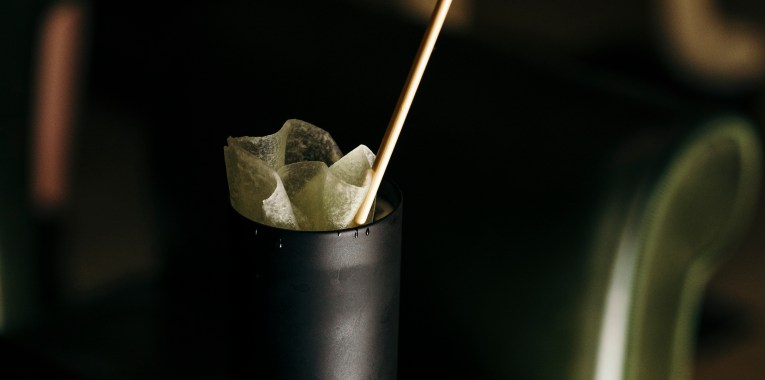
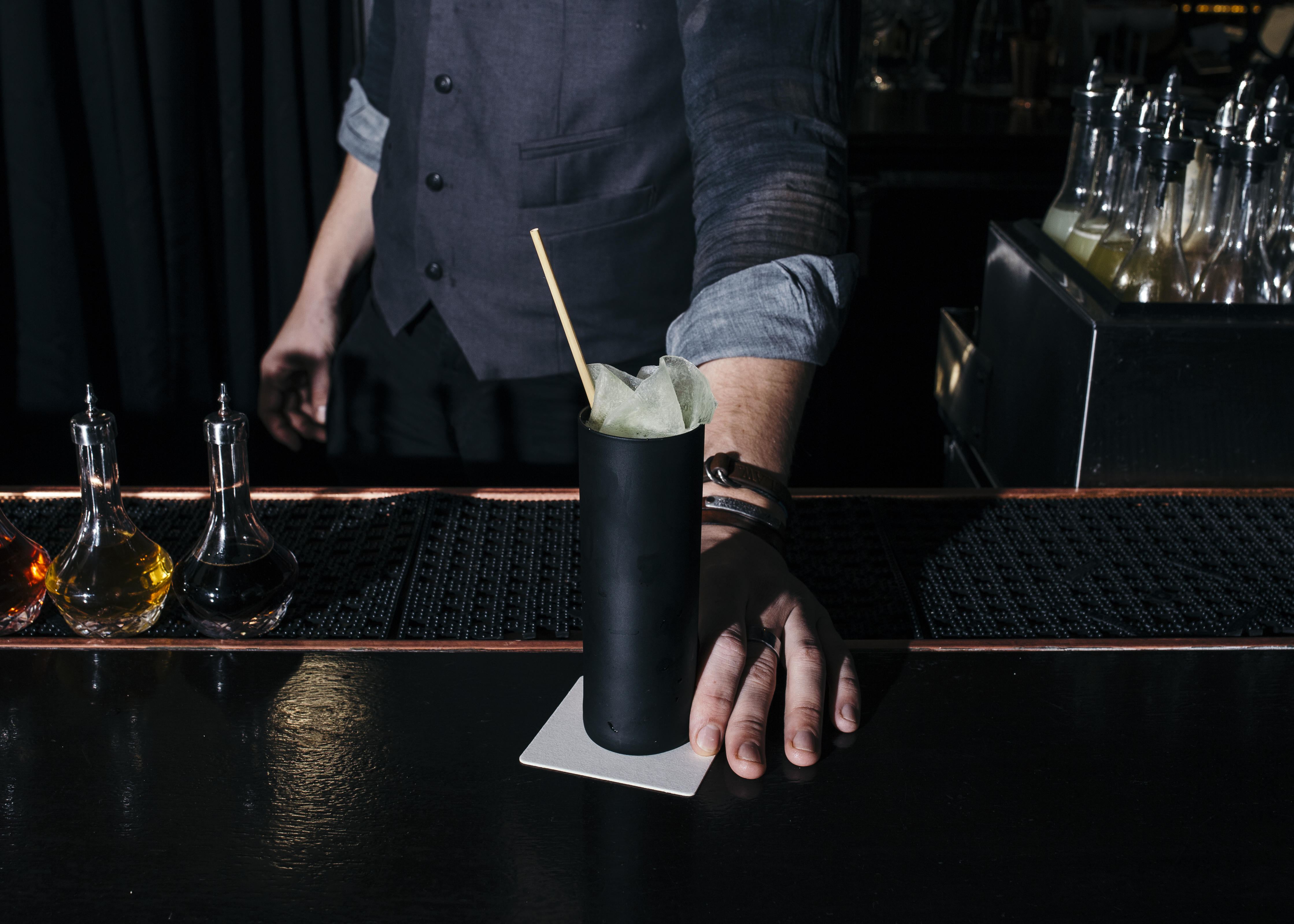
We also had a surplus of these beautiful black highball glasses that were sourced when we first opened. They were for a drink that was cut from the opening menu and during a heavy events season my fellow Bar Manager, Dave Purcell, and I started to joke that we could solve our glassware shortage by putting all of our vodka sodas into these highballs and let everyone panic order them as they walked across the floor to alleviate service.

This got the gears turning. What would be vodka soda in style, more culinarily driven, and quintessentially L.A.? The answer was clearly Kombucha. 

I spent some time talking with the fermentation nerds that are our sous chefs and put together a kombucha base made from a blend of Assam black tea and Jasmine Pearl green tea. This base sits with the mother scobe for a week eating all those delicious sugars. After that week the fruit juices are added and it’s allowed to bottle ferment for another week. This is an incredibly versatile base that allows us to build out flavors in a lot of unique ways. 

Because I was thinking of labor costs and efficiency, I wanted to create a kombucha that had a lot of complexity that could ideally be kegged and turn this into a two-step drink: pour vodka and top with kombucha. I started with a base flavor that felt very spring and refreshing, honeydew melon. To add a complimentary complexity to this I added one of my favorite secret ingredients: bitter melon. 

Bitter Melon is actually a gourd that is used in a lot of eastern cooking and because of its intense bitterness is thought to have cancer fighting properties. This intense vegetal, green bitterness also plays incredibly well in cocktails, especially as a bitters for stirred citrusy drinks. In this case it helped balance the natural sweetness of the melon and ties in the tannins from the tea. To round everything out and add just a touch more acidity some fresh lime juice was also added to the mix. 

Kombucha modeling.

In my younger years this would have been where the drink stopped. It was fine, it fit the slot on the menu, wham bam let’s move along. But part of the process that I’ve grown to enjoy over the years is the collaboration and once this drink entered the R&D tasting with Dave, Leo Robitschek, and I it evolved dramatically.

After having worked with Leo for a year and a half what I’ve learned is that our minds work very different stylistically. I’ll often present a drink with an ingredient that he finds tantalizing, he then pulls it out of the drink, and then start building from the ground up again. In this case I was essentially presenting an ingredient masquerading as a full drink. To him the kombucha was fascinating as an ingredient but not as a drink on its own so we began breaking it down and started utilizing it like we would for a beer cocktail or other collins style drink with just a few ounces to finish the drink. 

We knew we had a vodka base so we started there. We then needed a touch of sweet to balance the whole concoction and this is the place that we were hung up on the longest. Basic syrups became too cloying, fruit liqueurs were overpowering the bitter melon, and the floral notes of St. Germain completely overtook the drink at even a half ounce. We eventually settled on Dolin Genepy which complimented the bitter undertones while adding a just a touch of sweet.

We now wanted to bump the vegetal notes so we added a cucumber to the tin for the shake, and lemon juice to compliment a traditional sour base. This made the drink distinctly more green but now the fruit notes were not as strong. We tried out a few drier fruit options and ended up with a quarter ounce of apricot brandy to round out the mouthfeel while also making the fruit shine. 

Throughout all these additions though the nice acidity of the kombucha was lost. To add that back in we turned to a few dashes each of two of the classic NoMad ingredients: yuzu and white balsamic. All it needed now was a garnish. I went back to the kitchen for some technical help and we started slicing honeydew melon in to wonderful ribbons that roll up and act as a melon flower growing out of the black highball. When the new menu went live the drink was at the top of the page on the right hand side so if you’re at the bar and don’t know what to get the Panic Order is ready and waiting for you. 

This, however, isn’t the end of the story. Things are constantly changing and evolving, one of the core tenants of the NoMad is “Constant Reinvention”, and this means constantly retasting drinks. On a recent whirl wind visit Leo was secretly ordering drinks for quality control. He loved the feel of the menu but felt that the Panic Order was too dry. We went though a mini R&D process again trying different basses ultimately ending up simply adding a teaspoon of agave. This makes the drink much rounder and balanced with a negligent increase in sweetness. Though as I sit here typing this I wonder what would have happened if we tried a half ounce of Green Chartreuse instead of the genepy… 

But, for now, our Panic Order is: 

1 cucumber slice
5 dashes of White Balsamic
5 Dashes of Yuzu
Tsp Agave
.25 oz Apricot Brandy 
.5 oz Dolin Genepy
.5 oz Fresh Lemon Juice
1 oz Absolut Elyx 

Combine all ingredients in a cocktail shaker. Whip Shake and double strain over Kold Draft ice in a black highball. 

Top with Bitter Melon-Honeydew Kombucha, garnish with a Honeydew Melon Ribbon, and Keep Calm.

Bitter Melon-Honeydew Kombucha Recipe 

15g Assam Tea 
15 g Jasmine Pearl Green Tea 
1650ml Hot Water 

Steep each tea individually for 5 minutes each for a total brew time of 10 minutes.
Add another 1500ml water and 300g of sugar.
Mix Until sugar is fully dissolved.
Let this sweet tea cool then add the mother scobe.
Cover the container in cheesecloth and store in a cool, dry place for one week.
After a week gently remove the scobe and store in a clean container with 200ml of the mother vinegar.

To the kombucha base add:

250ml honeydew melon juice
100ml bitter melon juice
50 ml fresh lime juice

Bottle ferment in a cool, dry place for an additional week. 
Hand made and hand presented.


Whiskey Wednesday: Teeling’s 24 Year Old Single Malt Award

Awards are a fickle thing. Being the “best” is an arbitrary construct that essentially says that something followed the rules really well. Without a larger context the sentence “an Irish Whiskey wins best single malt in the world for the first time” doesn’t carry any meaning even if it is 100% factually accurate. Which it is. 

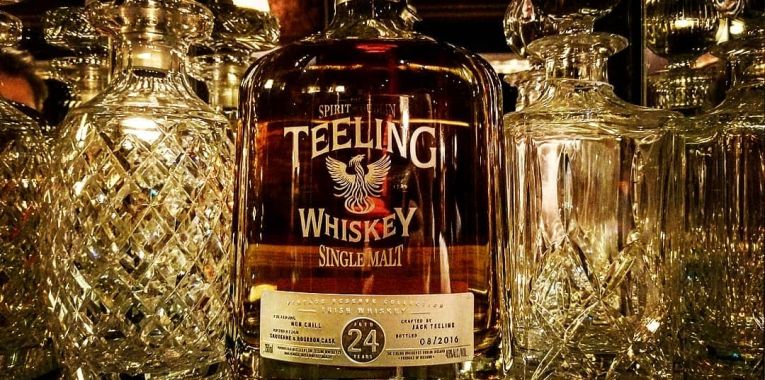
In March of 2019 the World Whiskey Awards, presented by the thedrinksreport.com, announced the Teeling 24 Year Old Irish Single Malt whiskey as the Best Single Malt in the world. Much of the conversation after this announcement was how Ireland had won an upset victory over Scotland, the home of Malt Whisky. Especially since an Irish Whiskey had never won this award before.  

But the World Whiskey Awards have only been handed out since 2012. Meaning there haven’t been many opportunities for an Irish Whiskey to make the list. Also, in 2014 the same awards selected a Taiwanese whiskey as the best single malt so there was already precedent for Scotland not being the top dog. 

It’s easy to see the headlines as mere clickbait but there’s a deeper story. Ireland isn’t traditionally associated with Single Malt whiskey, for a wealth of historical reasons, so they’re not going to traditionally win single malt whiskey awards. And while Irish Single Malt has been made for centuries if anyone was going to win an award it was probably going to be the Teeling’s.

The Spirit of Dublin

The Teeling family first got into the Irish Whiskey game in 1782 when Walter Teeling established a distillery on Dublin’s Marrowbone Lane, an epicenter of distilling at the time. This original distillery was eventually purchased by William Jameson & Co., cousins of the more famous John Jameson. This original distillery was shuttered in 1923 as economic woes began to systematically destroy the Irish Whiskey industry. In fact, by 1976 every single distillery in the city of Dublin had shut its doors. Then in 2015 Teeling reestablished itself in Market Square, not far from the family’s first distillery.  

Now, if you’re paying attention you’re probably asking, “How does a four year old distillery win an award with a 24 year old whiskey?” and the answer reveals another layer.

The new Teeling Distillery was founded by John Teeling and his sons, descendants of good ol’ Walter, and it was not his first time starting new Irish Distillery. In 1985 John purchased an old industrial alcohol production plant in Cooley and began converting it to an actual whiskey distillery. It reopened in 1987 as the Cooley Distillery and was the first “new” distillery in Ireland in at least a decade. 

Over the next several years the Cooley Distillery gained a reputation for quality and excellence in style. One of those being a distinctly Irish style of single malts. The Tyrconnell has always been one of my favorites, winning the International Wine and Spirits (IWSC) Gold Medal in 2004. They also gained a cult following with the Connemara, a peated Irish Single Malt, and the distillery quickly became a go to source for the slowly growing segment of drinkers looking for Irish Single Malt. After winning “Distillery of the Year” from the IWSC in 2008 and then the same award from Malt Advocate Magazine in 2010 the distillery was sold to Beam, now Beam Suntory, in 2011. 

With all of this old Cooley whiskey I assumed that this bottle was old Cooley malt but after talking with people who know more about these things than I do it turns out that this is actually old Bushmill’s Single Malt.

As part of the sale Teeling kept 16,000 barrels worth of whiskey from Cooley and used that stock to establish the new Teeling brand in 2012, quickly followed by the new Dublin distillery three years later.

With all of this old Cooley whiskey I assumed that this bottle was old Cooley malt but after talking with people who know more about these things than I do it turns out that this is actually old Bushmill’s Single Malt. This adds yet another layer to the story as trying to pick apart who distilled, blended, aged, and otherwise had a hand in this whiskey over the years.

Here is a family, accustomed to winning awards winning another award on a whiskey that seems to have a foot in almost every part of the active Irish Whiskey world.

Whatever its providance the whiskey itself is a 24 Year Old Single Malt Irish Whiskey distilled in 1991. It was first aged in ex-Bourbon barrels before being married and further aged in ex-Sauternes casks. How much time it spent in each barrel type is unknown. Only 5000 bottles of 92 proof (46% ABV) non-chill filtered whiskey were produced, meaning that even if it wasn’t the best it’s still one of the rarest and oldest Irish whiskies on the market.

NOSE: Orange Zest, apricot, a slight nuttiness, and a bittersweet chocolate 

PALETTE: Honey and malt, bright stone fruit, leather, caramel and a sprinkle of saltiness 

FINISH: A long mellow finish that leans into the saltiness and the Sauterne finish 

After all that, is this the best Single Malt in the world? I have absolutely no idea. It certainly falls into the rich flavors that I expect from old, indulgent malts yet it also presents a few flavor curve balls and is surprisingly alive which helps it stand out. 

This is a malt that is relying on the past while building a future. It’s caught between multiple worlds and you can almost taste the journey it’s been on. Best may be a matter of opinion meant to generate buzz but the more I’ve learned about where this whiskey comes from the more interesting it’s become.

Whiskey Wednesday: O.F.C. 1985 Vintage Bourbon

Spontaneity is not my strong suit. 

Example A: my girlfriend swears by the deals emailed out daily by Scott’s Cheap Flights. Yet every time a deal lands, I have to ask about time frame, logistics, check on available vacation days, and generally stressed about the fact that booking this trip means that we won’t be able to book some other hypothetical trip that doesn’t yet exist and just like that the deal, and the moment, is gone. 

Example B: We received a bottle of the O.F.C 1985 Vintage Bourbon a year ago and I’ve been planning to write about it ever since. So, what the hell is O.F.C. and why has it been on my mind for literally a year? 

O.F.C. stands for Old Fashioned Copper and is the original name for the distillery founded by Col. E.H Taylor in 1869. Col. Taylor was an expert marketer and helped establish the concept of a Bourbon “brand” as well as being one of the major figures behind the passing of the Bottled In Bond act of 1897. 

The distillery itself was sold to another legend, George T. Stagg, in 1878. There’s an apocryphal story that one of the conditions of the sale was that Stagg could keep the initials O.F.C. but he had to change at least one of the words it stood. This is why the distillery is sometimes called the “Old Fire Copper” distillery. Regardless of the veracity of this claim the distillery’s name was officially changed to the George T. Stagg Distillery in 1904. It was the first distillery to utilize climate-controlled aging warehouses when Stagg installed steam heaters in 1886 and was one of only four Kentucky Distilleries granted a license to continue distilling throughout Prohibition.

The distillery changed hands a few more times in the 20th century before finally being purchased by the Sazerac Corporation in 1992 and its named changed once again. Now known as Buffalo Trace it arguably produces some of the most sought after American Whiskey on the market, including bottles named after both Taylor and Stagg as well as the much desired Pappy Van Winkle line. 

The distillery clearly has experience with special releases but even amongst the plethora of rare bottles the O.F.C. stands out. 

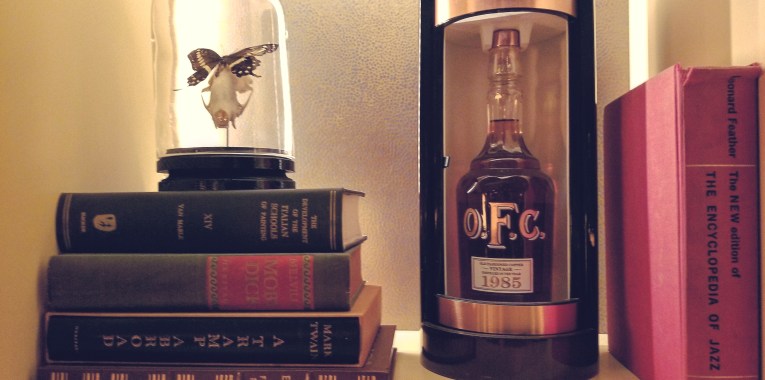
 The O.F.C. is less a special release and more of a time capsule. These are all single barrel, vintage dated Bourbons. Each bottle is sourced from a single barrel and marked with the year of distillation. This makes each vintage completely unique with the mashbill and age varying depending on the bottling. Another intriguing fact is that this line up was originally produced only for charity. 

A literal Time Capsule.

The team at Sazerac and Buffalo Trace are just as savvy marketers as Col. Taylor was back in the day. I have to imagine that when they see bottles of their whiskey selling for thousands of dollars on the secondary market that they looked for a way to capitalize on that market value yet still offer an added bonus. The original three releases were only made available to 200 charities, at no cost, to auction off and help raise money for their cause. It was a great way to turn the image of limited whiskey auctions on its head and raise $1.2 million dollars for charity. It also immediately established the O.F.C. line as a super limited, ultra premium bottle. I was silently jealous of the fact that I would never see one of these bottles yet still applauded the move to raise money for worthy causes. But when the second round of releases was made available for retail purchase I leapt at the opportunity. Especially with the vintage being offered was the 1985. It’s not often you have a shared birth year for your whiskey. 

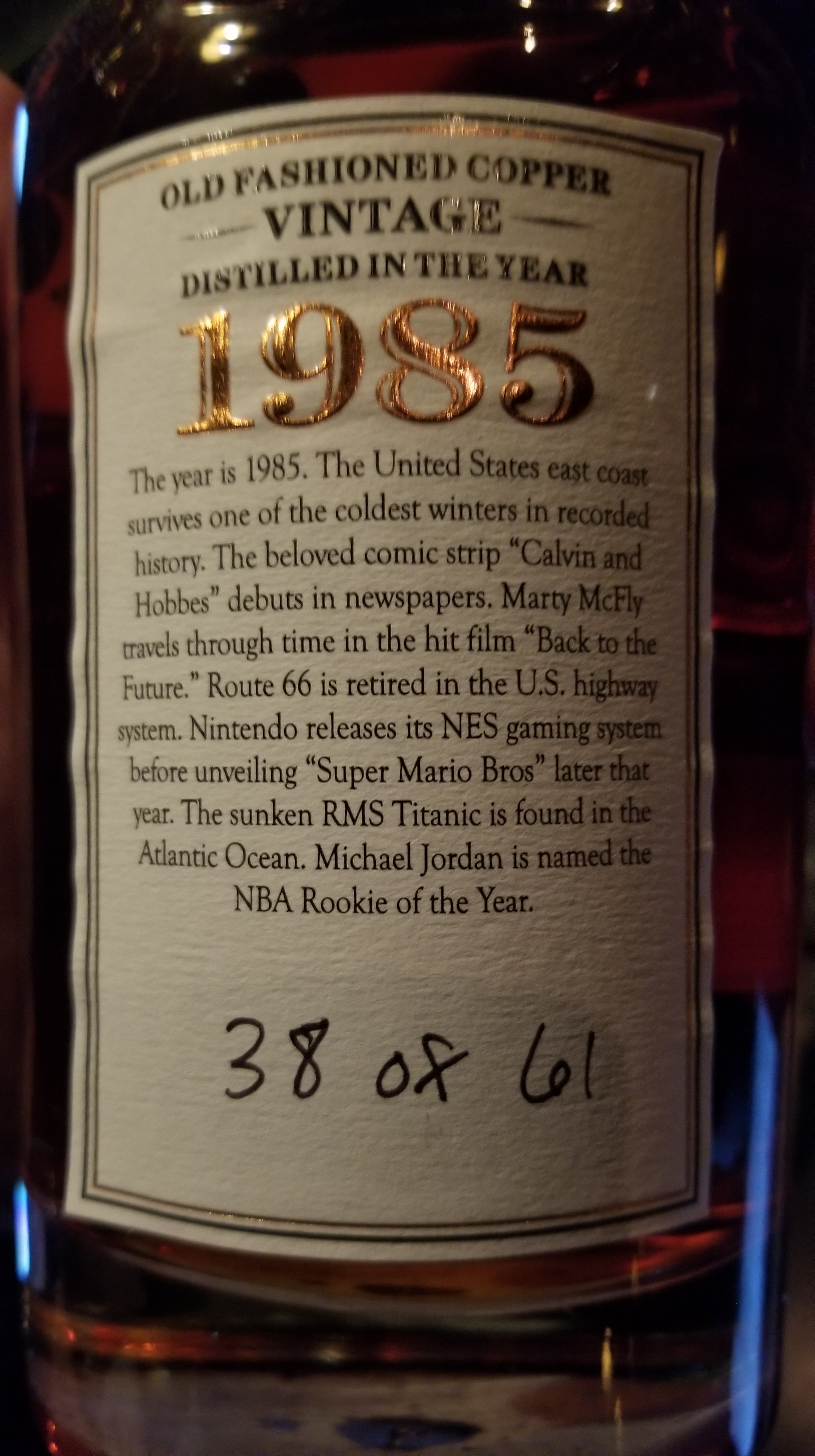
The 1985 Vintage is one of only 61 bottles to come from a barrel which was stored on the second floor of Warehouse Q. Buffalo Trace says that all of the barrels were tasted over time and removed from the barrel before becoming over oaked and since there is no age statement listed on the bottle it’s hard to tell the precise age of the bottle. This isn’t an uncommon practice, Buffalo Trace has done similar things with Eagle Rare 17 and Sazerac 18 so the whiskey isn’t as much as an oak bomb as you might expect. It is certainly old but there’s no official word on if it was a full 33 years in oak before being bottled. With that in mind let’s dive into the glass: 

NOSE: Rich oak, Dried fruit, and vanilla 

PALATTE: Rich vanilla, dark cherry, prune, oak, and a dark earthiness 

FINISH: Bitter chocolate, a touch of tobacco, and a coating lingering sense of time 

Overall this is an excellent example of old American Bourbon whiskey. It is still alive without being over oaked and has a power of flavor to match up to the power of the years it spent asleep in the barrel. The issue, as always, is the price. The bottle comes in at a staggering suggested retail price of $2,500. When the proceeds were going to charity this number wouldn’t have raised peep from me but now it changes the talking points. 

Is this good whiskey? Yes. Is it for everyone? Absolutely not. It is a special occasion, made so by the fact that it is a living time capsule. You are paying for the time and history as much as the whiskey itself. I will argue that experiences are more important than money but  the value is certainly subjective. I for one am going to savor the fact that I get to experience this bottled moment of time and not take it for granted.