Whiskey Wednesday: Early Times Proof of Concept

I’ve talked about it before but I’m really into traveling. Travel opens our eyes to new things, it also shines a new light on the familiar and common place. While most people filter this experience through art or culture being a bartender and a boozehound I end up seeing it through the glass at the bottom of a bottle.

Proof is often erroneously conflated with quality

Spirits nerds, especially us whiskey focused ones, love to talk about “the rules.” Your spirit can’t be a Scotch if it isn’t made in Scotland, your spirit can’t be whiskey unless it’s made from some type of grain, your corn whiskey can’t be Bourbon unless it uses a brand new, freshly charred barrel, etc., etc,. We love these rules because they help us clearly delineate the teams and offer an offer a definitive right vs. wrong answer in any debate.

These rules also offer consumer protection. Ever wonder why most spirits in the US are bottled at 80 proof (40% ABV)? It’s because that’s the legal minimum. In the EU that minimum is 37.5% so you will see products, even ones that are traditionally 40%, packaged at the lower threshold. Why? The answer as it so often is, is taxes.

Proof is often erroneously conflated with quality. While the higher the alcohol content the more intense the intrinsic flavors of the sprit will be this is not the sole indicator of quality. If it was Everclear would be the number one premium spirit in the world. But it is true that spirits used to be sold at much higher alcohol content. The old standard of “proof” used to be if gunpowder soaked in the spirit would still light on fire. This ensured that rum rations on ships wouldn’t interfere with the firing of it’s canons but also that the spirit hadn’t been watered down. This proof point is 57%.

All of these taxes, traditions, and experiences coalesced over the years until it was finally turned into law with the double whammy of the Bottled in Bond Act of 1897 and the Safe Food and Drug Act of 1906

57% being proof is slightly intellectually irritating though so for ease of use in the US the scale was reduced to 50%=100 proof for easier conversions for, you guessed it, tax purposes. And before you could simply buy a prepackaged bottle of booze from the store you used to take an empty bottle to the store and fill it up directly from the barrel. Diluting the spirit to 40% again made the math easier. A 26oz bottle filled with 40% alcohol will always contain 10oz of alcohol so you always know exactly how much to pay in taxes. But why settle on 40% instead of 50%? That’s the ABV strength where ethanol mixed with water lights on fire at room temperature.

All of these taxes, traditions, and experiences coalesced over the years until it was finally turned into law with the double whammy of the Bottled in Bond Act of 1897 and the Safe Food and Drug Act of 1906 which finally legally defined all of the nefarious white lightning, applejack, and whiskies floating around the American country side. And while this does a wonderful job of maintain a threshold of quality, and safety, it ends up excluding flavors and drinking traditions that fall outside these norms.

For instance, The EU ended up with a lower proof point to respect many of the Eastern European vodka makers, and it should be noted that most international councils, like Scotch and Cognac, have their own rules and minimums that have to be met. And in one of my favorite anecdotes Elmer T. Lee, one of the Father’s of Modern Bourbon, supposedly only drank his Bourbon at 60 proof because he felt that was the perfect point where the alcohol burn didn’t get in the way of the flavor. The guy knew a few things so lets take a look at something that falls outside of almost all of these rules.

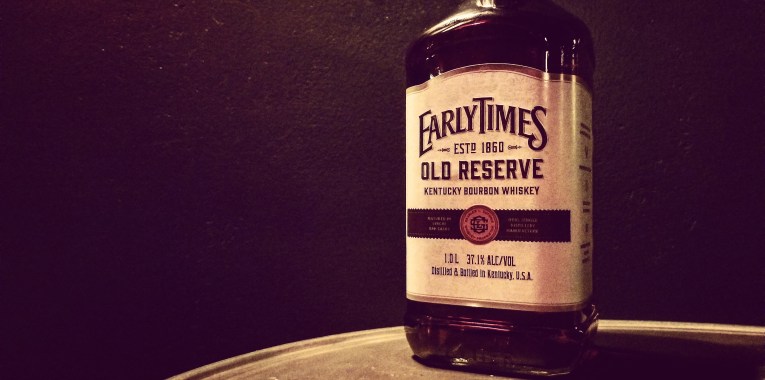
On a recent trip to the Cook Islands (look it up) in the second Duty Free store in an airport with only two gates I came across this bottle of Early Times. Now Duty Free is often a testing grounds for new products, premium bottlings, and a place to dump large amounts of product that aren’t moving.

Despite what the label says this bottle of Early Times is not a Bourbon, at least not in the United States. And this is where confusion comes in, does it follow the rest of the Bourbon laws? I have no idea so let’s assume it’s produced exactly the way regular Early Times is.

Regular Early Times is also not a Bourbon. It is produced in Kentucky by the Brown-Forman Corporation at the same distillery that produces Old Forester, which is a Bourbon. What separates the two is the barrel. Early Times is aged in reused Bourbon barrels so already it’s legally “just” a whiskey. But it’s packaged below the EU threshold of spirits at 37.1%, which means that this bottle isn’t even legally a whiskey. For the sake of novelty and the equivalent of nine American dollars I brought this bad boy across the ocean, through customs, and back home to the United States.

images.jpg

The reused barrels effect on the whiskey is immediately obvious as it’s color is lighter, more straw and hay than a full aged Bourbon that has those deep dark barrel influences.

On the nose there are all of those traditional whiskey aromas: vanilla, caramel, and a touch of stone fruit but they’re less intense due to the barrel. The spirits corn base is readily apparent even on the nose.

On the palette is sweet corn, a hint of spice, a touch of caramel, and not much else. It meats the flavor points of whiskey.

The finish is short but inoffensive. This isn’t terrible whiskey, but it is exactly the kind of whiskey an Old Fashioned cocktail was designed to enhance. Though it this case it would require a delicate touch because everything about this is so light that it would be easy to overwhelm the spirit with just a hair heavy dash of bitters.

I picked this bottle up because the proof point was amusing to me but in the end do those 2.9% points really make a difference? Yes, but there’s so much else going on with Early Times that they’re not going to make or break this spirit. It is putting in the minimum effort.

Ultimately, that’s why people look down on these bare minimum bottlings. It doesn’t feel special. They’re offering an experience that is just meeting a requirement. But sometimes all it takes is crossing an ocean for a requirement to transform into an unique, glass bottomed lens and let you see things in a new light.

Whiskey Wednesday: Willett Of The Past

Age adds value.

That doesn’t just mean a dollar value, I personally own dozens of books, papers, and social media accounts that only still exist because they’ve essentially become a time capsule. They’re important simply because they’ve survived.

Before NDP, Non-Distilling Producer, was short hand for overblown marketing these producers were some of the most celebrated.

I started collecting whiskey when I got back into bartending in 2011. I suddenly found myself with income surplus for the first time in years and set about recreating the back bar I had at work in my tiny Venice apartment. I ended up with more whiskey then I conceivably drink on my own, which leads directly to the fact that I have dozens of bottles in my overblown collection that are there because anytime I pick them up I think to myself, “I can’t drink that! I’ve had it forever.”

This is directly antithetical to my belief that all whiskey is for drinking, not hoarding. So I thought it was high time to revive that spirit and open some “old” spirits.

Before NDP, Non-Distilling Producer, was short hand for overblown marketing these producers were some of the most celebrated. And none have reached the cult status of the Willet Distillery.

willett-distillery.jpg

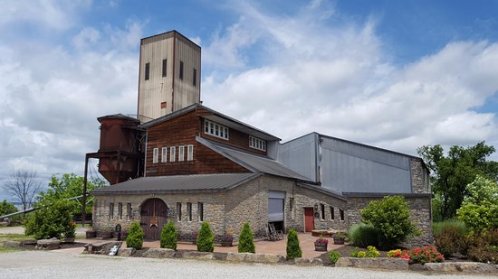
Officially know as the Kentucky Bourbon Distillers the distillery is most closely associated with it’s Willet Family Reserve line of premium whiskies. And that’s not marketing. The distillery was founded in 1935 by the Willet family as the Old Bardstown Distillery, which produced its first bourbon in March of 1936. Flash forward to 2016 and the old distillery is still family owned and some of the first whiskey distilled on site rolled down the line all over again.

How do you do something for the first time twice? You stop producing whiskey in the 70’s to make ethanol during the fuel shortage. Then the fuel prices drop, the bottom falls out from under the market, and you’re left flat footed.

From the 1980’s until about 2012 the “distillery” was just in fact an independent bottler, a NDP. They began by relying on the back stock of their own product that was still aging and began to source excess whiskey from neighbor distilleries. Most notably they were sourcing from Heaven Hill, which is so close you could roll a Bourbon barrel down the hill and hit a rickhouse. During this time Willet/KBD continued to produce award winning whiskies like Noah’s Mill, Rowan’s Creek, the formerly eponymous Old Bardstown, and turned the Willet brand into a coveted line of old, premium, single barrel whiskies.

While they may not have been producing liquid in-house the team at Willet showed

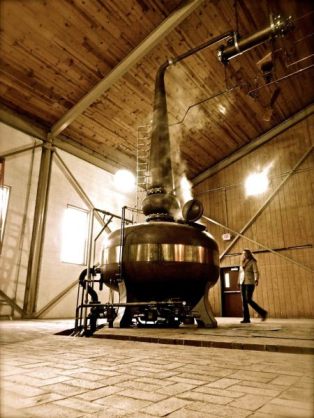
The Willet Pot Still…was incidentally also how I thought anyone who sat in front of my bar for years about what a “Pot Still” looked like.

remarkable skill in aging. The single barrels and older expressions of whiskey that they put together have long stood out as some of the best bottlings of the past two decades. But as the Bourbon boom ramped up the writing was on the wall for people trying to source whiskey. More was going to the in house brands and in 2012 KBD fired up its own set of stills and now 6 years later we are seeing bottles of old brands with new juice.

But lets get back in the way back machine to right before these stills started producing to when I bought this bottle of Willet Pot Still Bourbon.

The Willet line was already well established as a premium category but they were also pricey. The Willet Pot Still, introduced in 2008, was a non-age statement variation that could introduce people to the line with out breaking the bank. It was incidentally also how I thought anyone who sat in front of my bar for years about what a “Pot Still” looked like.

This bottle is a Single Barrel versus its modern counterpart, which is simple a “small batch.” Bottled at 94 proof, 47% alcohol, this whiskey has nearly as many awards for its packaging as it does for the Bourbon itself. So, after 7 years how does it taste?

Willett_Distillery20_ff71ed32-5056-a36f-2340837825148b38.jpg

On the nose is a sweet corn, yet dusty oak presence. The alcohol burn is larger than I would expect for something bottle at 94 proof, and for something that’s been in the bottle for three quarters of a decade. But under that burn is a touch of coffee and toffee.

On the palette the alcohol is much les noticeable. A large oak, vanilla, and slight char carry all the way through the dram with some darker fruit, a touch of cherry and almost blackberry, before giving sway to a musty, earthy, barn house sense.

The finish is light fades quickly leaving the oak on the tongue and the alcohol on the sides of the mouth.

It’s a good whiskey, something I wouldn’t be upset picking up off the shelf and drinking today but it’s not transcendent on its own. What is transcendent is the act of opening the bottle, pouring, and reminiscing as I sip on where I was at in my life when I bought this bottle and on all the events that have transpired since.

Nothing is precious on its own, the spirit we imbue it with verifies that value. And for something to have value it must have some use. So let’s raise a glass and reminisce.

Whiskey Wednesday: Nikka From The Barrel and to the US

 One of the best things about traveling is seeing what is out there in the world that can’t be seen from home.

When it comes to spirits traveling abroad often means encountering ex-pat style spirits; bottlings like Blanton’s Straight From The Barrel, an Early Times bottled at 37.1 Proof, or the Wild Turkey 13 Year. These are intriguing because they’re both familiar yet unattainable but they don’t fill a void or represent something new. Their appeal is mostly just that they can’t be had at home.

Despite what the name might imply, the whisky itself is not a single barrel expression.

More frustrating to me are those spirits that I discover but have no recourse to obtain at home. These are products that are fundamentally different from the familiar yet still incredibly appealing and often made by companies that already have products in the States. Products like the Giffard Melon, the Etter Apricot Eau-de Vie, and, until this past month, the Nikka From The Barrel Japanese Whisky numbered among them.

At this point it should be very apparent that Japanese whisky is the soup du jour of the whisky world, but instead of talking about the loss of an age statement or product line being discontinued for once we’re actually seeing an expansion of a product. And not a wholly new formulation specifically designed for a market, just an honest to god expansion of availability.

I first came across the Nikka From The Barrel when traveling to France a couple years ago. Not only was I struck but how incredibly flavorful it was but by how ubiquitous it was. I erroneously assumed it was a specialty release only to hear from the bartenders that it was their mixing Japanese whisky.  Keep in mind that this was pre-Toki when the prices were rising and stock plummeting and the ability to make cocktails with Japanese whisky was dwindling. Yet here was an over-proof, affordable, mixable Japanese whisky.  And I couldn’t have it.

Despite what the name might imply, the whisky itself is not a single barrel expression. It is instead a blend, remember the Japanese whisky makers consider themselves more blenders then distillers. This is Single Malts from Nikka’s Yoichi and Miyagikyo Distilleries, as well as grain whisky from Miyagikyo that has been rested and married in an oak barrel for 3-6 months. It is coming from the blending  barrel not a single barrel.

The extra aging allows the whiskies to marry and evolve together before being bottled at near cask strength, a powerful 102.8 proof. This power of proof and flavor is what made the whisky such an amazing value. There is just so much packed into its little bottle. And the bottle is little. Designed to be reminiscent of a “small lump of whisky” to visualize the concentrated power inside the bottle it is packed as 500ml. This is a bottle size so far outside the allowable norms for US production that I think this more than anything is what kept it from our shores for so long.

With its Stateside release, Nikka kept the same bottle design but simply scaled it to a 750ml size. Not quite as elegant and evocative but it’s always been what’s inside the bottle that counts.

So, what’s inside the bottle? The same blend of malt and grain married for 3-6

It’s also proof that global expansion and demand can be gracious and bring you new experiences and treasures, instead of putting up artificial boundaries.

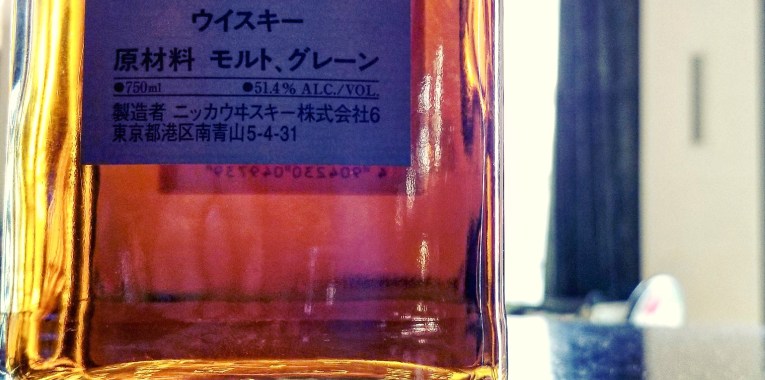
months in oak casks. Still bottled at 51.4% alcohol this is a big hitter.

The Nose carries a hint of fresh, green fruit, with a baking spice overlay and of course a discernable oak note. The alcohol vapors can accidently overpower some of the more subtle notes if you inhale too deeply on the first sniff.

On the palate is a big, full bodied whiskey. The dark baking spice notes leap to the front. Brown sugar, caramel, and the fruit stays fresh and a touch more citrusy than expected from the nose. The distillate is incredibly clean and dry.

The finish is long, drawn out, and the oak lingers after the alcohol has burned off. A few drops of water really does help mellow this whisky and expand the range of flavor.

What’s truly great about this whisky to me is that it’s simultaneously an entry level whisky and yet not. It’s something the evolves over time, much like the person drinking it.

It’s also proof that global expansion and demand can be gracious and bring you new experiences and treasures, instead of putting up artificial boundaries.

Whiskey Wednesday: The Declaration of Jim Beam’s 200th Anniversary.

“We hold these truths to be self-evident, that all men are created equal, that they are endowed by their Creator with certain unalienable Rights, that among these are Life, Liberty and the pursuit of Happiness. — That to secure these rights, Governments are instituted among Men, deriving their just powers from the consent of the governed, — That whenever any Form of Government becomes destructive of these ends, it is the Right of the People to alter or to abolish it, and to institute new Government, laying its foundation on such principles and organizing its powers in such form, as to them shall seem most likely to effect their Safety and Happiness.”

There are some words, some achievements, that are worth celebrating, even if their modern iteration doesn’t live up to its ideals in the popular imagination. It’s hard to find a more iconic American brand than Jim Beam. It’s the #1 selling Bourbon in the world and in many ways the Beam story, both that of the family and of the whiskey, parallels the story of America.

download-3.jpgThe story begins with members of the Böhm family, German immigrants who would latter change the spelling of their name to “Beam,” settled in the Kentucky territory in the late 18th century. The family patriarch, Johannes “Reginald” Beam, was a farmer. And like many farmers of the time he started producing corn whiskey as a way of preserving crops. This side venture lead to the first Beam whiskey to start flowing from the Old Tub Distillery in 1795.

Known as Old Jake Beam Sour Mash, this whiskey proved successful enough that when David Beam took over the family business not only was he able to expand the distribution he was also able to construct a new distillery in Nelson County in 1854. This move came amidst an industrial boom in the country which allowed for modernization of production, and the move to Nelson County allowed for greater use of the massively expanding rail system in the States.

The eponymous James Beauregard Beam over saw the family business both before and after the Great Failed American Experiment of Prohibition. Prohibition interrupted the family production but James was able to rebuild the distillery in 1933 in Clermont, Kentucky in a mere 120 days. It was at this point where “Jim Beam” entered the international lexicon and a member of the Beam family has been at the still, and half the other whiskey stills in the country, ever since.

download-2.jpg

The Beam family has spearheaded this spirit for over 220 years now. However, the actual company hasn’t been owned by a Beam since 1945 when it was purchased by Harry Blum, a Chicago Spirits Merchant. It’s changed hands several times throughout the decades but currently it is a subsidiary of Suntory Holdings known as Beam Suntory. The most American of products is now owned by the second largest international beverage corporation in the world.

Flash back to the mid 90’s. Bourbon wasn’t the hip, award winning, auction breaking behemoth that its turned into today, yet it was still worth celebrating. In 1995 Beam released a 200th anniversary edition decanter and it’s like a little time capsule of Bourbon Past crossed with where Bourbon Future.

Decanters used to be the industry gimmick. When no one wanted to drink Bourbon you made the bottle so irresistible that you had to snatch it up. Compare that to the specialty releases of today where a warehouse surviving a tornado is cause for an award winning bottling.

It was a unique bottling. Bottled at 95 Proof and aged for 75 months, also known as 6.25 years. A higher than standard proof and emphasize on aging, albeit in an archaic ,confusing way. Yet ,the most interesting difference is that there is almost no information about this bottle online. No mashbill info, no tasting notes, and only a smattering of secondary market offerings.

We can assume this was the standard Beam mashbill, which puts us at something like a 76% Corn, 12% Rye, 10% Malted Barley with a #4 Barrel Char.

On the nose there is a farm house quality, along with a dusty oak and touch of sweet caramel. The palette gives way to a familiar barrel char, dark stone fruit, and a lively backbone. The liquid is still very much alive even after 20 years in the bottle. The finish is clean and lingers for just an extra moment and leaves the yeasty, dusty feel that, to me at least, is an indelible part of the Beam DNA. In the end this is a bottle that simply, and eloquently, celebrates the style of whiskey that Jim Beam made, makes, and continues to make.

The Declaration of Independence was a larger enough summer blockbuster that it will inevitably get a sequel. And I hope that this time we truly do mean all humankind are created equal, and that the casting is colorblind.

This is a whiskey made by a family of immigrants, who traveled to a new country, set down roots and became synonymous with one of the most iconic, and living, pieces of Americana to ever exist. A hometown hero on the international stage. I just returned from a trip to the Cook Islands which is in the middle of nowhere South Pacific and they had one bourbon: Jim Beam. Yet, this All American Bourbon isn’t even American owned. To me this doesn’t take away from it’s Americanness, in fact in just speaks to how tightly we are tied to the rest of the world. No matter how much we fight it, there is no “Us” and “Them” any more. We’re all in this together.

As I sit sipping this whiskey musing on the fireworks, hot dogs, and pool side celebrations I can’t help but think that the Declaration of Independence was a larger enough summer blockbuster that it will inevitably get a sequel. And I hope that this time we truly do mean all humankind are created equal, and that the casting is colorblind.

Whiskey Wednesday: Decanting Old Fitzgerald Bottled In Bond

Growing old is an interesting proposition.

It’s right there in our language. We GET older, we GROW up whether we like it or not. But these phrases imply a gift. The imply that it is a privilege to age and that we are constantly changing and growing.

Contrast that with the utter fear of aging that our culture exhibits. It’s also right there in our language. We don’t just develop. We deteriorate, mellow, and mature. And at every point along the journey we can’t help but express disbelief at how many chronological ticker marks we’ve accrued. Our own experience is that we are always the oldest that we have ever been, so exclamations like, “I can’t believe 90’s kids can legally drink!” or “Holy Shit, it’s been nearly five years since Old Fitzgerald Bottled-In-Bond was discontinued!” make us feel old and make those older than us roll their eyes at the young ‘uns.

Even in whiskey we want our spirits older, but not too old. Age at a certain point becomes a novelty act, reacting to a new release almost as if to your great-great aunts 97th Birthday, “A 27 Year old Bourbon you say? That’s adorable.” Yet we bemoan the loss of every single age statement, and doubly so when it’s a rocksteady brand that’s stood the test of time yet is still dropped in favor of something new, young, and millennial.

The loss of the Old Fitzgerald Bottled-In-Bond was a loss I felt personally and deeply. While never technically discontinued the Old Fitz was removed from most markets over the past five years in favor of it’s cousin Larceny. Same liquid inside, even still has the Fitzgerald name on the bottle still. It’s technically John E. Fitzgerald’s Larceny, referring to the legend that the original brand was named for.

In short, this tastes like Old Fitzgerald, which is a blessing and a curse

John E. Fitzgerald was a tax bondsman for the U.S. government, which meant that he was one of two people on site at the Old Judge Distillery to have keys to the bonded warehouse. This ensured that there was no theft, since no one could enter the warehouse with out him, and that the government was properly collecting it’s taxes on the whiskey production. However, the workers kept noticing certain honey barrels, the especially tasty ones, were coming up short and that Old Fitz always seemed to have some extra tasty liquid on hand. These barrels became known as “Fitzgeralds” and a brand of whiskey was eventually named after the man and his harmless acts of larceny.

The brand went on to become a working class hero. Bourbon Legend says that the brand was originally sold only to steamships, rail workers, and private clubs. After Prohibition the brand was purchased by Stitzel-Weller, the famed distillery owned by the notorious Pappy Van Winkle. In fact, during his tenure at the Stizel-Weller Distillery Pappy didn’t sell any Pappy. He sold Old Fitzgerald and it was by far their most successful brand. Like all the whiskies made at Stitzel-Weller Old Fitz had that “whisper of wheat” in the mashbill that made their whiskey so unique at the time.

old_fitzgerald_bottled_in_bond_bourbon_large.jpg

During the whiskey dark ages of the 70’s and 80’s the brand was purchased by United Distillers, which through several mergers and acquisitions eventually became the behemoth that is Diageo. United Distillers/Diageo closed the Sitzel-Weller distillery in 1994, moved production of Old Fitzgerald to the Bernheim Distillery. Then in 1999 they sold the Bernheim Distillery, and the Old Fitzgerald brand, to Heaven Hill. Heaven Hill continues to make wheated bourbon and releases it under the Old Fitzgerald name to this day.

ftcyrn5wmsfx.jpg

The story hasn’t changed. The whiskey hasn’t changed. But the age, the label, and the price certainly have. While Larceny is still a very reasonably priced bottle of whiskey it doesn’t carry the massive bang for your buck that the old Bottled-In-Bond did. And by freeing up the Fitzgerald name from a bargain priced Bottled-In-Bond the team at Heaven Hill have been able to make attempts to push the premiumization of the brand. Some of them more successful than others.

They tested the waters with the one off release of John E. Fitzgerald’s 20 Year Old Bourbon which was some of the last whiskey actually distilled at Stizel-Weller which was released to mixed reviews. And now comes the release of the long awaited Fitzgerald Bottled-In-Bond Decanter Series.

The series will be a limited release each Spring and Fall for the next few years. The throw back to the old label name also comes with a throw back to another old Bourbon tradition: fancy decanters. More important than the glassware though is that this is a Bottled-In-Bond whiskey, it’s 11 years old, and it’s got the price tag to prove it with a suggested retail price of $110.

So how does it stack up?

20180602_164023The packaging and labeling are fantastic. It’s like seeing an old friend after the divorce now that they’ve started working out and gotten a haircut. It still looks like them but a cleaner, fitter, more attractive version of them.
The nose has all the oak you’d expect from an 11-year old, but also a touch of apricot and butter. On the mid palette is black pepper, stone fruit, a hint of nuttiness and a slightly thin caramel which leads into an aggressively woody finish that lingers hot and with a slight exhalation of cherry.

In short, this tastes like Old Fitzgerald, which is a blessing and a curse.

On the one hand I’m incredibly happy to have something that tastes like my old timey Bottled-In-Bond back but at the rarity prices it’s not something I would necessarily pick up off the shelf, and it’s certainly not an every day drinker like it used to be. The extra aging has made the product deeper and mellower but it’s also made it richer and pricier. Much like your recently divorced friend it doesn’t seem interested with hanging out with the same crowd it used to.

In the end I’m happy to see the return of Old Fitzgerald in a semi regular release but it does feel like the difference between hanging out with your college buddies and your great-great aunt. The one you want to see every weekend, the other you’ll drop in on at the holidays. Maybe. If the plane tickets aren’t too expensive.

Whiskey Wednesday: A Bitter-Sweet Hakushu

Life is a bittersweet balance. I’ve been hosting Whiskey Wednesday for going on six years now. It’s exposed me to more bottles and drams than I can count, constantly challenged me to stretch my creative muscles, and introduced me to some of the most delightful nerds/people that I’ve ever met.  I’ve grown as a person, a bartender, a writer and a insufferable know it all.

I never would have thought six years ago that these Wednesdays would be something that I would still be doing, let alone have my thoughts and notes for them become so expansive that they would undergo a biogenesis into a blog that people actually read. I also wouldn’t have survived all these years with some semblance of my sanity intact if things had stayed stagnant. Change, experimentation, and misplaced passion have kept me going.

And now it’s time for another change. After today, Whiskey Wednesday continues but it’ll become more abstract. Less about every scattered soul flocking to the bar once a week for a drink, and more about raising a glass from where ever we might be. So, for my last night behind the stick for the foreseeable future lets combine the past and the future and pour some Hakushu.

The Hakushu Distillery was found in 1973, 50 years after Yamazaki, it often seems to live in the shadow of its older sibling. It also lives in the shadow Mt. Kaikoma in the Japanese Southern Alps. This was a deliberate choice made by Keizo Saji, the company’s second Master Blender. He chose the site primarily because of the quality of the water. The naturally granite filtered water leant a subtlety and effervescence to the distillate but the site also offered a distinct microclimate with the surrounding forest and with it sitting at 700m above sea level its definitely one of the highest elevations for whisky distillation in the world. For comparison Scotland’s two highest distilleries, Dalwhinnie and Braeval, both sit around 355 meters above sea level.

All of this combines to create a spirit that is lighter, more delicate, and often more mellow than its Yamazaki counter points. Also, unlike Yamazaki, Hakushu utilizes peated malt. When combined with the distillery and terrior this peat takes on more of recently extinguished early morning, mountainside cooking fire than more maritime and often aggressive smokes of the Scots.

The distillery also takes to heart the Japanese respect for nature. It strives for harmony with its surroundings right down to its aging warehouses. Built into the mountain itself they utilize earthquake safe, single story tacks that are about 13 levels high. This kind of aging space, combined with the high elevation has allowed them to mature a spirit with relatively low barrel influence, especially for the age of the whiskey.

As for the whiskey itself, both Hakushu and Yamazaki import their barley, both the peated and unpeated barley. However, they do grind, mash and ferment on site. They have six pairs of stills at Hakushu with at least 4 different shapes. They then utilize five different type of aging casks while primarily focusing on ex-Bourbon and hogsheads. All of this diversity in barley, stills and barrels allows them to create what they call a combination of 40 different styles of whisky. Keep in mind Suntory’s primary craft, as they see it, is blending. And unlike Scotland where even rivals will trade barrels back and forth to get unique flavors for blends, Suntory was essentially trying to build a category from scratch. If they wanted diversity they had to make it themselves. And 44 years later it feels like Hakushu is finally coming into its own.

It may seem odd to call a 44-year-old operation “young” but when your primary marks are a 12 year and 18 year old single malt a 44 year old distillery may not be an infant but its still most certainly a toddler.  Hell, the first release of Hakushu 12 wasn’t until 1994, a solid 10 years after the release of Yamazaki 12 year. And while the Yamazaki has the experience and the award that come with it the Hakushu is certainly flexing it’s muscle.

Both the 12 year and the 18 year are primarily composed of three styles of distillate: unpeated distillate aged in sherry buts, unpeated distillate aged in hogsheads, and peated distillate aged in ex-Bourbon. These truly show off the complexity and depth of the distillery creating a whiskey that is light, yet powerful. The aroma of smoked pears wafts over a palette that is green, with a touch of citrus and smoke. The 18 draws out more of the stone fruit qualities while adding a touch more sweetness from the extra oak.

In short, Hakushu also knows what they’re doing and while it may stay in the shadows of its mountain forest home it won’t be in the shadows of its Yamazaki brethren.

So, come share a glass with me because it won’t be long before Hakushu catches up to the Yamazaki awards and it disappears like a forest mist of rarity and also because who knows where we’ll both be the next time we can.

Whiskey Wednesday: Leopold Maryland Style Rye

Alright nerds, here’s a good one for you today. Maryland Style Rye.
Before the advent of the ‘Great Experiment’ that was Prohibition there were two dominant styles of American Rye Whiskey. The Pennsylvania Style (spicy, dry, and oaky) and Maryland Style, which was more floral, fruit forward and less aggressive. Among the many great things that Prohibition destroyed, Maryland Style Rye was one of them.

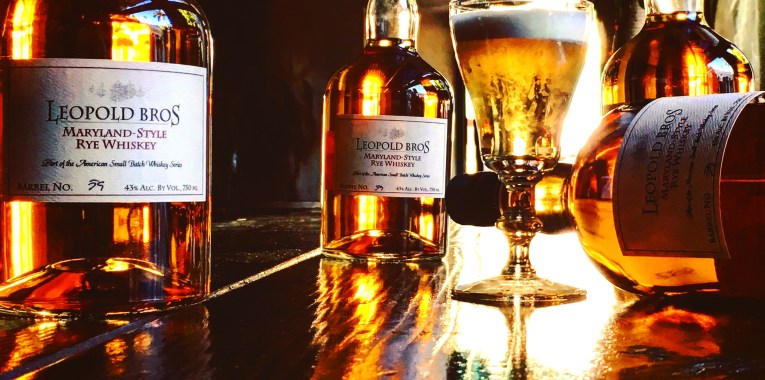
But the boys at Leopold Brothers are fighting the good fight and trying to recreate the style in the only way they know how: with exceptional quality and attention to detail. And boy are they fighting hard, you can read about the future here. But as for the pastWhile ye olden Maryland Ryes often achieved their more mellow nature and fruit flavors from additives and prune juice, the brothers are following their eco-distilling nature and recreating the flavors throughWight'sMarylandRye3.jpg careful distillation and selection of yeast strains to create a wholly unique product. They’ve even had an old time compound still made exclusively for them, and are working with local farmers to grow late 1800’s style rye, which has a completely different flavor and starch content than it’s modern descendant.

While we’re still waiting on the first batches off the new still, the current bottling shouldn’t be ignored. Young, but light and green. Green as in like biting into a huge green apple, apricot, and stone fruit. All supported by a rich chocolate malt rounding out to a juicy and more mellow finish than your more familiar ryes.

Whiskey Wednesday Adjacent: Pick Your Apple Poison

You can always tell what a bar manager’s secret passion is. You’ll look at the backbar and no matter how well curated it is there will always be a collection of bottles that are out of place, an odd amount of variety in an esoteric category. For me, that guilty pleasure is apple brandy.

Bourbon may have become the United States Native Spirit through Congressional Resolution in 1964 but Apple brandy, that New Jersey Lightning, is the real first spirit of the colonies. In the cold New England winters colonists would leave cider outside overnight allowing it to freeze. Since alcohol doesn’t freeze what was left over after this rudimentary distilling, or “jacking”, process was a more concentrated alcoholic apple beverage.

This proto-brandy became known as Applejack and had as large a reputation for causing blindness from poor ‘distilling’ as it did for getting the drinker drunk. But it wasn’t long before industrious businessmen started cleaning things up. Robert Laird was a Continental Soldier who served under George Washington during the Revolutionary War. There are records of Washington requesting Laird’s family recipe for “cyder spirits” which has lead to the claim that Laird supplied Applejack to the Continental Army. After the war Laird founded a distillery in Scobeyville, NJ and which is now the oldest licensed distillery in the United States, receiving License Number 1 from the U.S. Treasury in 1780. But the “cyder spirits” and their hard cider cousins did not fair well under prohibition.

Prior to Prohibition most of the apple orchards in the colonies were not the juicy, edible fruit that we think of today. They were in fact the hard, bitterly sour variety that make excellent cider. Apples are what are known as extreme heterozygotes. Essentially, the latent genetic diversity of the actual seeds means that a tree grown from a seed will bare almost no resemblance to the varietal of the parent tree and more often than not will be completely inedible. These types of apples are known as “spitters.” To create consistent apple varieties a process known as grafting, where a budding branch of the parent tree is implanted into existing rootstock essentially cloning the original tree. There were a few issues with getting active graft to the New World in those early Colonial days which meant that most attempts at growing apple trees were from seeds. And while these spitters were terrible for eating they were perfect for cider.

On the frontier, Cider was actually safer to drink than the water so settlers again turned to cider orchards. And many of these orchards were in fact planted by John Chapman, or as he’s better known, Johnny Appleseed. John Chapman was a real man who bares an actual resemblance to his folkhero self. He did wander the frontier planting apples from seeds, but Chapman was more a shrewd businessman than a carefree vagabond.

Starting in 1872, the Ohio Company of Associates promised potential settlers 100 acres of land if they could prove they had made a permanent homestead in the wilderness beyond Ohio’s first permanent settlement. To prove their homesteads were permanent the settlers were required to plant 50 apple trees and 20 peach trees in three years. This proved they were sticking around because an average apple tree took ten years to bear fruit.

Chapman realized that if he stayed just ahead of the settlers, doing the difficult orchard planting he could sell them for profit to the incoming frontiersmen. And being a member of the Swedenborgian Church his belief system explicitly forbade grafting because the thought it caused unnecessary suffering for the plants. Thus his orchards were grown from seeds and unfit for eating but perfect for cider.

Unfortunately, most of Chapman’s orchards were cut down during Prohibition when FBI officers were targeting cider productions and orchards helping hasten the downfall of America’s cider tradition. Meanwhile, the apple brandy world had consolidated with Laird’s being the only game in town. The drinking populace’s tastes also changed looking for lighter, less flavorful options like vodka and blended whiskey which transformed Applejack into a blend of apple brandy and grain neutral spirit. By 1970 Laird’s had shrunk from three distilleries to its single plant in New Jersey. They even ceased production for several years as the stocks on had were more than sufficient for demand.

Flash forward to 2017 and Apple Brandy and cider are riding a resurgent wave. Craft cider producers have expanded the category and given it respectability. Apple brandy got to come along for the ride and also got it’s own boost from the Cocktail Renaissance. Many classic drinks called for “applejack” and I know personally it helped be ease many drinkers off of drinks calling for “apple pucker.”

The variety of apple brandy these days is rather astounding. From classic French Calvados, to Laird’s New Jersey Bottled-In-Bond, to Germain Robin’s French style California apple brandy, to Copper and Kings new wave distinctly American Apple Brandy made right in the heart of Bourbon Country. They are all as unique as the seeds that they sprang from. Which is why I need so much shelf space for them.

Whiskey Wednesday: Four Roses Al Young’s 50th

Almost every shift I get asked what has to be one of my least favorite questions, “What’s your favorite whiskey?” My response is usually, “That’s like asking a mother to pick her favorite child.” We all know mommy had a favorite but it’s a lot more complicated than it looks at first glance.

Is it a special occasion? What kind of bar am I at? What’s the price of a pour? These are all things that I take into consideration when it comes to what I drink but increasingly when I’m out I find myself ordering Four Roses Single Barrel. Part of this is that the whiskey is damn good, but it’s also the fact that it’s become almost ubiquitous and it’s cost effective. That wasn’t always the case though.

There are a few conflicting stories about the origin of the brand but the one that Four Roses currently promotes is that they were founded by Paul Jones, Jr. who trademarked the name Four Roses in 1888 with a claim of production and sales back to the 1860’s. The name supposedly comes from Jones, Jr. being smitten by an unnamed Southern Belle. He sent her a proposal and she replied that if her answer was “yes” she would arrive at the ball with a corsage of roses on her gown. When she arrived she was wearing not one but four red roses. This legend of romance lead to a romance in a bottle.

After prohibition Four Roses thrived. In the 30’s and 40’s it was the number one selling Bourbon in the United States. In 1943 the brand was purchased be Seagrams who, despite the brands popularity, discontinued the brand in the United States to focus on overseas markets. It quickly became the number one American bourbon in Europe and Asia while at home it became rotgut, blended whiskey, despite Seagrams creating new Bourbon brands in the following decades.

While the Seagrams company might not have been putting out the highest quality brands, they were training some amazing distillers. After Seagrams collapsed in 2000 we began to see the quality that was going on behind the scenes. Because a large part of Seagram’s business was contract distilling and blended whiskey there were a massive amount of recipes being produced at their distilleries that turned out to be absolutely phenomenal drinks on their own. Like Bulliet? That 95% rye mashbill is all made at MGP, the former Seagrams distillery in Indiana. And that Bulliet Bourbon? It was all originally made at the Four Roses.

After the Seagrams collapse Four Roses was purchased by Japanese beer giant Kirin, and while contract distilling remained part of the business this change also allowed Master Distiller Jim Rutledge to win his battle to revive the Four Roses label as an actual Bourbon whiskey.

Rutledge had been with the company since 1966 and had taken over as Master Distiller in 1995. And in 2004 he saw his dream realized as Four Roses was once again sold in the U.S and has quickly reclaimed its reputation of excellence.

Part of that quality again comes from the variety of distillation. Four Roses utilizes two different Bourbon mashbills, both of them high rye recipes, and five different strains of yeast. This allows them to create ten different reciepes each with their own unique characteristics. All ten of these mecipes are blended together for the Four Roses Yellow Label, four of them are used for the small batch, and only a single recipe, the OBSV, is used for my personal favorite Single Barrel.

These bottles have such an ever day, soft spoken elegance that its easy to see why it’s become such a ubiquitous bottle. But these recipe have also allowed some legendary special releases. The latest of which is the Al Young 50th Anniversary Edition.

While Jim Rutledge was the heart of the brand until his retirement in 2015 Al Young has been its face. Al started with the company  only a few years after Rutledge in 1967 and this bottle celebrates his 50 years with the company. Working with current Master Distiller Brent Ellis the bottle is a blend of four recipes: 23 year old OBSV, 15 year old OBSK, 13 year old OESV, and 12 year old OBSF.

The result is a Bourbon that has a lot of fruit, the expected fig and cherry but also a touch of peach and raspberry. The oak is deep, but mellow with a toasted nougat and cinnamon. The bottle is also a throwback design. One of Young’s many hats at Four Roses is as archivist and looking through old ads and press clippings they settled on a bottle design from the year he started.

The end result is a prime example of what has given Four Roses such growth and recognition since it reemerged on the U.S. market. It combines the history, talent, and skill of the company and the people who make it up. Four Roses may still be making blends but this ain’t your granddad’s blend.

Whiskey Wednesday: Tyrconnell’s Long Odds

Every now and then I like to remind myself that Irish Whiskey isn’t spelt “Jameson’s.” I’ve talked about the explosive growth of Irish Whiskey before but here are some quick facts.

While everyone is gaga for Japanese whiskey as a luxury product Irish whiskey is expecting to double its sales by 2020. In 2014 Jameson’s sold 18 million liters in the US alone. The Scots and the Irish will fight until the Sun goes cold over who first created whiskey but there’s no debating the fact that it was Irish monks that tought most of the Western World how to distill. Hell, even the word “whiskey” is an Anglicization of “uisge beatha” which is Gaelic for water of life. The Irish are indelibly linked to whiskey so what’s the problem? It’s a monoculture.

Need proof? In 2014 Jameson’s closest competitor, Bushmill’s, sold a whopping 1.3 million cases. Jameson’s currently accounts for 63% of the global Irish whiskey market. Monocultures are great for business but are incredibly susceptible to full scale collapse. Look at what’s happening to the Chiquita bananas or how the agave industry is actively working to reinvigorate the gene pool with the Bat project.

Irish whiskey has traditionally lived and died with the American market and like so many other things it was ruined by Prohibition. On top of that throw in the Irish War for independence, a civil war, trade disputes with Great Britain, and you end up with an industry made up of over 160 distilleries and 400 brands reduced to a mere two distilleries in the mid-70’s.

The remains of the Irish whiskey industry banded together to form Irish Distillers which was then purchased by Pernod Ricard in the late 80’s. They then began the massive push to get people to drink Irish. It worked and since 1990 Irish whiskey has been the fastest growing spirit in the world. It’s ballooned the industry with 32 new or proposed distilleries across Ireland. Not bad for an industry long sustained by only four distilleries and of those four only one has been in operation longer that 1975.

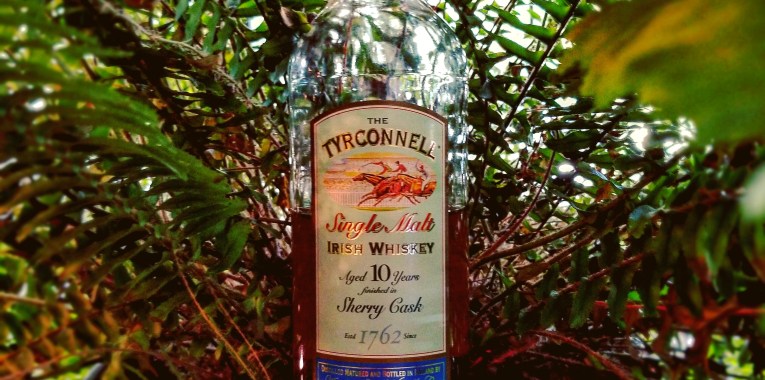
It’s a old industry with new blood and the near death of the industry left many historic brands and styles in the grave. Irish Single Malts and Tyrconnell are great examples. Tyrconnell was the flagship brand of the Old Watts Distillery, It takes it name from a racehorse who won the National Produce Stakes in 1876 at literally  at 100 to 1 odds. It was incredibly popular in the US, there are photos of Yankee Stadium at the turn of the century with Tyrconnell ads on the billboards. But prohibition shuttered the brand and the distillery in 1925. The Brand was revived by the Cooley distillery in the 80’s.

It’s made in traditional Single Malt Style, 100% malted barley and double copper pot still distillation with no peat, and then aged in ex-Bourbon Barrels. The 10 Year Old Madeira Cask Finish is my real jam though. A light, fruit forward whiskey with bitter chocolate, green, tropical fruit, and a incredibly creamy finish. It’s one of those whiskies that slips below the radar while being incredibly excellent. And they’ve gotten to the place where they are now planning on a limited release of a 16-year old Single Malt. And maybe that’s the silver lining to the Jameson’s problem.

All of this growth in the Irish whiskey world is being fueled and often literally paid for by sales of Jameson’s. For many people that’s all Irish whiskey will ever be which leaves a lot of hidden gems to be found flowing from the Emerald Isle. The world has caught on to Bourbon, its caught on the Japanese whisky, hell its even caught on to Taiwanese whiskey, but not Irish. Not yet anyway…

The days of Yamazaki and Weller Antique being undervalued have faded and instead of being sipped and shared it’s now being hoarded and auctioned. And i miss sipping and sharing. And at least with Tyrconnell I still can.