Whiskey Wednesday: O.F.C. 1985 Vintage Bourbon

Spontaneity is not my strong suit. 

Example A: my girlfriend swears by the deals emailed out daily by Scott’s Cheap Flights. Yet every time a deal lands, I have to ask about time frame, logistics, check on available vacation days, and generally stressed about the fact that booking this trip means that we won’t be able to book some other hypothetical trip that doesn’t yet exist and just like that the deal, and the moment, is gone. 

Example B: We received a bottle of the O.F.C 1985 Vintage Bourbon a year ago and I’ve been planning to write about it ever since. So, what the hell is O.F.C. and why has it been on my mind for literally a year? 

O.F.C. stands for Old Fashioned Copper and is the original name for the distillery founded by Col. E.H Taylor in 1869. Col. Taylor was an expert marketer and helped establish the concept of a Bourbon “brand” as well as being one of the major figures behind the passing of the Bottled In Bond act of 1897. 

The distillery itself was sold to another legend, George T. Stagg, in 1878. There’s an apocryphal story that one of the conditions of the sale was that Stagg could keep the initials O.F.C. but he had to change at least one of the words it stood. This is why the distillery is sometimes called the “Old Fire Copper” distillery. Regardless of the veracity of this claim the distillery’s name was officially changed to the George T. Stagg Distillery in 1904. It was the first distillery to utilize climate-controlled aging warehouses when Stagg installed steam heaters in 1886 and was one of only four Kentucky Distilleries granted a license to continue distilling throughout Prohibition.

The distillery changed hands a few more times in the 20th century before finally being purchased by the Sazerac Corporation in 1992 and its named changed once again. Now known as Buffalo Trace it arguably produces some of the most sought after American Whiskey on the market, including bottles named after both Taylor and Stagg as well as the much desired Pappy Van Winkle line. 

The distillery clearly has experience with special releases but even amongst the plethora of rare bottles the O.F.C. stands out. 

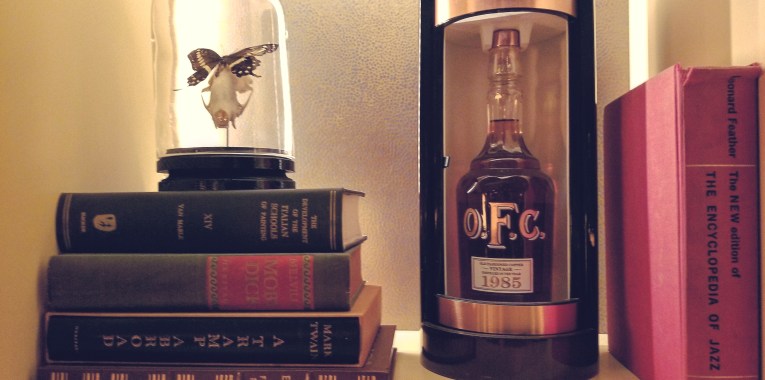
 The O.F.C. is less a special release and more of a time capsule. These are all single barrel, vintage dated Bourbons. Each bottle is sourced from a single barrel and marked with the year of distillation. This makes each vintage completely unique with the mashbill and age varying depending on the bottling. Another intriguing fact is that this line up was originally produced only for charity. 
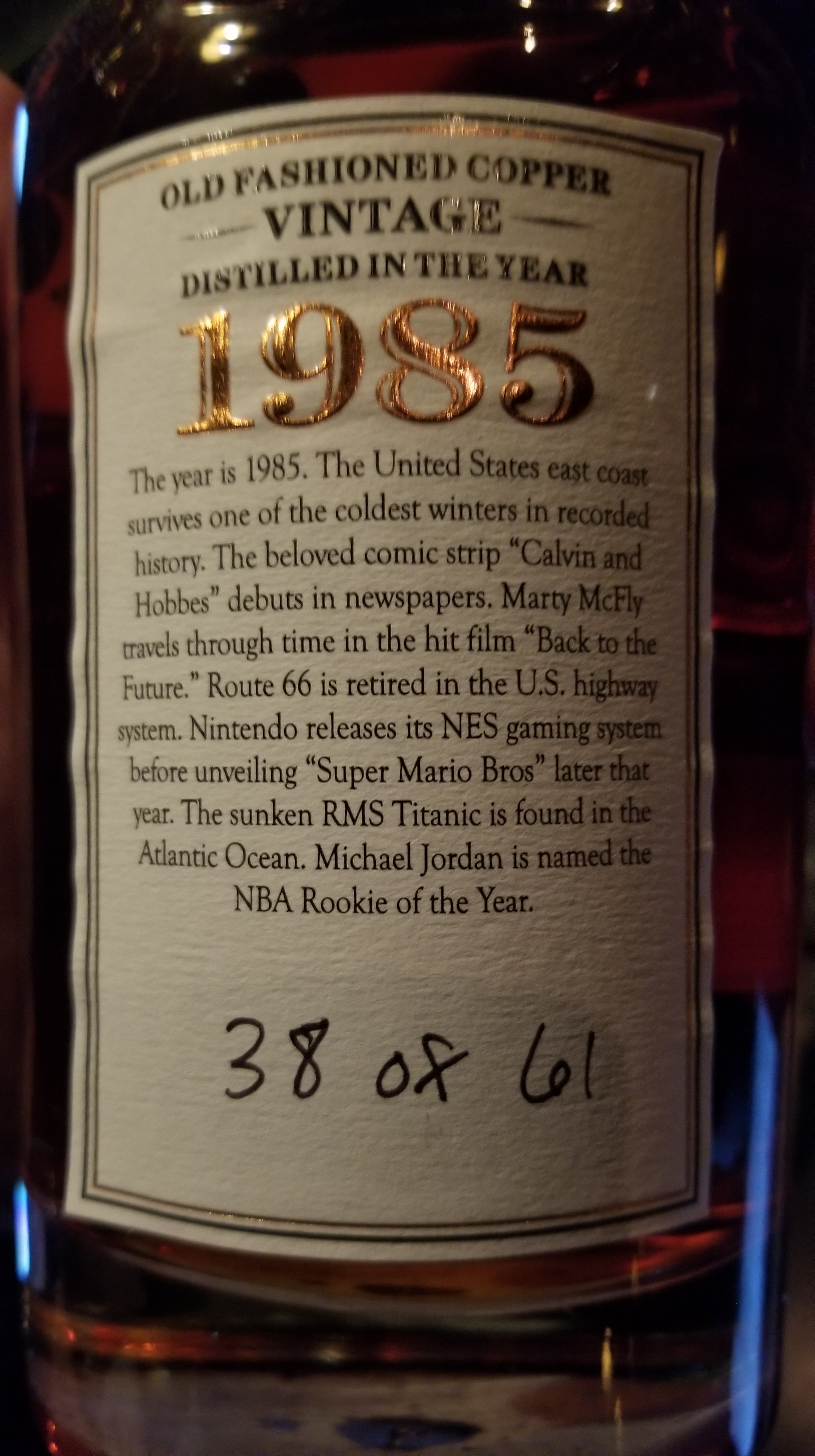
A literal Time Capsule.

The team at Sazerac and Buffalo Trace are just as savvy marketers as Col. Taylor was back in the day. I have to imagine that when they see bottles of their whiskey selling for thousands of dollars on the secondary market that they looked for a way to capitalize on that market value yet still offer an added bonus. The original three releases were only made available to 200 charities, at no cost, to auction off and help raise money for their cause. It was a great way to turn the image of limited whiskey auctions on its head and raise $1.2 million dollars for charity. It also immediately established the O.F.C. line as a super limited, ultra premium bottle. I was silently jealous of the fact that I would never see one of these bottles yet still applauded the move to raise money for worthy causes. But when the second round of releases was made available for retail purchase I leapt at the opportunity. Especially with the vintage being offered was the 1985. It’s not often you have a shared birth year for your whiskey. 

The 1985 Vintage is one of only 61 bottles to come from a barrel which was stored on the second floor of Warehouse Q. Buffalo Trace says that all of the barrels were tasted over time and removed from the barrel before becoming over oaked and since there is no age statement listed on the bottle it’s hard to tell the precise age of the bottle. This isn’t an uncommon practice, Buffalo Trace has done similar things with Eagle Rare 17 and Sazerac 18 so the whiskey isn’t as much as an oak bomb as you might expect. It is certainly old but there’s no official word on if it was a full 33 years in oak before being bottled. With that in mind let’s dive into the glass: 

NOSE: Rich oak, Dried fruit, and vanilla 

PALATTE: Rich vanilla, dark cherry, prune, oak, and a dark earthiness 

FINISH: Bitter chocolate, a touch of tobacco, and a coating lingering sense of time 

Overall this is an excellent example of old American Bourbon whiskey. It is still alive without being over oaked and has a power of flavor to match up to the power of the years it spent asleep in the barrel. The issue, as always, is the price. The bottle comes in at a staggering suggested retail price of $2,500. When the proceeds were going to charity this number wouldn’t have raised peep from me but now it changes the talking points. 

Is this good whiskey? Yes. Is it for everyone? Absolutely not. It is a special occasion, made so by the fact that it is a living time capsule. You are paying for the time and history as much as the whiskey itself. I will argue that experiences are more important than money but  the value is certainly subjective. I for one am going to savor the fact that I get to experience this bottled moment of time and not take it for granted. 
Drinking Poetic: West of Brooklyn

I’m sentimental in my head. I say head because I’m less emotionally sentimental and more intellectually sentimental, meaning that I hold on to things because I feel like I’m supposed to. This often means I find myself with collections of stuff that sometimes seem to stick around simply because it’s already stuck around.

Enter The West of Brooklyn, a drink that is now pushing its 6th consecutive year on my cocktail menus.

It certainly wasn’t planned that way and if you had asked me five years ago what drink of mine I’d still be making half a decade later it wouldn’t have been this one. I was young(er) and getting super into bespoke cocktails and was currently working my way through the Neighborhood Series and thought, “I want in on that.”

The Neighborhood Series was lineup of drinks from the Milk & Honey family and friends in New York that gave us some modern classics like the Cobble Hill, The Green Point, and the Red Hook. All of these drinks grew out of one simple fact: The Brooklyn Cocktail is terrible.

The classic Brooklyn Cocktail was first printed in 1910 in Jack’s Manual and is often modernly interpreted as:

2 oz Rye Whiskey (Preferably a Bottled-In-Bond)

.5 oz Dry Vermouth

.25 oz Maraschino

.25 oz Amer Picon

Looking at this you can see that it’s not the Brooklyn’s Fault that it’s terrible. Today we’re missing a vital ingredient: old school Amer Picon.

Amer Picon is a classic bitter orange French liqueur that also has notes of gentian, cinchona, and quinine that is no longer available in the States. But even if you were to get your hands on a bottle of it from France the recipe was changed in the 1970’s reducing the proof and making it sweeter. This means it doesn’t make the same drink. I’ve been fortunate to have classic Amer Picon and a classic Brooklyn thank to Andrew Willet over at Elemental Mixology and it’s a damn tasty drink. And for what it’s worth Andrew believes that CioCiaro makes a Brooklyn that more closely matches the classic.

Looking at this family of drinks and personally loving stirred drinks that add a subtle element of citrus or fruit I set about to add my own Neighborhood Cocktail.

At the time I was just getting started at Areal a mere block from the Pacific Ocean and was living in Venice Beach. I had moved West instead of to NYC where I would have more than likely settled in Brooklyn so before I started I already had a name: The West of Brooklyn. It was only later that I realized that Manhattan is also ‘West of Brooklyn’ but I will retroactively take credit for being that clever.

My base was clearly going to be Rittenhouse BIB Rye but knowing I was never going to get my hands on pre-70s Picon I looked for a more readily available substitute. Bigalett’s China-China had just hit the market so I pulled out a bottle of that and started mixing. I was enamored of Blanc Vermouth at the time so that joined the Bigalett and being in California and also being rather disparaging of maraschino, I looked around for a orange liqueur and ended up with a bottle of Solerno Blood Orange and thought, “That’ll do.”

That pretty much sums up my mentality about this whole drink with this first pass. I didn’t put enough thought into it. It looked like this:

2 oz Rittenhouse BIB Rye

.5 oz Bigalett China-China

.25 oz Blanc Vermouth

.25 oz Solerno Blood Orange

Stir. Served up with a Lemon Zest.

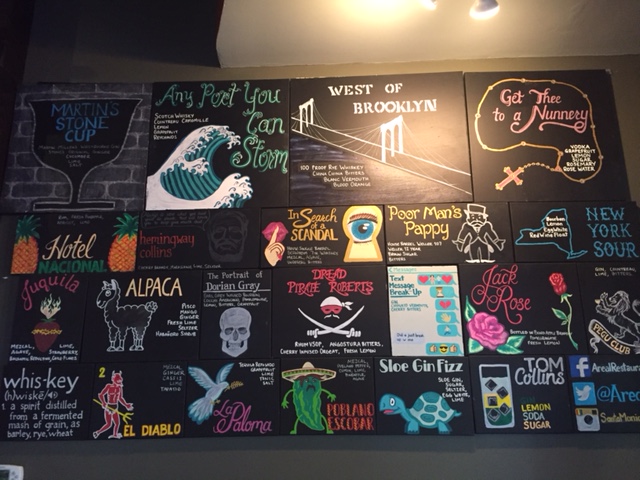
It ended up being a bit of an aggressively blunt instrument but it went on the menu and people seemed to enjoy it. It fit the bitter and stirred category and I let it be. I replaced it on the next printed menu but we had a cocktail board in the bar at Areal with drawings for every drink and our artist had been so pleased with her artwork that she wanted to leave it on the wall. I shrugged and gave it no thought.

809EA2AE-9EF9-4512-98CE-2400E3B9704C

People would continue to order the drink but it wasn’t until I had a customer come in and tell me that he had been in several times over the past months just for the drink because he liked it so much that I realized I had been making the drink for two years. I felt like I should revisit it.

I found the Bigallet was completely taking over the drink, but any attempt to dial it down just caused it to be lost. So I went back to the drawing board looking for a Grand Bitters to take its place and I started playing with the Clementi China Antica. The Clemanti focuses more on the bitter quinine notes without the orange which turned out to be perfect for the drink since I was adding the orange notes with the Solerno. But again any attempt to use less than a half ounce caused it to be lost when butting heads with the power of Rittenhouse so the drink remained a blunt instrument, albeit a drier more whiskey-focused one.

I left it at that an ended up leaving that bar. I honestly thought that would be the end of the drink. But as we were doing R&D for my first menu at Faith and Flower my friend Ryan Wainwright and I were doing an event at Seven Grand LA celebrating the Manhattan and lo and behold the drink came up. The night was being sponsored by Buffalo Trace and Sazerac Rye and suddenly the drink clicked.

In the years since I first got into the LA bar scene Sazerac Rye was highly allocated so trying to use it in a featured menu drink was a touchy proposition and that mentality stuck with me even as the rye became more available. Sazerac is a lighter, less aggressive rye than Rittenhouse with more of a green apple spice, and edges that bleed into ripe fruit. Switching out Sazerac allowed me to dial down the Clemanti Antica and bring up the blanc vermouth making it more true to its family of drinks while leaving it elegant, with a white pepper spice tied with a subtle fruit that has a perceived sweetness before drying on the palette. It now looked like:

2 oz Sazerac Rye Whiskey

.5 oz Dolin Blanc Vermouth

.25 oz Clemanti China Antica

.25 oz Solerno Blood Orange

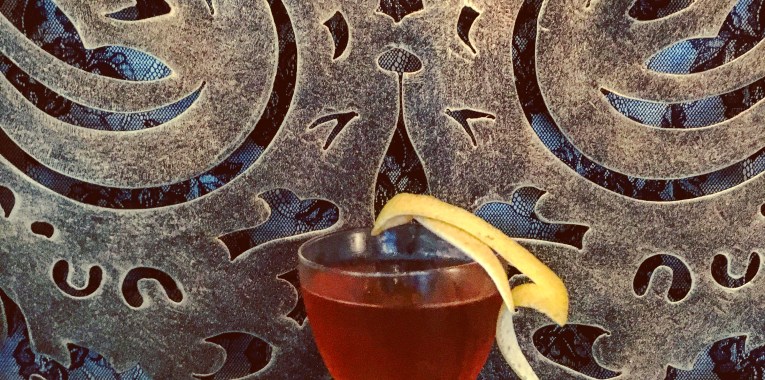
Stir with ice. Strain into a Nic and Nora glass with a lemon zest.

The drink perfectly fit the summer time Manhattan vibe we were looking for the menu and it was resurrected. And as I sit here doing R&D for the Fall/Winter menu it finally looks like the drink will truly come off the menu for the first time in five years. Until I change it again…

Whiskey Wednesday: Ancient Age

I tend to live my life with a fair amount of snark and irony wrapped around the place where most people keep an actual personality. As such it sometimes becomes hard for me to tell when I stopped ironically appreciating something and start genuinely liking it. Or if that change ever happened.

Example A: Ancient Age.

Ancient Age is a low level or “value” brand. I remember drinking handles of it inAncient-Age.jpg college not because it was phenomenal stuff, but because it was affordable. I moved on as a slight increase in disposable income allowed me to try other things yet here I am unabashedly keeping it in a decanter of honor on my back bar. And I’m not the only one, Ancient Age has a massive cult following for its affordability and quality, at least its quality in comparison to its price. But why?

The brand is relatively old as far as Bourbon brands go. The brand was first introduced in 1946 by Schenley Industries, and has been made at the same distillery for the brands entire life. Both the brand and the distillery have changed hands many times but Ancient Age has always been made at what we now know as the Buffalo Trace Distillery. It is not, however, owned by Buffalo Trace. It is owned by a company known as Age International which is one of those incredibly interesting corners of the Bourbon world that is rarely talked about.

In the 80’s things were not good for brown spirits. Consolidation, shut downs, and sell offs were happening everywhere. Especially if you weren’t really a booze company, like say Nabisco. At the time Nabisco had a subsidiary called Standard Brands, which included Fleischmann’s Distilling. In 1983 Standard Brands was sold to Grand Metropolitan, which a few years later would merge with Guinness to become the behemoth Diageo.

Knowing that Grand Metropolitan already had a successful drinks arm Ferdie Falk and Bob Baranaskas, the CEO and President of Fleischmann’s respectively, resigned and started their own company. Having previous relation with Schenley, Falk approached them and the pair were soon the proud owners of the Ancient Age brand and its home distillery.

The new company was dubbed Age International and they believed that the future success of Bourbon lay outside the U.S., hence the ‘international’. Their interest in foreign markets led them to work with Elmer T. Lee to create Blanton’s Single Barrel, which was originally designed for a Japanese market and just happened to be released in the States as well. This focus on over seas markets is also why there are so many variations of Blanton’s available around the world that aren’t available here at home.

In 1992 Falk and Baranaskas sold the remainder of their shares in the company to their Japanese partners, Takara Shuzo who immediately turned around and sold the distillery to Sazerac while maintaining control of Age International and its brands.

Sazerac continues to distill Blanton’s, Ancient Age, and the other Age International Brands which lead them to develop a separate mashbill to create their own proprietary brands, like the distilleries eponymous Buffalo Trace. So while Buffalo Trace does distill Ancient Age the two Bourbons sit on different branches of the Bourbon Family Tree.

Over the decades there have been several different variations of Ancient Age, my personal favorite being Ancient Ancient Age 10 Year Old for the name alone, but the whiskey shortage has even effected value brands so you’re most likely to come across just standard 80 proof Ancient Age these days.

images.jpg

The bourbon itself is fiery. Despite its name it is a young whiskey where the grains are more predominant that in many of its older siblings. It’s more cereal with the vanilla and caramel taking a backseat with the barrel presence being much less refined. Honestly, this is the kind of whiskey an Old Fashioned Cocktail was designed for. It’s a whiskey that benefits from having its edges softened and it’s hot heart rounded.

In the end, I just like this whiskey. It is what it is and I just have to accept that it’s essentially the Pabst Blue Ribbon of the Bourbon world. Except people aren’t proudly drinking Ancient Age at their back yard hipster BBQs. Though to be fair I can’t remember the last time I actually saw someone drink a Pabst these days. Everything is cyclical. So I’m going to circle it back around and keep pretending I’m fancy even if it’s just Ancient Age in my decanter.