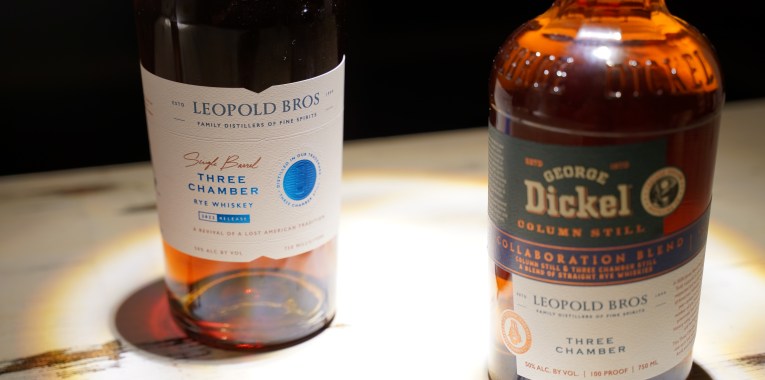
Whiskey Wednesday: The Three Chamber Rye

Alright, let’s get this out of the way: I am a Leopold Brothers fan, I’ve been a fan of their work for years. They are one of the best examples of what a mid-sized distillery can offer to the larger spirits world. They’re not trying to grow beyond their capacity and that capacity is often defined by quality standards, not production goals. They once said that what they make is liquid food, and their products back it up.

But with all of those standards and expectations comes a pressure to deliver. Especially when it comes to the Three Chamber Rye.

The Three Chamber Rye journey is one that I have followed for years, for at least as long as I’ve been writing Bottled-In-Bond, LA. In fact it was something that I was able to taste right off the three-chambered still before it had ever been bottled. The pressure of those years since tasting the white dog on my expectations has been enormous but to truly understand why we need a history lesson.

The Three Chamber Rye takes its name from the still used to produce it. While many people these days are familiar with the difference between a pot still and a continuous still, chances are they’ve never heard of a three chamber still. That’s because the last one was decommissioned just after the end of Prohibition. 

But before Prohibition the three chambered still was the tool for making rye whiskey in the United States. We know this because of the Crampton and Tolman papers. These were two reports commissioned by the IRS after the passing of the Bottled In Bond Act of 1897. These papers would become the basis for the standards of identity for what would define a bourbon, a rye, or other spirits aged in wood in the US. Every distillery that was surveyed that produced rye whiskey, except one, used a chamber still.

The three chamber still works much like its name suggests, there are three chambers stacked on top of each other. Each chamber is separated by a valve to prevent wash from each chamber from flowing into the other. The best way to understand how it works though is to start at the end with the third chamber.

This is where the mash from the last run will have ended up as the last stop of the process. Stripped of almost all alcoholic content and essentially stillage, this spent mash is pumped out of the chamber. 

The valves on the other chambers are opened one by one and the mash from chamber two flows down into the third by gravity, the mash from chamber one flows into chamber 2 and the first chamber is refilled from the pre-heating chamber.

Once all of the chambers are filled the steam valve is opened. It rises through the bottom (third) chamber, extracting oils and flavors, passes up into the middle (second) chamber, extracts alcohol and more flavor, continues up into the first chamber continuing its extraction before passing into a heat exchange in the preheater charger to warm the waiting mash without interacting before the vapor passes into a thumper and condenser to become new make. 

Each of these chambers operates at its own temperature, pressure, time, and inefficiencies. Each extracts different flavors and compounds.

If you’re familiar with how a continuous still works this may sound like a more difficult, less efficient version of that. And for many years that’s how this still was considered: as a transitory technology between the pot still and the continuous still.

Todd Leopold’s research into this forgotten technology however, led him to an article about the Hiriam Walker distillery in the 30’s. At the time this distillery was the largest distillery in the world and rather than instill another continuous still the very deliberately had a three chamber still limiting their production numbers. This told Todd that this still must have been producing a whiskey of such a unique flavor that the average consumer would notice its absence. And this led the team at Leopold Bros to commissioning Vendome to make the first Three Chamber Still in 100 years.

I don’t think Vendome would have agreed to make this still for any other distiller, as it was the first still they ever made that they couldn’t guarantee would work, or even not explode. Yet once it was functional and paired with Todd Leopold’s skill as a distiller it became clear that the resulting whiskey, even before being aged, was incredibly unique. The Chamber still essentially worked as an oil extractor. 

By the time the mash hits the third, bottom chamber almost all of the alcohol has been stripped from it. This means that the steam is extracting oils, flavors, and other compounds that it carries into the other chambers that are then slowly mixed with the alcohol being pulled from those chambers before being passed into the condenser to be collected. This allows a lot of time for compounds to interact and to add in compounds that don’t usually have time to exist in more familiar distillations.

The production goes beyond just the technology though. When you look back at production in the late 1800’s you quickly realize that the grains grown then are drastically different from the grains grown now. Over the past 150 years we’ve bred grains to produce more yield, meaning more starch. This is efficiency at the cost of flavor.

To solve this, Leopold Brothers worked with local Colorado farmers to start growing essentially extinct Abruzzi Rye grain. This rye has a starch content of about 60-65% which is much lower than the 75-80% starch content of modern, comercial rye. This unlocked yet another key to the flavor of this bygone whiskey. Add this to the fact that it’s distilled to 100 proof, goes into the barrel at 100 proof, and five years later comes out at 100 proof and you have a whiskey that hasn’t been tasted in literal generations.

I’ve now been fortunate enough to taste this whiskey as a new make straight off the still in the first year of its operation, to be able to taste the first bottled release, and now the first single barrel release. It has a unique character worthy of the wait; floral, fruity, bready, unctious, and heavy.

That term heavy is important because it leads us to the next stage of the conversation. That’s right, we aren’t done yet! While doing more research, and examining the blueprints laid out by the Crampton and Tulman papers, as well as the flow charts of the Hiram Walker Distillery it became clear that this Three Chamber whiskey, this “heavy” whiskey, was a component. Just a part of the standard bottle of rye. It would be blended with “light” whiskey to create a completely separate flavor.

This “light” whiskey would now be what we consider rye whiskey distilled on a continuous still. To truly recreate pre-Prohibition Rye the Three Chamber Rye would have to be blended with a continuous still rye.

Without a Continuous Still of his own, Todd reached out to Nicole Austin of Cascade hollow, formerly George Dickel. If you haven’t heard of Nicole or her work at Cascade Hollow go Google her now. She deserves her own full breakdown for her innovation and creativity as she’s doing for a macro distillery what Todd has done for an independent distillery. (Which is why she happened to have a four year old, experimental, column distilled rye already on hand.)

The two were able to collaborate. Not just as individual distillers, but as a mid-sized distillery working with the largest liquor company in the world. They produced a collaboration bottling that equally featured the work of both distillers while recreating a historic flavor profile.

The result is one of the best, most versatile rye whiskeys I’ve ever tasted. It is bright, spicy, weighty, fruity, delicate, and slightly floral. While this is a whiskey to sip it is probably one of the best cocktail Ryes I’ve ever worked with. A Manhattan or Sazerac with the Collaboration Rye is stellar. 

*If only the price were.

As you can imagine recreating a century old style of whiskey, and doing it right, doesn’t come cheap. Getting a bottle of the single barrel Three Chamber Rye is a couple hundred dollars. And depending on where you live getting a bottle of the Collaboration is 100+.

I absolutely believe that the price is worth it for experienced whiskey drinkers. They both explore something new, unexpected, and delicious. I want to open that door to appreciate the complexity of this whiskey to more people. And the easiest way for that is with cocktails. But the price point, for now, is aspirational rather than available.

Leopold Bros might think they’re making liquid food, but with the Three Chamber Rye they’ve made a whole meal.

TASTING NOTES:

Leopold Brothers Three Chamber Single Barrel Rye
NOSE: Malt, Baking Spice, Light Oak, Herbs
PALETTE: Stone fruit, oily, lavender, bright spice, bready
FINISH: Long, floral, roasted peach, tobacco, oak

Dickel and Leopold Bros. Collaboration Rye
NOSE: Dried fruit, citrus zest, rye spice, vanilla
PALETTE: oak, caramelized pear, floral, stone fruit, dill, baking spice
FINISH: Long, honied, spiced apple

Whiskey Wednesday: Four Roses’ New Selection

Conservatively, I would say that 87% of the Four Roses Single Barrel depletions at any bar I work at are due to it ending up in my mouth.

Conversely, my Partner-In-Bars, Dave Purcell, would rather sit in the pool with a bottle of the Four Roses Small Batch. I’ve sourced Four Roses Barrel Strength Single Barrels and have dived into the history of the distillery in the past. All of this is to say that I am a big fan of Four Roses and became very excited when they announced their first permanent product line extension in over 12 years. And immediately became wary when they announced that it would be called the Small Batch Select. 

Four Roses is one of the two great modern distilleries to emerge from the collapse of the old Seagram’s Empire. While Four Roses languished as a bottom tier blended whiskey for the later half of the 20th century it quickly became a staple of the new Bourbon Boom in the ‘00s when the distillery was purchased by the Japanese beverage conglomerate Kirin. Under the leadership of Master Distiller Jim Rutledge Four Roses became one of the most sought after Bourbon’s in the world. This was in part due to the process that Four Roses uses to make their whiskey.

Four Roses makes 10 different Bourbon recipes. And they’re all coded so you can tell what whiskey is being used in every bottle. For every code there are four letters, the first and the third will always be the same. The first letter will always be ‘O’, signifying that it was made at the Four Roses Distillery in Lawrenceburg, KY and the third letter will always be “S” meaning that it is Straight Bourbon. 

 The second letter will then signify that mash bill. Four Roses utilizes two different mash bills:

Mash bill E, which is 75% corn, 20% rye, and 5% malted barley
Mash bill B, which is 60% corn, 35% rye, and 5% malted barley. 

These mash bills are then fermented with one of five unique yeast strains, which is designated by the fourth letter: 

K – rich in spiciness, full bodied 
O – floral, spicy, medium bodied 
Q – slightly fruity, spicy, medium bodied 
F – herbal
V -delicate fruit 

The Single Barrel is always OBSV, high rye and delicate fruit. The Small Batch is a blend of four: OBSK, OESK, OBSO, OESO, and the standard Yellow Label is a blend of all ten. Special releases throughout the years have used different mash bills in different amounts. 

My initial hesitation upon hearing about the Small Batch Select was two fold. I’m just not as big of a fan of the Small batch as the Single Barrel and I didn’t know if it would be different enough from the Small Batch to warrant a new extension. So, what makes it different?

First up is the proof. Bottled at 104 Proof and Non-Chill Filtered the Small Batch Select is hotter than the Single Barrel which comes in at 100 Proof. Second, while there is no age statement Four Roses has said that it is a blend of 6-7 year old Bourbons. Lastly, that blend is a blend of six of the recipes: OBSV, OBSK, OBSF, OESV, OESK, and OESF. We still don’t know the proportions, but this brings in distinctly different flavors from the standard Small Batch. 

NOSE: Baking Spice, red fruit, and oak 

PALETTE: Vanilla, apricot, cinnamon, oak, and dark chocolate 

FINISH: Medium and dry, tobacco and leather 

This fourth Four Roses is truly distinct from its siblings. Enough to warrant its entry to the family. My initial skepticism came from the name yet upon further research and tasting its clear that this new entry is vastly different from the established small batch while still being a technical small batch. 

It’s also important to note that this is new Master Distiller Brent Elliott’s first permanent edition to the Four Roses line up since taking over in 2015.  Coupled with previous limited releases like the Al Young 50th Anniversary and the 130th Anniversary Small Batch I think we’re getting a sense of how Brent’s palette differs from Jim’s. 

While this won’t replace the Single Barrel for me it is a worthy addition that fans of Four Roses will love but is also a great introduction for new comers to the brand. 

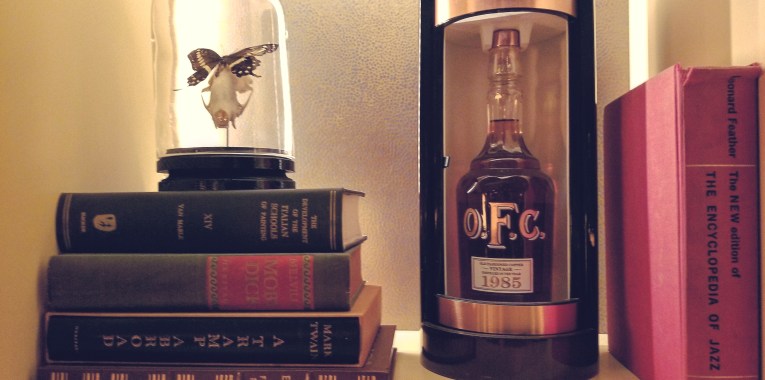
Whiskey Wednesday: O.F.C. 1985 Vintage Bourbon

Spontaneity is not my strong suit. 

Example A: my girlfriend swears by the deals emailed out daily by Scott’s Cheap Flights. Yet every time a deal lands, I have to ask about time frame, logistics, check on available vacation days, and generally stressed about the fact that booking this trip means that we won’t be able to book some other hypothetical trip that doesn’t yet exist and just like that the deal, and the moment, is gone. 

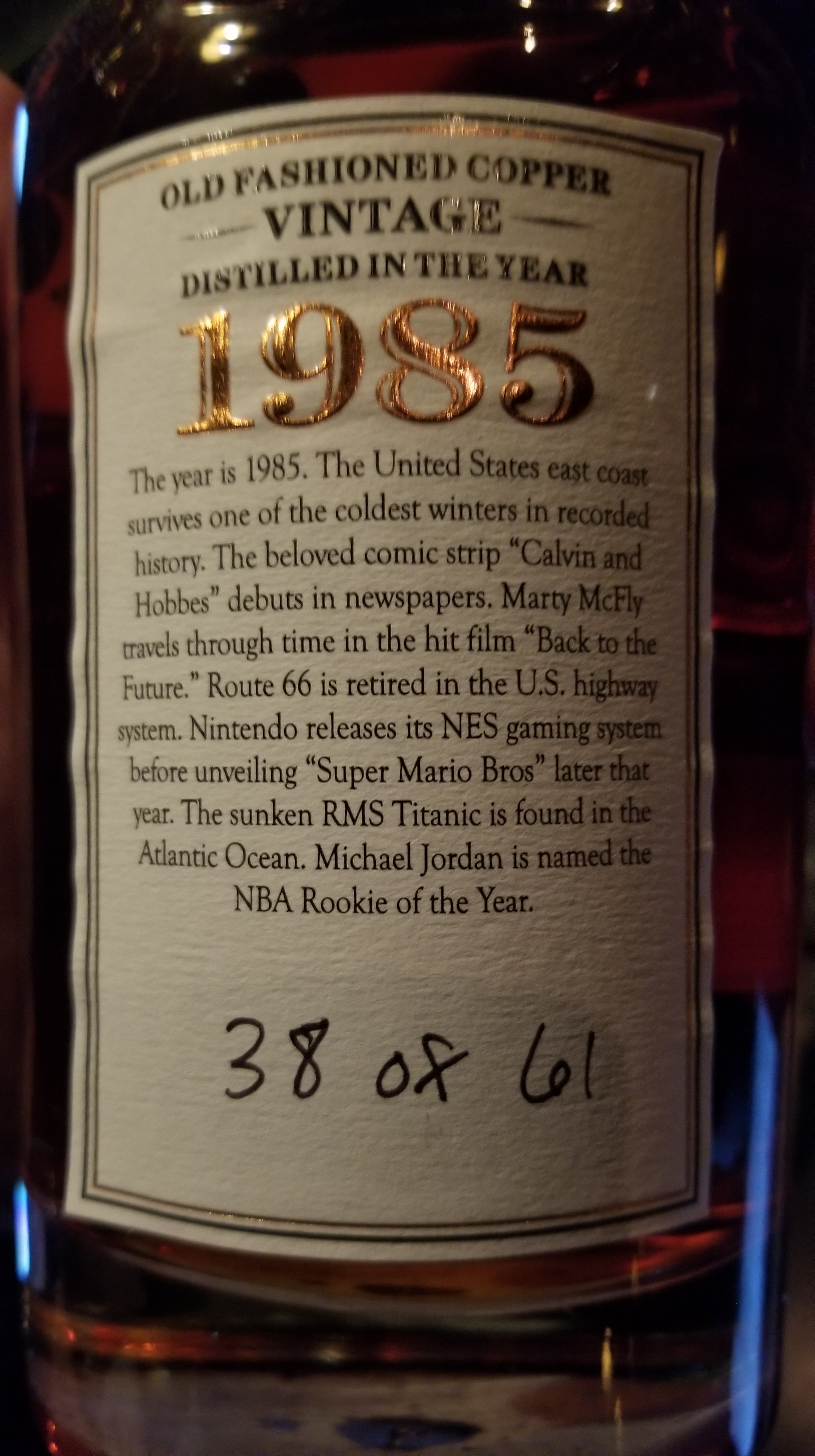
Example B: We received a bottle of the O.F.C 1985 Vintage Bourbon a year ago and I’ve been planning to write about it ever since. So, what the hell is O.F.C. and why has it been on my mind for literally a year? 

O.F.C. stands for Old Fashioned Copper and is the original name for the distillery founded by Col. E.H Taylor in 1869. Col. Taylor was an expert marketer and helped establish the concept of a Bourbon “brand” as well as being one of the major figures behind the passing of the Bottled In Bond act of 1897. 

The distillery itself was sold to another legend, George T. Stagg, in 1878. There’s an apocryphal story that one of the conditions of the sale was that Stagg could keep the initials O.F.C. but he had to change at least one of the words it stood. This is why the distillery is sometimes called the “Old Fire Copper” distillery. Regardless of the veracity of this claim the distillery’s name was officially changed to the George T. Stagg Distillery in 1904. It was the first distillery to utilize climate-controlled aging warehouses when Stagg installed steam heaters in 1886 and was one of only four Kentucky Distilleries granted a license to continue distilling throughout Prohibition.

The distillery changed hands a few more times in the 20th century before finally being purchased by the Sazerac Corporation in 1992 and its named changed once again. Now known as Buffalo Trace it arguably produces some of the most sought after American Whiskey on the market, including bottles named after both Taylor and Stagg as well as the much desired Pappy Van Winkle line. 

The distillery clearly has experience with special releases but even amongst the plethora of rare bottles the O.F.C. stands out. 

 The O.F.C. is less a special release and more of a time capsule. These are all single barrel, vintage dated Bourbons. Each bottle is sourced from a single barrel and marked with the year of distillation. This makes each vintage completely unique with the mashbill and age varying depending on the bottling. Another intriguing fact is that this line up was originally produced only for charity. 

A literal Time Capsule.

The team at Sazerac and Buffalo Trace are just as savvy marketers as Col. Taylor was back in the day. I have to imagine that when they see bottles of their whiskey selling for thousands of dollars on the secondary market that they looked for a way to capitalize on that market value yet still offer an added bonus. The original three releases were only made available to 200 charities, at no cost, to auction off and help raise money for their cause. It was a great way to turn the image of limited whiskey auctions on its head and raise $1.2 million dollars for charity. It also immediately established the O.F.C. line as a super limited, ultra premium bottle. I was silently jealous of the fact that I would never see one of these bottles yet still applauded the move to raise money for worthy causes. But when the second round of releases was made available for retail purchase I leapt at the opportunity. Especially with the vintage being offered was the 1985. It’s not often you have a shared birth year for your whiskey. 

The 1985 Vintage is one of only 61 bottles to come from a barrel which was stored on the second floor of Warehouse Q. Buffalo Trace says that all of the barrels were tasted over time and removed from the barrel before becoming over oaked and since there is no age statement listed on the bottle it’s hard to tell the precise age of the bottle. This isn’t an uncommon practice, Buffalo Trace has done similar things with Eagle Rare 17 and Sazerac 18 so the whiskey isn’t as much as an oak bomb as you might expect. It is certainly old but there’s no official word on if it was a full 33 years in oak before being bottled. With that in mind let’s dive into the glass: 

NOSE: Rich oak, Dried fruit, and vanilla 

PALATTE: Rich vanilla, dark cherry, prune, oak, and a dark earthiness 

FINISH: Bitter chocolate, a touch of tobacco, and a coating lingering sense of time 

Overall this is an excellent example of old American Bourbon whiskey. It is still alive without being over oaked and has a power of flavor to match up to the power of the years it spent asleep in the barrel. The issue, as always, is the price. The bottle comes in at a staggering suggested retail price of $2,500. When the proceeds were going to charity this number wouldn’t have raised peep from me but now it changes the talking points. 

Is this good whiskey? Yes. Is it for everyone? Absolutely not. It is a special occasion, made so by the fact that it is a living time capsule. You are paying for the time and history as much as the whiskey itself. I will argue that experiences are more important than money but  the value is certainly subjective. I for one am going to savor the fact that I get to experience this bottled moment of time and not take it for granted. 

Whiskey Wednesday: A Tale of Two Elmer’s

            I received a text this week from a friend that without preamble said, “Did Elmer T. Lee get worse?”

            My gut reaction was, “Of course not! How dare you besmirch the name of the dearly departed father of modern Bourbon!?” After calming myself with a hefty dram I remembered that despite centuries of tradition whiskey making is a constantly evolving art and barrel aging is by no means an exact science. To add to that, there were claims of “cork taint” by members of the Reddit whiskey community in 2016.  The popularity of Elmer T. Lee has also exploded in recent years so the odds are that it’s younger stock than previous years. By the end of the glass the question was less of an attack and more of a probability.

Son, we’re not hiring today.”

            This could have remained a simple thought experiment but a recent trip to the Liquor Locker left me with a bottle of 2014 Elmer and the ability to do a little compare and contrast. But first a little context.

What exactly is Elmer T. Lee? Elmer T. Lee is both a Single Barrel Kentucky Straight Bourbon, and the deceased former Master Distiller of the distillery we now know as Buffalo Trace. 

“Son, we’re not hiring today.” Is how Col. Albert B. Blanton first greeted Elmer in 1949, but at the instance of his friend at the distillery he showed up to work the next week anyway.  Over the years Elmer grew from a maintenance engineer to the distilleries first Master Distiller. He officially “retired” in 1985 but not before releasing the world’s first Single Barrel Bourbon, Blanton’s, named after the man who didn’t hire him.

After Blanton’s became a hit the distillery honored its Master Distiller emeritus with his own namesake Single Barrel. Elmer was still heavily involved with the distillery and would come in every Tuesday to taste barrels and make selections for his namesake release.

Before Blanton’s, and Elmer, the concept of a “Single Barrel” Bourbon didn’t exist.  Remember, barrel aging isn’t an exact science. Every barrel ages differently depending on where in the rickhouse it sits, the quality of the barrel, the temperature swings over the years, all of these factors contribute to each barrel being a unique specimen But the whole idea of a bottled whiskey is consistency so generally barrels are blended, or batched, together to recreate a specific flavor profile. For a Single Barrel all of the whiskey in the bottle comes from one single barrel and has to stand on its own individual merits. While there will always be some variation, it is a sign of the skill of the distillery to be able to produce quality single barrels that are still consistent.

Both Blanton’s and Elmer share the same DNA. They’re both Buffalo Trace Mashbill #2 which is slightly higher in rye content (about 15%) and are both technically co-owned and produced with Age International. They’re both single barrels and they’re both non-age statement Bourbon’s so we know they’re at least older than four years. But two things separate them from each other: aging and proof.

Drinking is such an individual experience. It’s can be a social activity but the act of tasting is something intrinsically personal.

Blanton’s is always aged in Warehouse H, which was commissioned by Blanton himself. It  is a fully metal clad warehouse which allows for greater heat transfer and, supposedly, more rapid aging. Elmer has no such restrictions on what warehouse it must be aged in which theoretically allows for a larger variation in flavors.

Elmer is also bottled at 90 proof (45% ABV) where as Blanton’s is bottled at 93 Proof (46.5% ABV). While this difference seems small the alcohol is where the flavor is. A few extra proof points can make a world of difference and a whiskey can open up with just a few more drops of water. That isn’t to say that higher proof is always better, just like older doesn’t always mean better, it just means a different flavor profile. Interestingly, Elmer was said to drink his Bourbon at 60 Proof as he felt that was the point when he could taste all the flavor with out the alcohol getting in the way.

Now that all the intellectual foreplay is out of the way, how do they actually taste?

Four Years can really change a bottle.

2014

  NOSE: Oak and Clove

  PALETTE: Earthy, Dark Chocolate, Coffee, Tobacco

  FINISH: Long, slightly damp and musty

2018

            NOSE: Oak, Stone fruit, Vanilla

            PALETTE: Rye Spice, Stone Fruit, Tobacco, Coffee

            FINISH: Light, Spicy

Surprisingly, the 2014 is livelier in the glass, with a bigger spice on the nose and a more rounded midpalette. However, the 2018 carries a darker earthiness, more of the tobacco I associate with Elmer’s and a longer finish. Yet they are both still Elmer. In fact, pouring the two together creates an almost uber-Elmer that is exactly what I expect Elmer to taste like all the time.

Drinking is such an individual experience. It’s can be a social activity but the act of tasting is something intrinsically personal. Where you are at, what time of the year, and how much effort you put into finding the bottle all effects how the spirit tastes. So, back to my friends original question. Did Elmer T. Lee get worse? I’d say no, but it is different. But then again, so am I.

Whiskey Wednesday: Elijah Craig: NoMad Edition

I sat down and did this almost exactly a year ago and it’s time again for the annual arrival of a privately selected Elijah Craig Barrel. This one, like all of them, is special because it is a 100% unique bottling but it’s also the culmination of an insane year.

Elijah Craig is the whiskey I’ve probably written about the most so I’ll skip the folklore and brand history, you can read about those here. Instead I want to get personal and talk about the time since the last barrel rolled into my hands.

I started buying single barrels of whiskey years ago.  Elijah Craig was the first barrel I bought and it lit a fever in me. It was pretty easy to track where I had been working using this as a metric. As time went on as the list of “House Single Barrels” would balloon seemingly overnight. Last year was full of first for me. This year has been about constant change.

20180102_170727
Training Tome

When the last barrel of Elijah Craig showed up to Faith & Flower I already new that in a few months I would be leaving it behind and traveling blocks away to the corner of 7th and Olive as one of the opening bar managers for NoMad Los Angeles. What I didn’t know was what that really meant.

I knew that I was joining a well-established,well-regarded, restaurant and bar team. I knew Leo Robitschek mostly by reputation and I knew the program; Pietro Collina, Nathan O’Neil and the rest of the team in NYC had built one of the most impressive bar programs not just in the country but the world. I knew it was going to be a lot of pressure and an immeasurable amount of work. What I didn’t know was how I fit into the equation.

My partner-in-bar Dave Purcell had already been a part of the team for months before I was brought on and given my crash course in everything NoMad. Three weeks after I started training I had pivoted learning to teaching. We were now training a barstaff that was 55 people large on an opening cocktail menu that was nearly 60+ drinks (not counting house specs on classic drinks) spread across four bars and not enough back bar space.

Every single member of that opening team was a goddamn rockstar and every member of our team, nearly a year later, is a member of that opening squad. It speaks to their professionalism and skill that they have risen above and beyond as the restaurant has constantly changed around them. Constant Reinvention is one of our guiding principles after all.

IMG_20180122_021945_794.jpg
A lot of late night exits.

Our Head Bartenders, who moved across the country from to be a part of this project, are some of the hardest working, most dedicated hospitality professionals I have ever met and I couldn’t imagine a better crew to get this beast off the ground with.

But even after opening I still didn’t know where I fit in. I wasn’t behind the bar and the Head Bartenders embodied the program and the culture so much more deeply than I felt that I did. They had simply been living with it for longer then I had. As far as I could tell I was here to herd a pack of wild bartenders and to help make the NoMad more LA. The first inkling of what that might actually mean happened when the team at Heaven Hill approached me about buying another barrel this year.

I immediately leapt at the idea and pitched it to Dave and Leo. After some debate, and extended tasting sessions, we settled on this bottle that now sits before me. An Eight Year Old Elijah Craig Single Barrel aged on the 6th Floor of Rickhouse “S” outside the Heaven Hill bottling plant in Bardstown, KY.

It has a heavy caramel nose and an upfront sweetness yet also a delightful earthiness and tannic finish that allows it to be sipped on it’s own but also to be built into cocktails which are surely the lifeblood of any NoMad bar.

Elijah Craig has been an integral part of the history of NoMad. The only drink to have never left the menu at NoMad is the Start Me Up, a Whiskey Sour variation with ginger, honey, Strega, rum and of course Elijah Craig. Using this barrel really drives home those whiskey notes in this drink. Here was something that I could contribute to the NoMad lexicon that was still wholly the NoMad and also intrinsically me.

This year also had it’s fair amount of travel, back to Pennsylvania for my Grandmother’s 90th birthday, a trip to the Cook Island’s (look it up it’s a real place) and a chance to return to France with my always more intelligent than me girlfriend.

There were less competitions, opening four bars in less than three months eats up a lot of free time, but I now have a rotovap as part of my tool set and know more about working with sherry than I could have ever imagined. As I sit here sipping this whiskey I am incredibly proud to see the NoMad symbol on its label.

Last year I declared I hate change and this year I find myself wondering if the new norm is constant change. I don’t have an answer to the question but I do look forward to what next year’s barrel of Elijah Craig brings.

IMG_20180706_210048_991.jpg
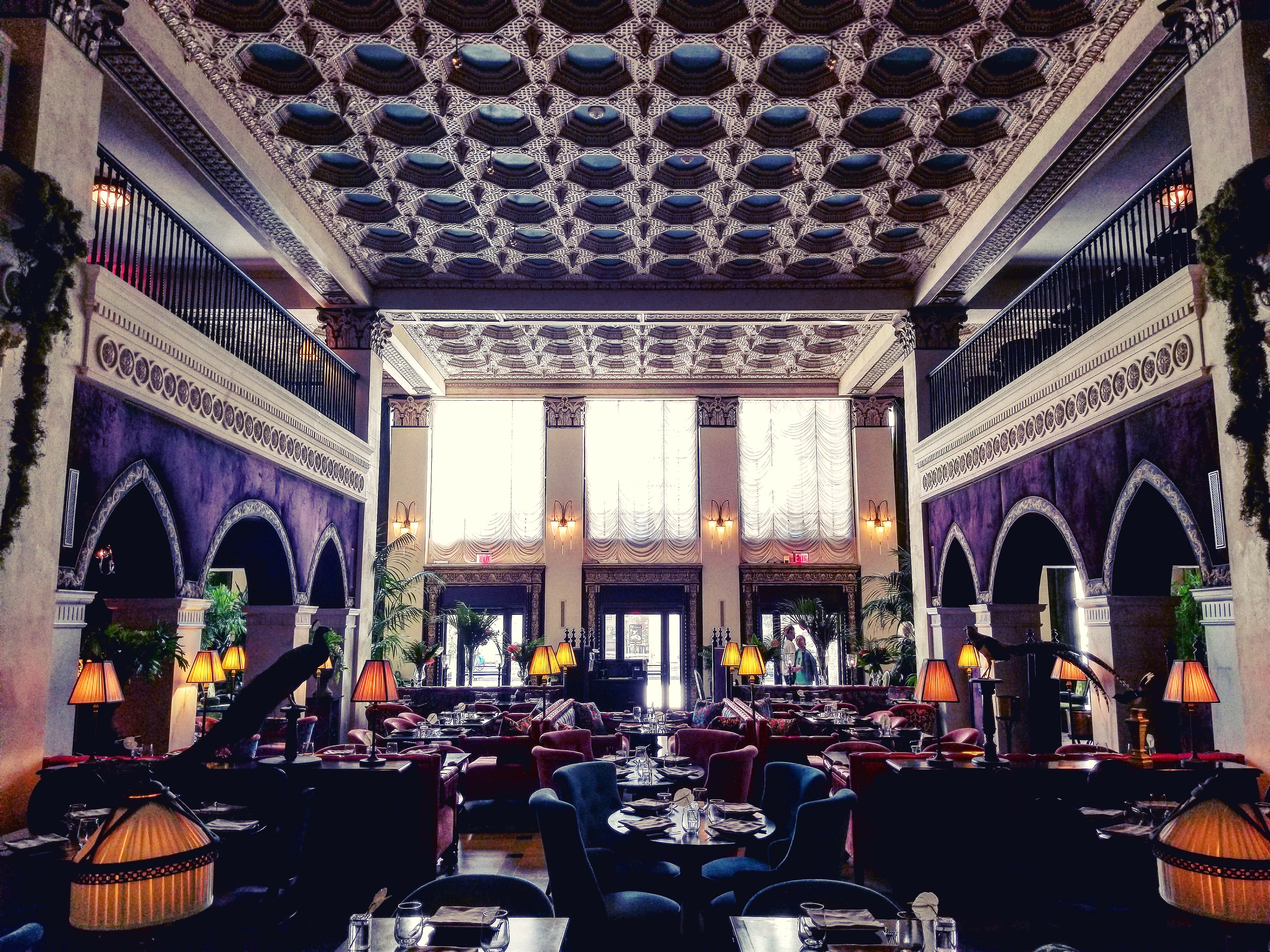
NoMad Los Angeles

Whiskey Wednesday: Elijah Craig Check In

Another year and another barrel of Elijah Craig. The very first single barrel I ever picked out for a bar was a barrel of Elijah Craig for Areal a good five years ago. I’ve been fortunate enough to select an Elijah Craig barrel every year since so its arrival is usually a great touchstone for me to reflect on the previous year. A Bourbon New Year as it were. And it’s been a hell of a year.

I left a bar that I ran for nearly five years that promptly closed six months later. I started a new job at Faith and Flower in Downtown LA, competed in the National finals of three major cocktail competitions, traveled to Tokyo, started this wordy blog, and picked out another barrel of Elijah Craig.

Elijah Craig is often the answer to the inevitable question, “What do you drink?’ I’ve talked about it at length here, and here, and during innumerable shifts behind the bar. The basic gist though is that Elijah Craig is one of the semi-mythical early Bourbon distillers that sometime after his death was decreed to be “the Father of bourbon” after he became the first person to char his barrels before aging his whiskey. It’s a completely unsubstantiated claim that makes a good story. So, we all tell the story and then acknowledge that it’s complete nonsense.

The current Elijah Craig brand was introduced by Heaven Hill in 1986 and has gone through multiple changes in its 30-year history but the past year was quite striking. The iconic 12-year old age statement was dropped from the label with the whiskey instead becoming a blend of 8-12 year old. The old school squat bottle was also replaced with a sleeker, taller, more streamlined bottle that I’m personally not a fan of but does actually fit a pour spout .

If you can’t tell, I don’t like change. And that’s not to say anything against the whiskey. It’s still an earthy, massively tanic, barrel forward whiskey that is one of the few bottles that I think works equally well in both mixed drinks and as a neat sipper. Most of these changes were made because there’s not enough whiskey to go around. Especially not old whiskey. Part of me feels like saying so what? Let there not be enough for everyone, don’t change this bottle that I love. Yet, that view is selfish.

Part of the joy of bartending, and indeed the joy of this very blog, is getting to share things that I love with other people. In the end, these changes aren’t for me. I clearly jumped on the train years ago. These changes are for the people seeing Elijah Craig for the first time on a billboard, or a sports arena, or even hearing about it on its recent NPR advertisements. The old Preacher is growing and hanging out with a younger crowd these days and I’m glad to see it.

In the end change isn’t good or bad. How we react to it, how we deal with it, that’s where the emotion comes in. Sometimes, change is just change. And I look forward to seeing what the Preacher and I have to talk about the next time we see each other.

Whiskey Wednesday: Four Roses Al Young’s 50th

Almost every shift I get asked what has to be one of my least favorite questions, “What’s your favorite whiskey?” My response is usually, “That’s like asking a mother to pick her favorite child.” We all know mommy had a favorite but it’s a lot more complicated than it looks at first glance.

Is it a special occasion? What kind of bar am I at? What’s the price of a pour? These are all things that I take into consideration when it comes to what I drink but increasingly when I’m out I find myself ordering Four Roses Single Barrel. Part of this is that the whiskey is damn good, but it’s also the fact that it’s become almost ubiquitous and it’s cost effective. That wasn’t always the case though.

There are a few conflicting stories about the origin of the brand but the one that Four Roses currently promotes is that they were founded by Paul Jones, Jr. who trademarked the name Four Roses in 1888 with a claim of production and sales back to the 1860’s. The name supposedly comes from Jones, Jr. being smitten by an unnamed Southern Belle. He sent her a proposal and she replied that if her answer was “yes” she would arrive at the ball with a corsage of roses on her gown. When she arrived she was wearing not one but four red roses. This legend of romance lead to a romance in a bottle.

After prohibition Four Roses thrived. In the 30’s and 40’s it was the number one selling Bourbon in the United States. In 1943 the brand was purchased be Seagrams who, despite the brands popularity, discontinued the brand in the United States to focus on overseas markets. It quickly became the number one American bourbon in Europe and Asia while at home it became rotgut, blended whiskey, despite Seagrams creating new Bourbon brands in the following decades.

While the Seagrams company might not have been putting out the highest quality brands, they were training some amazing distillers. After Seagrams collapsed in 2000 we began to see the quality that was going on behind the scenes. Because a large part of Seagram’s business was contract distilling and blended whiskey there were a massive amount of recipes being produced at their distilleries that turned out to be absolutely phenomenal drinks on their own. Like Bulliet? That 95% rye mashbill is all made at MGP, the former Seagrams distillery in Indiana. And that Bulliet Bourbon? It was all originally made at the Four Roses.

After the Seagrams collapse Four Roses was purchased by Japanese beer giant Kirin, and while contract distilling remained part of the business this change also allowed Master Distiller Jim Rutledge to win his battle to revive the Four Roses label as an actual Bourbon whiskey.

Rutledge had been with the company since 1966 and had taken over as Master Distiller in 1995. And in 2004 he saw his dream realized as Four Roses was once again sold in the U.S and has quickly reclaimed its reputation of excellence.

Part of that quality again comes from the variety of distillation. Four Roses utilizes two different Bourbon mashbills, both of them high rye recipes, and five different strains of yeast. This allows them to create ten different reciepes each with their own unique characteristics. All ten of these mecipes are blended together for the Four Roses Yellow Label, four of them are used for the small batch, and only a single recipe, the OBSV, is used for my personal favorite Single Barrel.

These bottles have such an ever day, soft spoken elegance that its easy to see why it’s become such a ubiquitous bottle. But these recipe have also allowed some legendary special releases. The latest of which is the Al Young 50th Anniversary Edition.

While Jim Rutledge was the heart of the brand until his retirement in 2015 Al Young has been its face. Al started with the company  only a few years after Rutledge in 1967 and this bottle celebrates his 50 years with the company. Working with current Master Distiller Brent Ellis the bottle is a blend of four recipes: 23 year old OBSV, 15 year old OBSK, 13 year old OESV, and 12 year old OBSF.

The result is a Bourbon that has a lot of fruit, the expected fig and cherry but also a touch of peach and raspberry. The oak is deep, but mellow with a toasted nougat and cinnamon. The bottle is also a throwback design. One of Young’s many hats at Four Roses is as archivist and looking through old ads and press clippings they settled on a bottle design from the year he started.

The end result is a prime example of what has given Four Roses such growth and recognition since it reemerged on the U.S. market. It combines the history, talent, and skill of the company and the people who make it up. Four Roses may still be making blends but this ain’t your granddad’s blend.

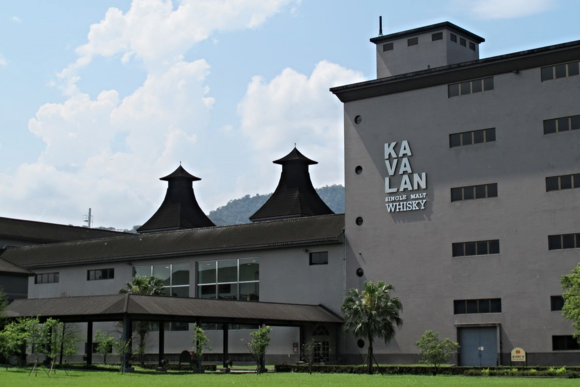
Whiskey Wednesday: The Art of Kavalan

If the Scots are the craftsman of the whisky world, passing down tradition and technique year after year because it works, then the Japanese are the engineers, dissecting and reassembling each component part. The Taiwanese are the artists, free willing and experimental; it’s insane that we can even make that analogy because there is only one distillery in Taiwan and it’s barely into its Tween years.

6a00e553b3da20883401b8d1223916970c-580wi

After Taiwan joined the WTO in 2002 Mr. Tien-Tsai Lee, founder of the KingCarbeverage conglomerate, was finally able to enter the whisky world and established the Kavalan distillery in 2005. The distillery takes it’s name from the Taiwanesse aboriginal ethnic group that originally inhabited Yilan county where the distillery is located in northeastern Taiwan. The distillery is built with classic Scottish pot stills and massive technological steps were taken to protect the fermentation and the distillation from the Taiwanese heat. Rather than adhere to how things are done traditionally they have worked to embrace the natural elements of Taiwan, most notably climate, to create something unique in the increasingly crowded whisky landscape.

The distilleries first new make flowed from the stills in early 2006 and the distilleries first whisky, the Kavalan Classic Single Malt, was released in December of 2008. That is a massively fast turn around for a new single malt. For the Scotch and the Japanese you can’t even legally call a product whisky until its aged for a minimum of three years and most distillers in those countries would call a three year old far too immature and unripe for release. This brings us back to the climate.

download.jpg            Almost every year, as reliable as new iPhone releases, someone touts a new aging process that’s a breakthrough that allows for rapid aging, creating the equivalent of a 12-year old scotch in a fraction of the time. In every case the whisky produced by these methods either never materializes or falls vastly short of it’s lofty goals. I’d be just as skeptical of the claims that once the team at Kavalan stopped resisting the humidity and heat of the sub-Tropical Taiwanese environment they were able to rapidly age their product if the whisky in the bottle wasn’t so damn good. As their Master Blender Ian Chang says, “We think of our heat as a sandpaper and our newly made spirit as a rock with edges,”

But it’s not just the unique climate. Kavalan is also exceptionally good at cask management. This cask management truly shines in their Soloist series.

The Soloist series is a lineup of Single Cask, Cask Strength, and Single Malt whiskies and it is these releases that made drinkers sit up and take notice. It is called the Soloist line because every release is like a soloist in a concert where their classic series is the whole orchestra. These releases quickly gained notoriety until in 2015, a mere ten years after breaking ground on the distillery, one of these releases, the Vinho Barrique, won “World’s Best Single Malt” in the World Whiskies Awards.

The Vinho Barrique harnesses the climate and marries it with excellent cask IMG_4520selection. The casks use a shave, toast, and re-char process on old Portuguese wine casks that creates a heavy oak influenced whisky. But rather than produce the heavily tannic, overly woody notes we often see in American quarter casks, instead it’s a finely tuned balance with rich dark berries, plum, and tropical fruit dancing along the edges of the oak’s vanilla and tannin while swimming in the traditional malt backbone of a well aged whisky. Being bottled at cask strength cuts through what could have been a cloying sweetness to instead add a spice note that allows the finish to linger long into the night.
 

This award and bottling blew the roof off of Kavalan and their prices soon followed. In fact, many of the Soloist series had to be turned into standard issue, non-cask strength releases for the U.S. to keep up with demand even with the distillery expanding in 2015 to become the 9th largest single malt distillery in the world. They’re still experimenting and utilizing that climate and those casks with a new series of single barrel, cask strength, sherry and port cask releases that you’ll probably never casually encounter without a starting price tag of $400+ per bottle.

So what are you likely to encounter? Well, with the Soloists taking a quick intermission the concert continues with the Kavalan Classic that we mentioned before. Keep in mind this is a young distillery, no matter what accolades they’ve accrued, and they’re still playing with their formula. Point in fact, the Classic is an 80 proof bottling for most of the world but to appeal to American palates and American fans of the overproof work, here it’s bottled at a slightly bigger 86 proof.

A blend of ex-Bourbon, ex-sherry, and ex-wine casks all about 4-4.5 years old it doesn’t drink like a young whisky and has a lighter complexion. Stone fruit, a touch of floral sherry, and vanilla with a distinctive toasted malt are all present. But it doesn’t hold a candle to the bonfire that is the Vinho Barrique or really any of the Soloist single barrels. Which is a shame because those bottles are quickly becoming unicorns.

In the end it comes back to our craftsman vs. engineers vs. artists. The artists at Kavalan have produced a few shining masterpieces but they haven’t quite mastered the skill that sets the craftsmen and the engineers apart: blending. The Japanese have been able to set themselves apart by truly understanding and controlling every drop of whisky to blend it together to create art and the Scots have years of tradition that makes it seem a natural talent. Kavalan is just dipping its brush into the wider world of consistency.

Just as the Taiwanese heat seems to speed their whisky more swiftly to maturity, Kavalan itself has sped right into all the major touch stones of the modern whisky world: craft distilling, underdog appeal, rapid growth and awards, price hikes and shortages. No matter where it goes from here there is no denying that Kavalan is true global player.

353da3ccccedcc82-_DSC9542Edit.jpg

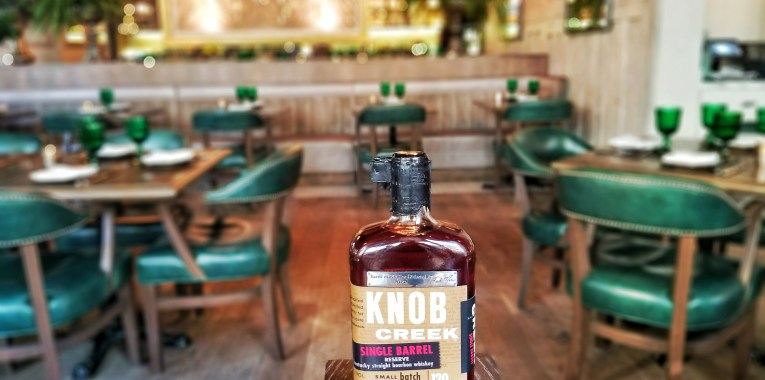
Whiskey Wednesday: Knob Creek 25th Anniversary

Bourbon is an old tradition, dating back hundreds of years to our rugged frontier forefathers and foremothers who proved their American spirit by making a distinct product using brilliant recipes and methods that they would pass down unchanged to us to be poured into a glass for our drinking pleasure today. At least according to the marketing materials  it is… the truth is a bit more complicated.

Although the term “Bourbon” is associated with whiskey as early as the 1820s, “Bourbon” was only declared the native spirit of the United States by Congress 53 years ago with the passing of a 1964 resolution. And the definition of “Whiskey” as a spirit distilled from grain, and Bourbon as a spirit distilled from 51% corn is only 108 years old. President William Howard Taft put the definition in place in 1909 as part of the Safe Food and Drug Administration Act of 1906. Yes, it took him three years to come up with the definition of “Bourbon whiskey.” But with the start of Prohibition a mere 11 years away its questionable how many people would have enjoyed whiskey that lived up to these new regulations. Think about that the next time someone tells you their whiskey is “Pre-Prohibition Style.”

All of this is to say that tradition is long and constantly changing and in the adjusted timeline some landmarks are bigger than they appear at first. Like, for instance, Knob Creek’s 25th Anniversary.

images

Knob Creek was the whiskey child of Booker Noe, grandson of Jim Beam who tookover as Head Distiller of his grandfather’s distillery in 1965. Booker, along with Elmer T. Lee and Jimmy Russell, is credited with the revitalization of the Bourbon market at the end of the 80s with the introduction of now iconic brands of Bourbon. Booker first released Booker’s Bourbon in 1988 to much acclaim, and this was quickly followed up with Baker’s, then Basil Hayden’s and Knob Creek in 1992. These are the heart and soul of the Jim Beam Small Batch collection, which led the way in many respects for the premiumization of Bourbon.  None of these have survived to their 25th year with out some alteration.

Knob Creek is named after the stream that ran alongside Abraham Lincoln’s childhood home in Kentucky and is Booker’s take on  “Pre-Prohibition Style” whiskey. A term that we can now see is as nebulous as those early definitions of whiskey.

In this case it meant a Bourbon whiskey bottled at 100 proof and carrying an age statement of 9 years. Traditional Knob Creek is a deep caramel color, with a nose that carries a lot of oak, along with a touch of maple and baking spice, a super vanilla, white pepper, and dark cherry palette with a earthiness and dustiness that I can only associate with Jim Beam yeast, and a gripping, dry finish that is a bit bracing at 100 proof. It’s iconic. Immutable.

Except it wasn’t. In 2001 Booker, who had continued to oversee the brand well into his 70’s, passed the torch to his son Fred. And shortly after the Bourbon boom that Booker had helped create hit full force.

Knob Creek expanded. In 2010 Knob Creek Single Barrel hit the market. It was a natural expansion, still 9 years old but bottled at 120 proof from a single barrel. Then they began releasing a non age statement Knob Creek Rye in 2012, followed in 2013 by ae008e3717aca1adfe229d4d561643efthe Knob Creek Smoked Maple, a bourbon flavored liquor bottled at 90 proof. Then camethe inevitable. In 2016, just shy of 25 years, Beam Suntory announced that Knob Creek would be dropping its age statement. That same year the Knob Creek 2001 was released; a 13 year, Cask Strength release comprised of the last barrel that Booker Noe laid down before passing the torch to his son.

Jim Beam has followed up with a 25th Anniversary release appropriately named Knob Creek 25thAnniversary. It’s a limited release of 300 barrels, all between 12-13 years old and bottled between 120-125 proof that is exactly what it sounds like: bigger, more intense, Knob Creek.

Whether you’re going by the centuries old “traditional” definition or adhering  to a more modern practice twenty five years is still a milestone worth celebrating in the midst of so much change. Hell, maybe a few more milestones like this will help us truly appreciate that some change is as much a part of Bourbon heritage as all those pre-Prohibition style ways of making it are.

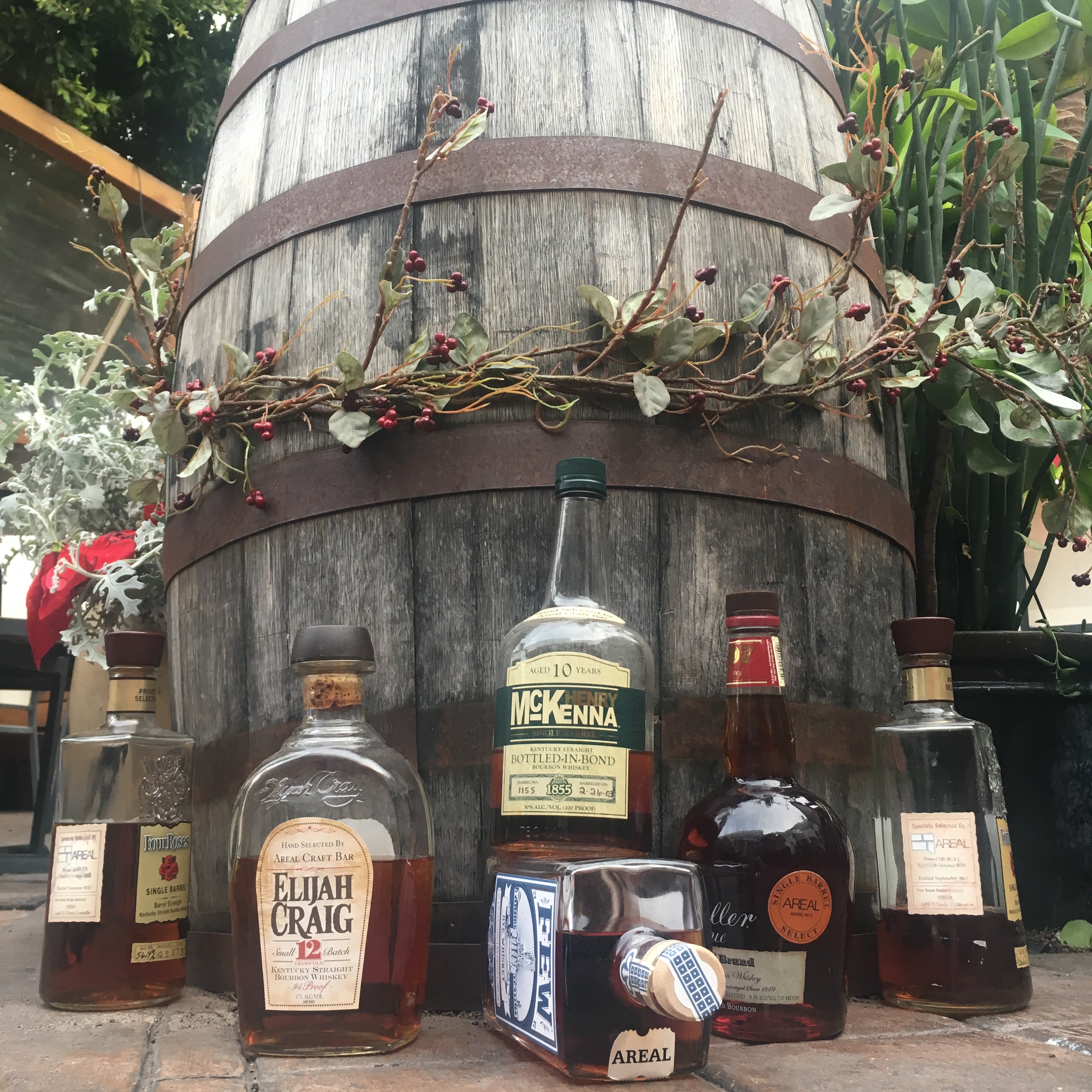
Whiskey Wednesday: Areal Origins

This morning I got off a plane in LAX coming back from Louisville,Kentucky where I was on a trip to Maker’s Mark helping design the next single barrel for Faith and Flower. At this point I’ve picked out over 30+ house single barrels of whiskey in the past five years and I was feeling a little jaded about the whole trip this time around if I’m honest. Well, not jaded, perhaps overly familiar is more accurate. But as I was walking of the plane and my phone regained its omnipresent internet access it promptly exploded in my hand.

Areal, the bar I had run for 4.5 years, that had been on the verge of closing when I was first hired, that I had helped grow into a million dollar a year liquor operation, that I IMG_2575.JPGhad spent more hours than I know how to count stressing over, had closed its doors over night. No warning. Just an email to the staff over their scheduling system.

I left Areal about 6 months ago to take over the bar at Faith and Flower but this news still hit me hard. That place had been my home for years. To say I cut my teeth there would be disingenuous but I definitely developed and turned into the bartender, and person I am today in that building.

When I first started there in the long, long ago of 2013 the place was dying. The owners had taken a beloved main street Santa Monica party location called the World Café and turned it into a fine dining cocktail bar called Areal. The locals didn’t take kindly to it. The drinks were good, the program was put together by two Harvard and Stone vets, but resistance to change is strong on Main Street. I, of course, knew none of this walking in the door. I was young, cocky and was convinced I knew what I was doing despite this being only the second bar I had ever managed.

31F29162-9977-488D-B1FA-70F4E6E57118.JPG  I set to work and was miraculously given free reign from my GM Mark Becker to do whatever the hell I wanted. He liked that the bar was striving towards something different.  It also became clear to me that despite knowing a lot and being good with numbers there was still a lot I had left to learn. (Not the least of which was how to deal with people.) How do you win over someone who just wants a bud light to drink a craft pilsner, and how do you convince someone who wants a Jack and Coke that they might really like this Old Fashioned cocktail that’s on your Happy Hour? Whiskey Wednesday, and this blog, were born out of my struggles to learn that.

I love whiskey. I don’t think anyone would ever argue with me about that but what I really love is the ability to share it with people. To me it’s not just an intoxicant. Whiskey at its best is a bottled story. Whether that’s the story of the brand or the story that you’re telling your drinking partner there is something to be shared in every pour, in every cocktail, and in every spilt shot.

I made a lot of mistakes in those early days, expecting everyone to fall in line 0288118A-6853-48C1-A8EA-52F1186BE1EB.JPGsimply because I knew a lot and could make a drink. But I found that the more I shared stories, whether with regulars that sat alone at the bar because there were no other customers or with staff at 3:00 in the morning after the weekend warriors had swamped us, the more people were interested. So I started telling stories, and history through a bottle of whiskey and three featured drinks a week.

Eventually the stories grew, along with the back bar. When I handed back the keys to Areal’s liquor room the back bar had grown into arguably one of the best whiskey collections in the city of LA. It wasn’t  forced, it wasn’t planned, it just grew. And so did I. I remember once being asked by a sales rep how we came up with the concept for the bar at Areal and I remember responding, “What concept? This is just me.” Hell, I even managed to seduce my badass girlfriend with the cocktail menu and back bar before she ever met me.

That bar, and the people in it, allowed me to become a wordy, confident, whiskey barrel buying nerd and in turn I hope I helped support them and shared a few stories.

While it certainly wasn’t my bar anymore I’m very sorry to see Areal shutter its doors. It was a building made up of stories, and people, and whiskey and I cherish all of those things deeply. So tonight, I’m pouring one out for another door closing on the past.

L’Chiam.


groupshot.jpg